
You can’t really capture Rivane Neuenschwander. She is not so much an artist who creates art as she is a sensibility at large in the world, who uses containment to supersede it. Surround her with life and she gives back... well... life, but more on the viewer’s terms, not hers. And it’s usually a richer version of that life or, more exactly—and she is very exact although one may not think so at first—life newly embedded by a quiet seriousness of intellect and symbolism that operates on the level of everydayness through play and sensuality.
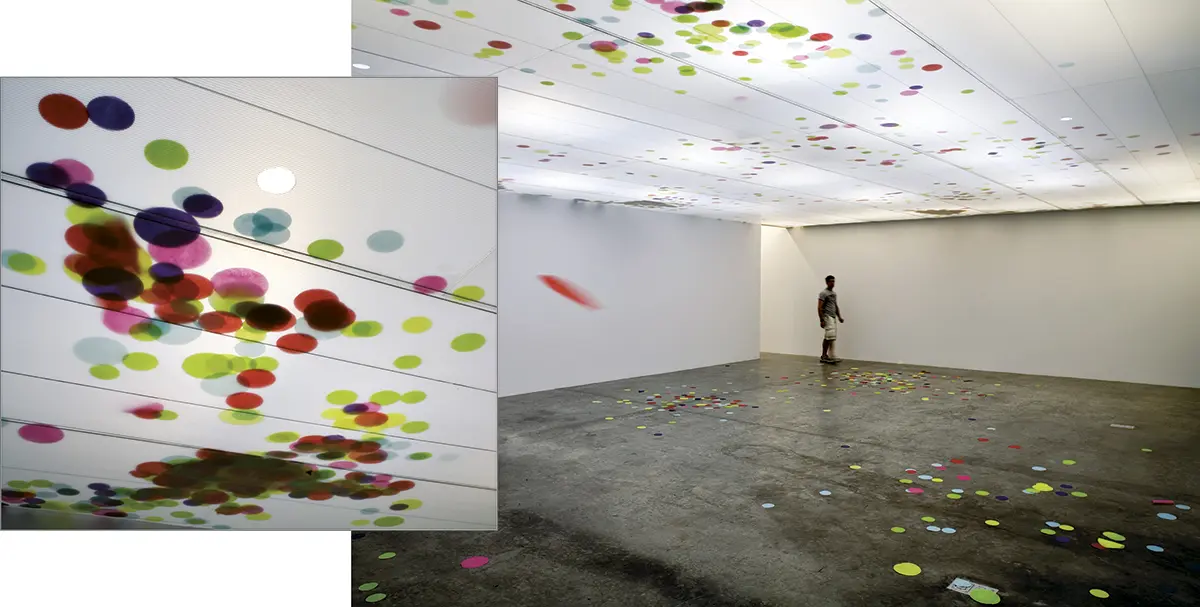
There were four parts to Neuenschwander’s first New York one-person show. All were not equal in strength nor equal to works she has shown internationally. But that’s the price paid for her sensibility. Because it is mercurial, it has to be taken cumulatively, like that of so many conceptual installation artists who deal with reality through the use of the ephemeral. What one accepts and admires, then, is a total aesthetic rather than single works that can vary. Neuenschwander has one of those sensibilities that one wants to plop down anywhere and everywhere to see what she’s going to create from what is around her.
To judge by the amount of time spent looking at the work by most visitors, the two strongest works were the central installation and the video. In the central installation, Secondary Stories, the artist created a perpetually changing composition over the heads of the visitors, as fans blew brightly colored circles of tissue paper around and above a translucent dropped ceiling; the colored circles occasionally fell through the perforations in the ceiling and scattered across the floor. Visitors were free to scuff and toss the colored circles about like fallen leaves, or the circles simply surfed and eddied on the wind of one’s bodily movement through the gallery.
What was ephemeral was not simply the bright bits of paper but one’s presence and the sense of containment. Yet it was a presence marked by something more colorful than oneself. A visitor was as accidental and as fabulous and uncontained—or could be—as the swirling colors. What or who, then, is the secondary story? Indeed, is there a secondary story in Neuenschwander’s additive universe? Two young girls were in the gallery, one excitedly kicking and swirling the papers on the floor, the other frozen in place except for her eyes, as watchful as a cat at the flickers of color above her. An older woman, in her effort to avoid the youngsters, moved swiftly to the side and sent upcurved traces of colors that argued against her maturity that ignored such youthful, momentary spectacles.
The spectacle was also at the aesthetic heart of the video installation, Quarta-Feira de Cinzas/Epilogue, made in collaboration with Cao Guimarães. Here, many types of black ants encountered small glittering pieces of colored confetti and carried them back to their nest holes. The glittering spectacle of the brightly colored circles of confetti moving through the dry and then lush greens and reds of the forest floor was thrilling and encouraged the creation of imaginary narratives. Was it a masquerade; what did the ants think in their industriousness? Were they gathering party favors or food? Had the ants been collected by the artist, who created work for them with no reward except a viewer’s fascination? The cooperation among the ants was impressive, but, during the middle of the video, a much larger soldier ant punished a smaller ant for its persistence by killing it with pincher mandibles. Death quickly lost in the parade of the spectacle. This went on while the blond, innocent, little girls danced in the main gallery, fascinated by the air-blown movements of color. As evolutionary biologists tell us, play is prey; can work be also?
Through Neuenschwander’s subjectivity, one is forced back along one’s own path, rather than hers. This is where her topicality—or what so many observers of her work call “the moment”—pays off. But it is a specific moment, not a transcendent one; it’s eternal only in its exactness, even if the specifics vary from one to another. Neuenschwander’s sense of the transitory and ephemeral was influenced by the Brazilian Neo-Concrete movement, which has been rightfully celebrated in recent years. But that conversation or moment was also different, moving against the abstraction and concretism of the 1950s and the dictatorship of the 1960s, when Neuenschwander was born. How do her moments of Minimalism and Post-Minimalism, installation, conceptualism, and the spectacle of “Imperial America” look through the individual and historically specific eyes she returns to us; to you?
RICHARD LESLIE