
If recent years are any indication, New York has begun to recognize Dominican art. Freddy Rodríguez, the diaspora artist with the longest career, has exhibited his work in the Jersey City and Newark art museums. Last year, Rodríguez won the international competition against dozens of artists and firms for the monument to the victims of Flight 587 from New York to Santo Domingo, which suffered a tragic accident soon after the World Trade Center attacks in 2001.
In 1996, The Americas Society had organized a show titled Modern and Contemporary Art of the Dominican Republic. El Museo del Barrio broke through the ice of institutional collecting by acquiring ten works by contemporary Dominican artists, some of them residing on the island, for its permanent collection. And the Bronx Museum of Art is preparing a mid-career exhibition of works by Quisqueya Henríquez, slated for March of 2007. This is the context for the exhibition Paradise Redefined by Scherezade García at Lehman College in the Bronx.
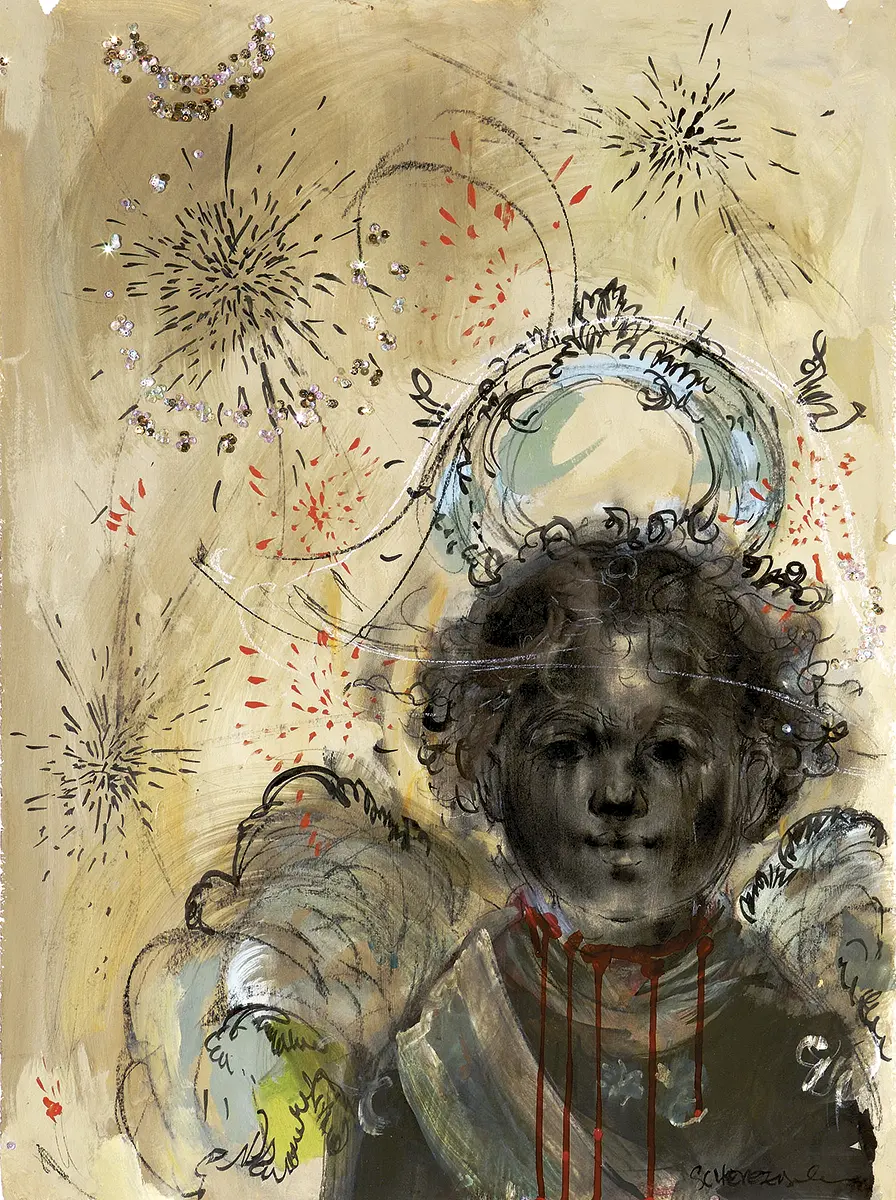
Scherezade (as she prefers to sign her works) is a skilled draftswoman who studied at the Escuela de Artes y Diseño de Altos de Chavón in the Dominican Republic and at Parsons School of Design in New York City. She later worked in the workshop of the fashion designer Carlos Falchi, which gave her a solid education both in traditional media and in high-fashion design. It is not a surprise, then, to find that drawing and painting are the media that better reveal her maturity.
In terms of its themes, Scherezade’s work oscillates and often hesitates between the experience of migration and the experience of maternity. At certain moments, these two vital areas coincide, as in her Serie de la Salvación (1999), in which Scherezade built and deployed floating objects as the supports for portraits of her two daughters. Interestingly, the topic of maternity leads to drawing and painting, as if the work is the product of daily observation, notes about the gradual development and growth of her daughters. Meanwhile, the topic of migration leads to explorations of other expressive territories, such as video/performance, sculpture, and installation. In the show at Lehman College, this artistic “dual life” was strongly highlighted.
The show included a series of mixed-media paintings and one video installation, which gave it an eclectic feel. The paintings represented skillfully executed faces and torsos surrounded by floating objects in an atmosphere of lightness. Scherezade also used collage to make the canvases’ surfaces dynamic. The installation, in turn, consisted of a series of field tents approximately five to eight feet in height. On the tents, Scherezade printed digital images of streets in Washington Heights, downtown Manhattan, and Brooklyn. Inflated inner tubes, of the kind used to float on water, hung from the ceiling in the background. Finally, a large video projection on the wall showed waves on a Dominican beach; the tubes’ shadows were integrated into the image of the sea.
This duplication game was significant—houses printed on tents (which are like types of houses), tires floating on air and on water. In the final instance, the duplication of meaning was combined with the temporal play proposed by the field tents, objects that are situated before and after migration. Indeed, they referred to the seashore wait for the boats that bring that “visa for a dream” as in the well-known Juan Luis Guerra song, and they also appeared as the seedlings of memory of diaspora at the very beach that saw the departure of a yola.
From inside each field tent, a voice told stories of the people of Washington Heights, a heavily Dominican Manhattan neighborhood. Scherezade has used this approach before. In Sabana la Mar, she recorded the testimonies of survivors of yola journeys attempting to reach Puerto Rico from Dominican shores.
Scherezade has dealt with the topic of Paradise from two perspectives: that of the Caribbean citizen who sees the metropolis as the place of possible happiness, and that of the modern inhabitant of the urban metropolis—which often includes Caribbean immigrants and their progeny—who see the Caribbean as a space for escape and relaxation, for happiness. Some of Scherezade’s best works, such as those included in this recent project is based on this dual life, this formal and conceptual duplication, this contrast of views.
ELVIS FUENTES