
Susan Schmidt’s paintings go beyond the idea of representation and come closer to the idea of montage: a well-planned series in which one painting follows another, changing perspective and characters, and developing a plot based on a sequence of images. The painted sequences, although inspired by 1940s and 1950s filmmakers like Otto Preminger, Alfred Hitchcock, and Michael Curtiz, appear contemporary because they develop the subject of romantic relationships and the expectations of the men and women of the “Me Generation.” Susan Schmidt’s artistic proposal recalls films by the British director Sally Porter, with whom she shares the theme of dance as an allegory for a couple’s encounters and missed encounters.
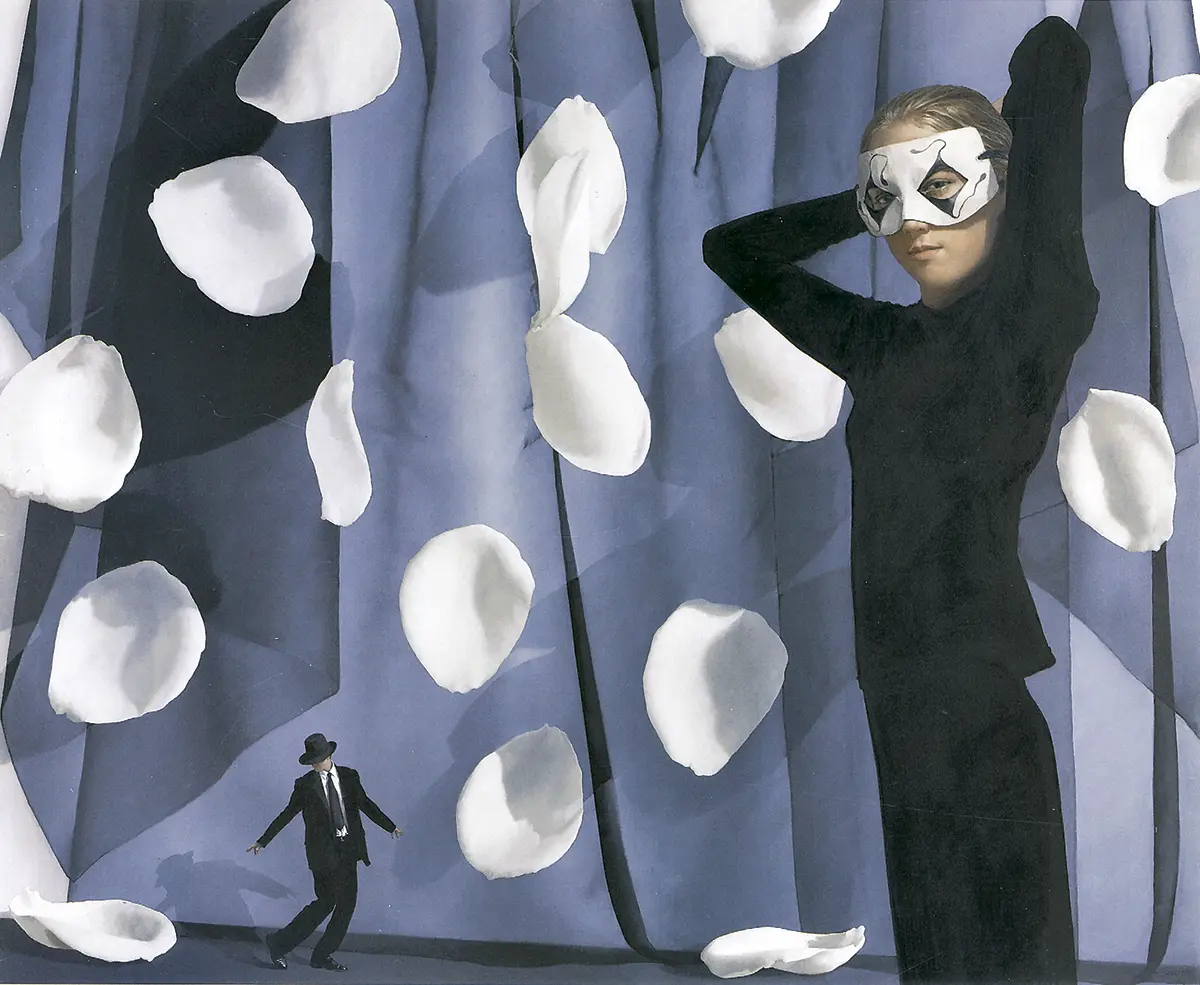
A passionate admirer of classic American film, Schmidt finds inspiration in the aesthetic of its silvery images, molding it to a pictorial symbolism that describes the phases of a woman’s life (from girlhood to adolescence to adulthood and maturity) and defines the male presence in more general terms. In the work, the men are represented by one model that does not age. Schmidt tells us this is a deliberate choice, “because aging does not cause the same anxiety in men as in women.” The work Not Quite So Still and Dark presents a confident adolescent, semi-disguised behind a mask, who despite her young age possesses a firm and defiant gaze. White petals fall in the background, provoking several interpretations: the loss of innocence, female fragility, and the subject’s own feelings. With candor and irony, this painting reveals the complex rituals of a woman’s transition from childhood into young adulthood.
Other works reflect the sensibility of the adult woman and the flimsy links on which male/female roles are built. Such is the case of How Very Strange the World Can Appear, in which a svelte, young blonde reclines on her side and watches a man standing in front of her, represented at a much smaller scale, who looks back over his shoulder and is oblivious to her condescending eyes. The scene is resolved with the same sense of humor that traverses Schmidt’s oeuvre. It is a contemporary version of the controversial Madame X by the celebrated American painter John Singer Sargent, a portrait of the independent woman of the early twentieth century, dressed in impeccable black with gloves covering her long arms. In both paintings, the woman ceases to be the object and becomes an active subject in a game in which traditional male/female roles have been perspicaciously inverted.
Using two scales to differentiate her characters, Schmidt builds her paintings on the tension between figures in stasis and figures in movement, which gives the series the quality of a narrative sequence moving from close-ups to broader shots. Her paintings respond to a paradigm of contemporary culture—the fusion of media, eras, and themes expressed in an instant, frozen on the canvas with brevity and concision.
In recent decades, the language of film has developed highly stylized aesthetics and baroque narratives, such as that of Quentin Tarantino, in which decadent values are often mixed with melodramatic situations and crime-story plots. On the opposite pole, we find authors like Jim Jarmusch or Lars Von Trier, whose works focus on a treatment that combines theatricality with a documentary style, in which filmic developments gradually link grave situations to arrive at forceful endings. I believe this tone is shared by Schmidt’s cinematographic painting.
Novelty arises from repetition as the unfamiliar emerges from the midst of routine. Theater actors know they will repeat their lines time and again but that there will be a spontaneous element in each performance. To do something unexpected yet coherent with a specific fact is the goal Schmidt has established for her art. Her work is filled with the observation of gestures, expressions, and gazes and of the body’s contraction and relaxation in dance. As John Berger says, “Man acts; his presence depends on the promise of power he embodies. If the promise is credible, his presence is strong, and reveals his objectives.” In contrast, the presence of a woman expresses her attitude toward herself. In There Is No Danger in Any of This, the presence of a tiny woman radiates an aura; the form of a much larger man seems to be watching her but she examines herself and is more self-aware. She contemplates herself, and he is discovering his own desire. With works like this, the artist provides the framework that describes most relationships between a man and a woman and also a woman’s relationship with herself.
Susan Schmidt’s painting derives from an examination of male/female roles, concluding with statements on how women see themselves and how they would wish to be seen by others. Within her world of reflections and projections (a Platonic world, no doubt), women find themselves on a theatrical stage on which they must play dual roles, as objects of male desire and subjects of their own identity. Discovering the line between one and the other is the leitmotif in Schmidt’s painting.
JOSÉ MANUEL SPRINGER