
The exhibition Vlady: Sensuality and Matter presented the universe of this unique artist, who was born in Petrograd in 1920 and resettled in Mexico at the age of twenty-one, staying until his death in 2005. In a posthumous tribute, this exhibition was the most exhaustive ever of Vlady’s production and gathered more than 500 works in a variety of formats, including painting, graphic arts, and drawing.
This great retrospective, held between April and July in almost all the galleries of the Museo del Palacio de Bellas Artes, also included a presentation of the artist’s background through a collection of photographs, documents, and drawings of unquestionable interest for an understanding of his legacy and filled with intimate reminiscences.
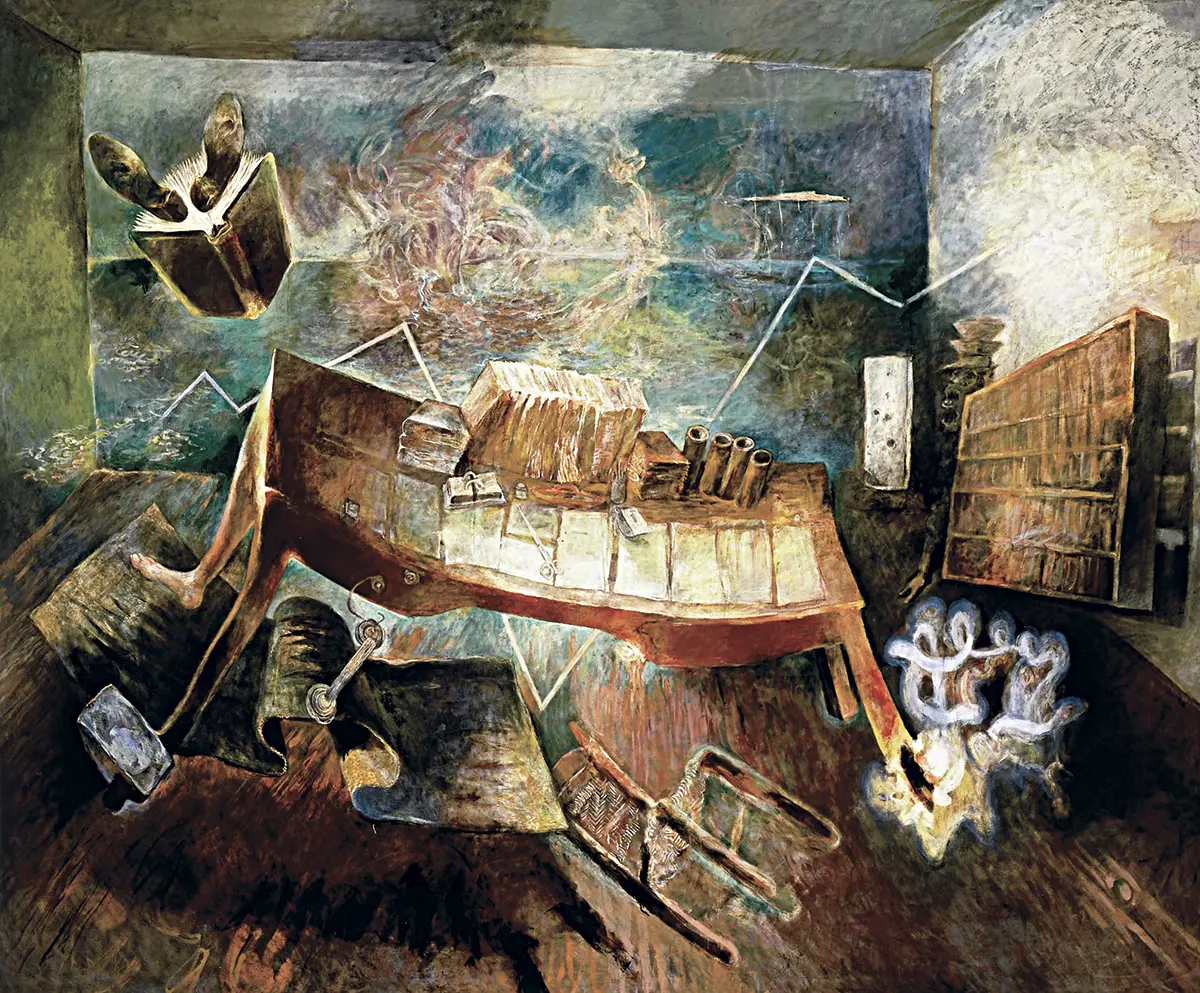
The curator Mercedes Iturbe opted for organizing Vlady’s work not chronologically but along the themes and genres more assiduously and even obstinately engaged by the artist. The hundred self-portraits from various periods in the artist’s life revealed Vlady’s great skill in the incessant construction and reconstruction of his own face. Exercises in oil, tempera, pencil, ink, and printing related to his search for a form capable of capturing the discoveries and uncertainties of a vision focused on the problem of identity and otherness that resulted from his personal journey, from his Russian roots to his exile first in Kazakhstan and later in Europe and then to his resettlement in Mexico.
Judging by the level of the artistic quality of the works exhibited, another of Vlady’s important achievements was in the realm of eroticism. This recurring theme revealed his sinuous, undulating lines that conferred sensuality to bodily forms, but it was also where forceful and frantic compositional dynamism alluded to powerful primeval impulses that the brushwork exorcized.
Vlady, an extraordinary draftsman and the son of the writer, Victor Serge moved back and forth between his mastery of drawing to the medium of pictorial transposition, and these moves highlight the diversity of his art and support his conception of the creative act as vocation, craft, the reason for living, and destiny. In the series of paintings presented at the National Gallery under the title of “Obsessions and Matter,” one could observe the passion and freedom that characterize Vlady’s large canvases, articulated by his inexhaustible search for light and movement.
Vlady’s was a solitary artistic journey, one that drove him to break with first the nationalistic postulates of the Mexican School and then with the avant-gardes and post-avant-gardes of international modern art. He was uninterested in a rigorous mastery of pictorial technique and knowledge. The exhibited works made clear Vlady’s sustained interrogation of a material that, rather than being mere servile support or a tool, gradually reveals its secrets to the forms inscribed in the interplay of plastic relationships—as seen in the canvas prepared with tempera, the elaboration of pigments, and, in particular, the Venetian contribution of inserting veils.
This conviction in the preeminence of painting in itself translates into a chromatic logic that progressively dissolves the representation of reality yet never devolves into pure abstraction, even in lyrical landscapes, such as Mecanismo carcelario, (1958–59), El subyacente, (1960–61), and La piel de los amantes chinos (1967). At the same time, figurative stylization reappears along with other themes contemplated in the curatorial discourse. The interpretation of the Old Masters can be seen in Las meninas caribeñas (1979), portraiture in Tatic, (1995–2000), and myths and archetypes in San Jerónimo o Zaratustra (2003).
Yet, the artist’s political dissidence did not mutate into a narrative intention but into metaphorical traces of universal significance, at three relevant moments in his career. The first moment is marked by the work that presided over the show, the Tríptico trotskiano (Magiografía bolchevique, La casa, and El instante) from 1967, whose light-enveloped configurations and vertiginous movement refers not only to the heroic dimension of the legendary Trotsky but also to the sense of vulnerability, fleetingness, and tragedy of the human condition. The second moment, the pictorial reflection on cruelty and brutality is expressed in Violencias fraternas (1993–94) and El uno no camina sin el otro (1994) through a language that possesses undeniable traces of expressionism and Goya-esque roots. And La inocencia terrorista (1982), a panel from the large mural at the Lerdo de Tejada library demonstrates the third moment, where an anonymous victim of totalitarianism ascends, vibrating in the light emanated by the colors—a dear alchemical dream of Vlady, who attempted to provide new foundations for painting.
ARGELIA CASTILLO