
This individual show by Ángel Delgado (Havana, 1965) at Nina Menocal Gallery in Mexico City illustrates the turn taken by poetics supported by the testimonial residue of the autobiographical. The way in which a visual producer as experienced as Delgado takes distance from his own time in order to create from another space, one that is free from the island’s traumas. A resistance to politics cedes the center of the stage to a resistance to the market. Thus, allegiance is maintained towards ephemeral materials such as laundry soap, or to icons related to the loss of freedom such as handcuffs of the kind used to restrain people under arrest.
In Constancias (November 2006 – January 2007,) a chronicle of ordinary confinement is replaced with a reflection about the existential prison or the punishment suffered by incomplete men. By distancing himself from the purely anecdotal, Delgado avoids officiating as a narrator-voyeur of the prison, a la Carlos Montenegro in Hombres sin mujer (1939) or Reinaldo Arenas in his posthumous memoirs. The jolongo, the raid, and the cordillera, the sudden transfer of prisoners from one prison to another, translate into the anguish for the lack of greater freedom: the impossibility of changing life. The social losers become that “accumulated memory” dispersed in the stillness of small men trapped between old newspapers that represent the circularity of history. Between event and forgetting, their immediate future would seem to be a re-writing of history that excludes them from the annals.
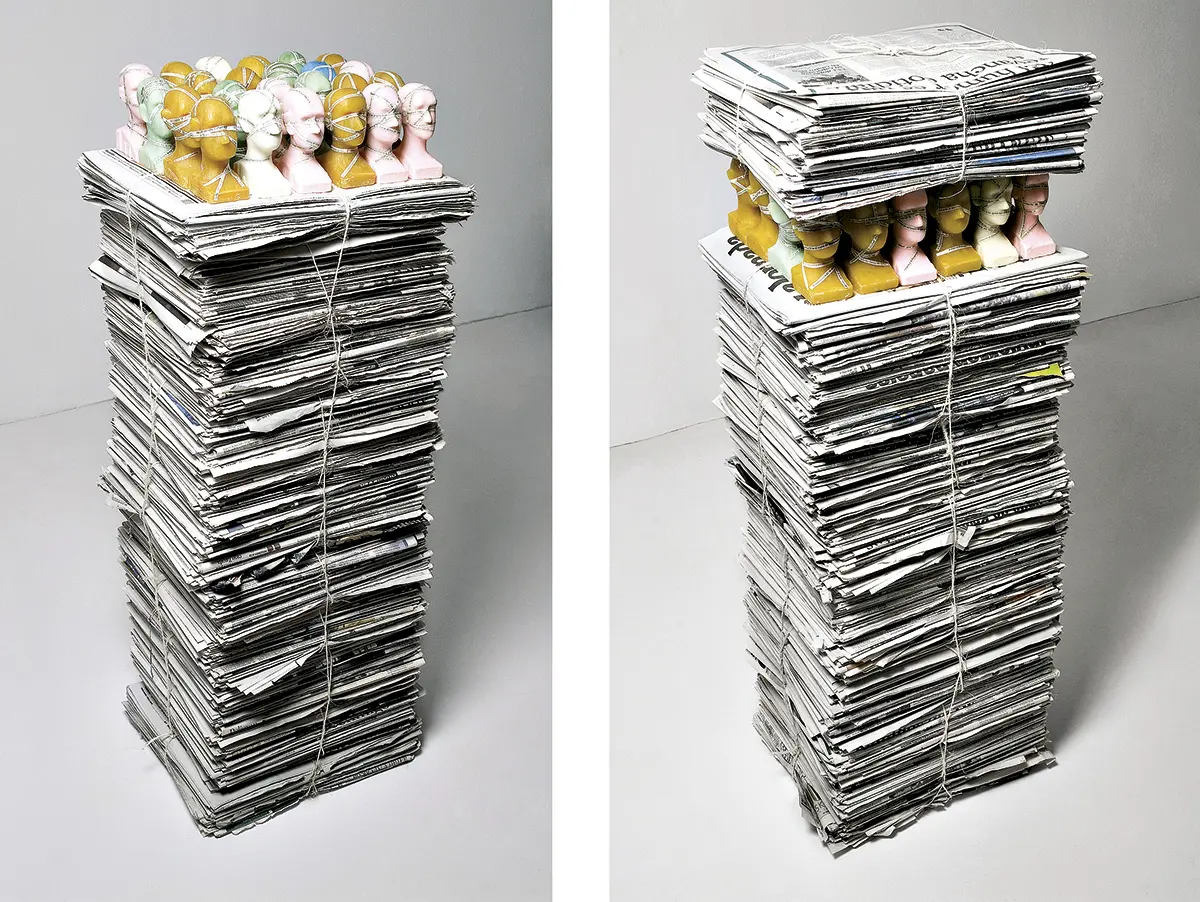
Subjected to the invisible threads of the dominant writing, these soap puppets represent the commodification of the human anticipated by George Orwell in his 1984. This is to say, Delgado reproduces the tragedy in which people without the right to chose end up relegated to the status of non-persons. If inside a prison prisoners must harden themselves in order to survive, in the imaginary galleries there is no possible redemption. The abstract dimension that prevails in these objects and installations vindicates the same despair generated by Ángel Delgado’s poetics in the 1990s. Outside the lime walls that obstruct the gaze of their tenants, the wall formed by tableaux of sheep-like beings embodies the irony of metamorphosis. From absurd rebellion to organic submission, there is no longer any sense in evoking the scene of a despairing man injecting oil into his leg in order to earn a few days in the infirmary. Muros (2006) synthesizes the process of renunciation in control societies. Under this symbolic premise, real episodes are lost in the name of abstractions derived from the hegemonic order.
Inside this ghostly realm, we notice a point-counterpoint between the soap bubbles as signals of cleanliness and the empty space generated by their vanishing. The installation Con el agua al cuello comprises a series of water-filled wheelbarrows with floating human heads made with soap. Their processal nuance resides in the photographic documentation of the characters until they are submerged in a kind of collective suicide. Without alluding to literal confinement, the wheelbarrows/cells illustrate other water walls through which subjects attempt to escape into nothingness. These identity-deprived images end up hanging on the gallery walls like emblems of a via crucis made believable by the sheer fact of their being unbelievable. The allegorical subtlety of this work reaffirms that the drama of real stories is not a pass for the creation of good art. Con el agua al cuello (2006) is a symptom of this paradox of the complicity between art and life.
Constancias is the reverse of its creator’s history. Here the topics of control and surveillance are not the center of the attention that resulted in the artist’s incarceration for defecating on an issue of the newspaper Granma in 1990. This is the cause of the fact that the effect of these infinite archives can be detected anywhere in the world. The Myth of the island as a perfect prison vanishes when confronted with a strange chest of drawers that could hold keys, locks, or alarm systems Ángel Delgado has been able to surpass the biographical event that one day ripped him apart from his loved ones in order to articulate fictions that are universally local. This time the cold manipulation of signs imposes itself on the warmth of shared experiences. By creating an atmosphere ruled by globalized paranoia, his post-testimonial discourse breathes as a form between virtual barriers like ideas where perceiving the beginning of the end of limits is rendered problematic.
HÉCTOR ANTÓN CASTILLO