
The photographs of Augusto Zanela document his site-specific installations. They also stand as independent works that display a profound understanding of space and light. Such technical depth and facility are essential to the successful expression of his conceptual program, one that challenges the very foundations upon which he has constructed his work.
The opening image, Cubo+Reflejo (Cube+Reflection), serves as a kind of portrait of the artist. Although the photographer is clearly visible, what it reveals about his internal world is far more important than a record of his external features. In this image, Zanela employs a one-point perspective, a system that has guided our representation of reality since the Renaissance and one that is strongly reinforced by the lens-mediated visual culture of our times. Zanela also employs essentially flat lighting that we associate with an ostensibly neutral presentation of visual facts.
In what seems like a long, narrow dance studio, Zanela shows himself behind a camera. Stretched across the floor before him, drawn with what appears to be masking tape, is an elongated geometric figure. Floating in the foreground before it, and containing the light reflected from above onto the highly polished floor, is the figure of a perfect cube.
Searching the composition for clues to explain the genesis of this mysterious cube, we discover that the perspective that creates and sustains it is an illusion. We are not looking toward the photographer; we are looking into a mirror. The photographer is behind us, our “eye” is contained in the camera we see in front of him. Thus, the distorted geometric figure in the mirror must be the floating cube. Since we have internalized the fact that mirrors distort, we are also aware that—although the geometric configuration exists—neither the cube nor the form we see in the mirror accurately represents it. Yet such is the power of visual learning that we persist in comprehending the photograph as if Zanela were somehow standing in front of the vanishing point.
Only a highly competent magician dares to show every element of his illusion, clearly demonstrate the ways these elements can deceive, and then proceed to astonish the viewer anyway.
The perceptual problems explored in Linea (Line), which appears to be a completely straightforward presentation of an installation made from recycled wood, are subtler. As with Zanela’s other photographs, the light on this construction clearly coincides with the light of the space around it. The longer we study the image, the clearer it becomes that the scale of this installation does not correspond. As this discrepancy is revealed, our eye continually shifts between Zanela’s construction and the gallery that contains it, which is a dynamic but ultimately futile attempt to make all of the components conform.
Anamorphic art and its analogs seem to be experiencing a revival of sorts; the exaggerated shadows of Regina Silveira’s installations, the distorted sculptures of Robert Lazzarini, and Vic Muniz’s wry Pictures of Junk series spring immediately to mind. As was true in the genre’s past, these artists employ anamorphic effects within essentially figurative realms of expression. Zanela, instead, returns to the mathematics that provides the basis of anamorphic art and both resituates and reinvigorates it within a nonobjective setting.
Pasaje (Passage) evokes both the form and the theory of a Russian Constructivist work, effectively using space as a sculptural element in a way that early-twentieth-century artists conveyed the essence of reality. By simultaneously affirming and rejecting the supremacy of perception through his use of an optical illusion to create this image, Zanela makes it clear that his concerns are aligned with the aesthetics of perception rather than the simple mechanics of seeing. While his installations would fit comfortably within the confines of a science museum, his interest lies in provoking our core ideas about perception, not in merely demonstrating its effects.
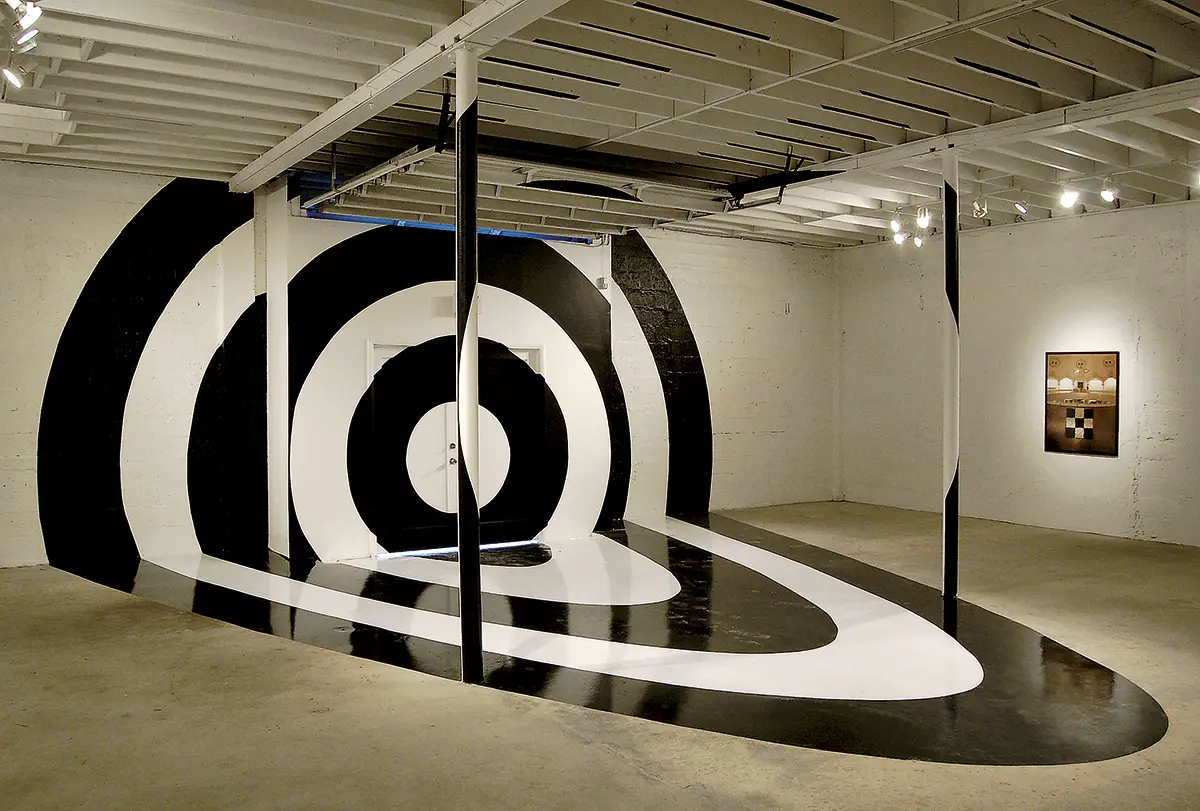
The video accompanying the photographs documents reactions to Pasaje and Apunte (Note). Not only does the video convey viewers’ delight at their encounters with Zanela’s illusions, it also documents another critical element of his work. His audience becomes highly engaged with these installations, particularly the concentric circles that make up Apunte, converting them into a kind of perpetual performance space. As viewers attempt to explain to themselves and others how their vision has been deceived, they run, play, and even dance within the illusions, compounding their visual effects.
Fortunately, plans are underway to bring a full-scale Zanela installation to Praxis International’s Miami gallery. Until then, the six large-scale chromogenic prints and videos that constitute this exhibition provide paradoxically compelling evidence of a talent whose international exposure is clearly destined to grow.
K. MITCHELL SNOW