
A language of art is inscribed in the concord and discord that an artist evokes throughout a career and maintains in the development of innovations, of visual explanations, and of continuities and ruptures with the everyday. This language is used to reveal proposals and analytical discourses that are, logically, connected to the visible and to all that can be known or not known. With more than forty-five years of uninterrupted work, the career of Carlos Poveda (born 1940, Costa Rica) has evolved in direct connection with the perceptual analysis of forms linked to the history of art. An excellent figurative artist, he distinguished himself as a superb draftsman, expressing the anguish of existence through the line, the same anguish that drove him toward an essential, monochromatically white landscape that broke the boundaries of the wall and became projected as an intelligible structure in space. By the 1990s, working with industrial detritus led Poveda to a different kind of landscape, which he defines as Paisajes domésticos, the title he has given his most recent exhibitions.
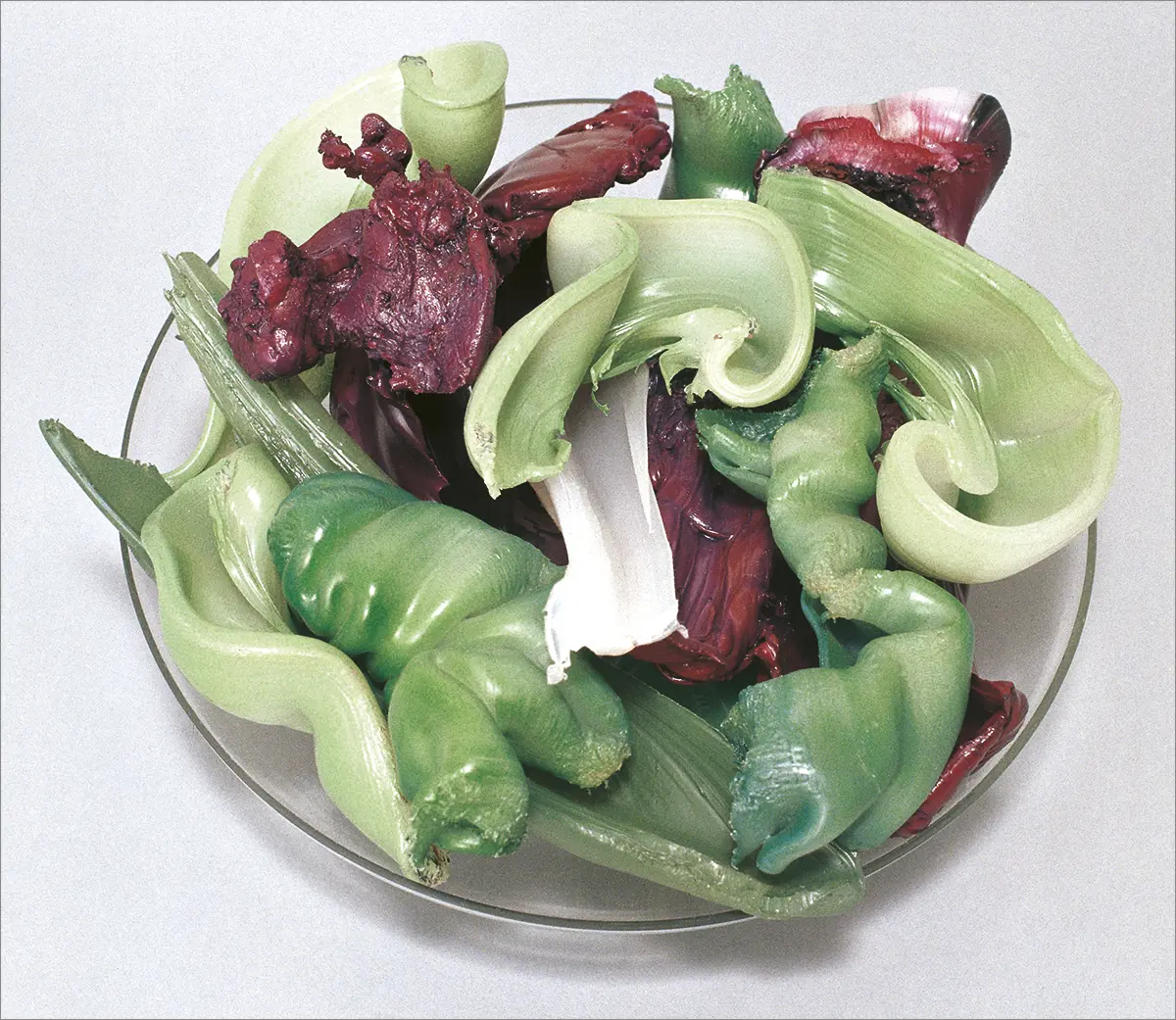
This has been a logical evolution. A new landscape has been resolved into objects regarded either individually or together as installations that call attention to certain personal mythology related to gastronomy and to domestic aspects of existence. Poveda works with ready-made industrial junk and mass-produced objects to build a still life that introduces contradictions between art objects and the relationship between artistic fiction and human reality. Here, Poveda is a protagonist of current artistic practice. Plates, trays, and planks in various materials, found in markets and street fairs, support “forms” of the universe of everyday food, such as a piece of meat, a sausage link, or some tripe. Poveda makes these forms in series, titles them Plato, and numbers them. In visual terms, Poveda is passionate about the textures, colors, and shapes of the objects he finds and organizes on the supports. The material and the matter he presents as art objects—the plate or tray inhabited by shapes that are definitely culinary—highlight with artifice a system of artistic practice that constructs an iconic illusion mimicking reality, which in this case is reality interjected into the field of art. Poveda constructs and unreality on the basis of reality, which is to say that it implies the calculated transformation of the found shape’s intimate matter, be it intuitive or calculated, in terms of a creative personality.
Paisajes domesticos, the most recent exhibition of works by this Costa Rica-born artist—a man who has lived in many places and, after thirty years of residence in Venezuela, now lives and works in Paris—offered a series of “dishes” that must properly be considered sculptures read as mimetic signs of reality transfigured into art objects. Poveda transforms matter—or better yet, its intimate figurative essence—into a visual space filled with abstract and organic connotations. His is a calculated intervention intended to transform the representative and figurative image into a visual experience closely connected to everyday human experience, the experience of the most concretely quotidian. His artistic work becomes the matter that he transforms, the matter that he renders as a positive and calculated gesture, to shift what is found in the street toward something else. It is the being of something to be transformed into the other. This philosophical proposal is intrinsically linked to that posited by the most contemporary of today’s art. To arrive at his domestic landscapes, Poveda appeals to the rational and affective experience of humans today.
BÉLGICA RODRÍGUEZ