
The most recent works by the São Paulo photographer Cássio Vasconcelos were on exhibit in three shows presented in São Paulo in November 2006: the group shows Paralela 2006 and MAM’s na Oca and his individual exhibition at Vermelho Gallery.
For the show at Vermelho, Vasconcelos shot an aerial view of São Paulo, focused on an area located close to the gallery. The artist later broke up this large aerial view into several vertical segments. These longitudinal strips were then placed, in the manner of a photo installation, at three different depths, taking over the exhibition space so that the image could only be visually reconstructed from a specific vantage point. The viewer had to position herself in front of the strips to see Vasconcelos’s operatic set and reconstitute the deconstructed image from the various strips. The artist had created an installation of simple, rectilinear elements as a device for the construction of an image.
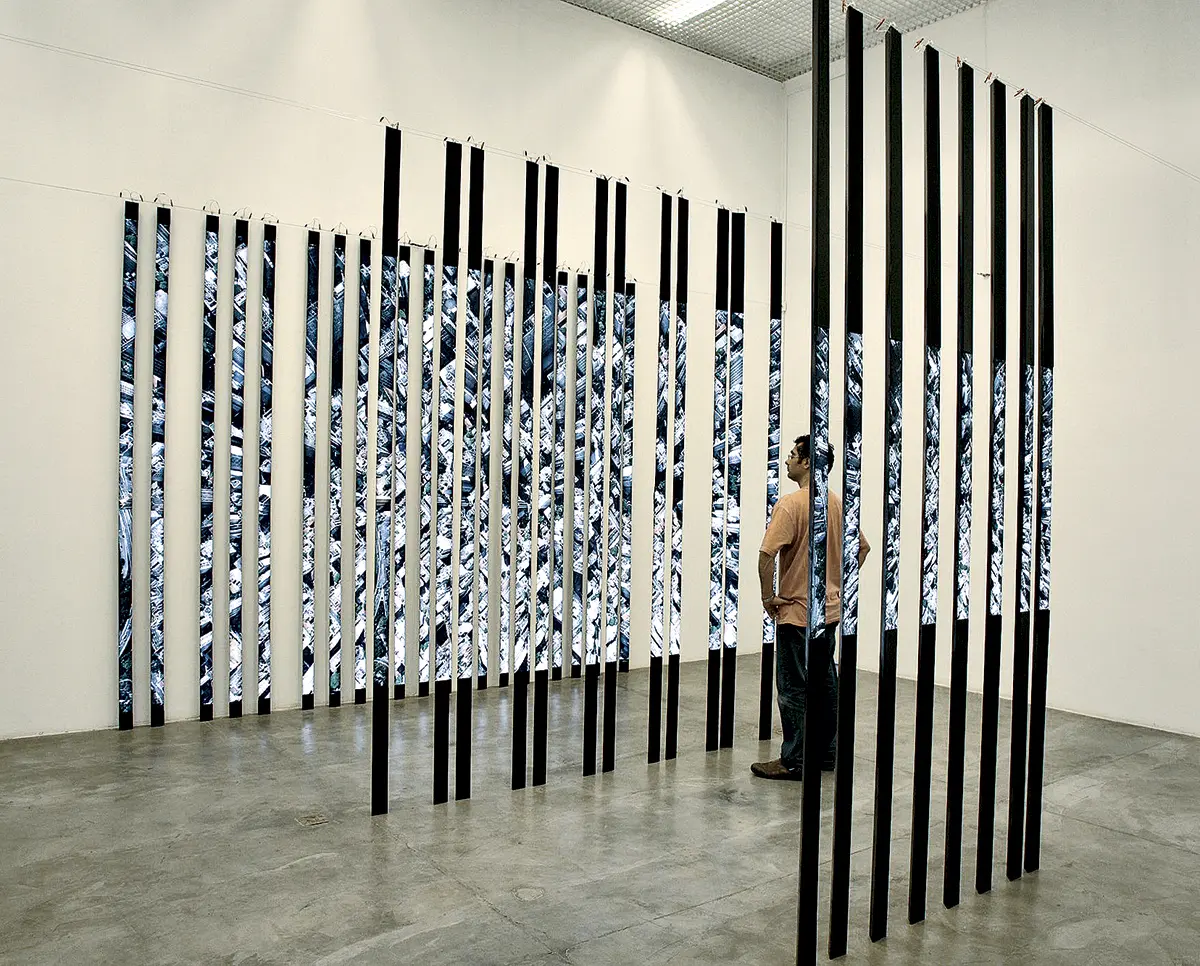
The work exhibited at Vermelho sustained an interesting dialogue with the work presented at the group shows mentioned above, but there were at least two significant differences between the various presentations. First, in the two group shows, the vantage point from which the viewer was to reconstruct the image was determined by the position of a bench (at the MAM) and a chair (at Paralela 2006), which in turn generated a distance between the viewer and the image. Also, despite the invitation to sit in order to focus the image and the disincentive to move about the work, the viewer found herself in front of a shifting image: first, a close view of a São Paulo freeway complex; and second, a view through a window.
The work São Paulo 2006 was a space through which viewers circulated before taking a position to visually reconstitute the image printed on the strips. The image itself referred to those made available by one of the most popular webs applications of recent years, Google Earth. In Google Earth, satellite images are updated periodically (every few days), and the idea is for the public to be able to identify streets, blocks, squares, and even their own homes, as well as to stroll through tourism destinations and to flag their “personal map” monuments and landmarks on the map of the planet. Whereas Google’s computer “canvas” provides an immediate and detailed vista of any city in the world, Vasconcelos’s installation forced one to constantly move and explore in order to identify what portion of the city was depicted. Finally, the aerial view did not offer any clue to quickly identify it—no landmark building, no emblematic monument, etc. Thus, the artist created a “personal cartography,” sending the viewer back to the experience of the gallery space. In this way, the work happened or unfolded in two dimensions: the first one, the moment when the image was recorded, invited one to fly over the area where the gallery is located; in the second one, the gallery’s interior space was composed of the external place that characterizes its surroundings.
In recent years, Vasconcelos has been recognized for his Nocturnos (2002), a series of Polaroid photographs made with strongly colored filters in which details of the urban landscape were shot as almost sculptural elements. In these works, the viewer was already in possession of the detail as a vast panorama.
Now, expanded detailed vistas are available. Vasconcelos’s work can be linked to that of two of his national colleagues: Nelson Kon (who recently presented a series of aerial views of São Paulo, also photographed as he flew over the city) and Márcia Xavier (whose current work uses images extrapolated from Google Earth to inscribe the street dimension onto the city grid). But Vasconcelos’s work displays another distinguishing characteristic: his exploration of the tools of photography and their potential to recreate and cut the image and to offer new ways to look at the city.
ANA GONÇALVES MAGALHÃES