
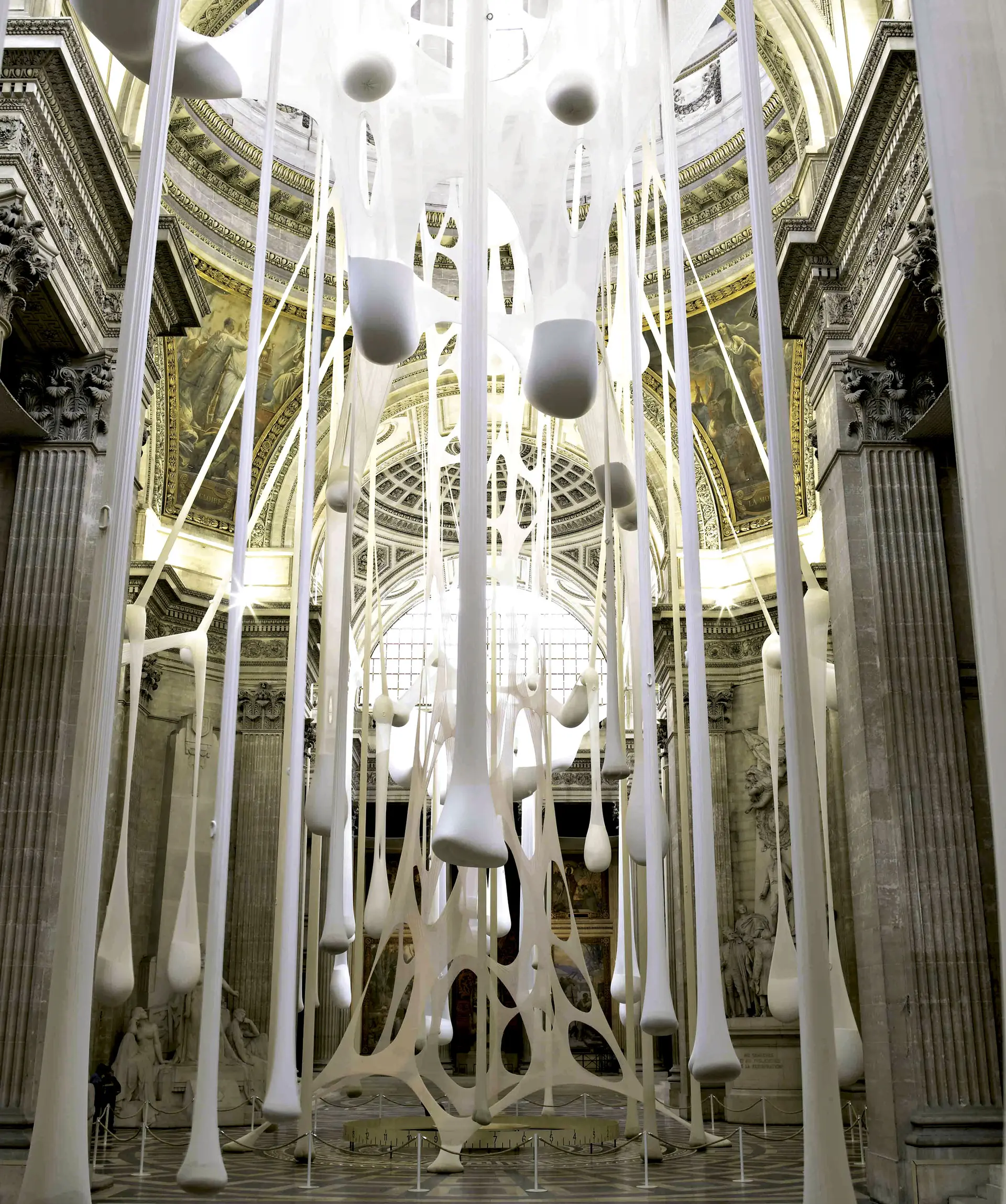
The Brazilian artist Ernesto Neto’s monumental installation in the emblematic Parisian landmark, the Pantheon, was presented between September and December of 2006. The exhibition was part of two important events: the thirty-fifth Paris Fall Festival, a traditional multi-disciplinary event that brings together the various arts, and the reopening of the Pantheon itself, after twenty years of being closed to the public.
With a plan to revive the national patrimony and to raise public awareness of it, the French government supported Neto’s project. Indeed, the Pantheon holds France’s historical memory and the most fertile aspects of the nation’s intellectual life since the tombs of the most important political and cultural figures, including Napoleon, Voltaire, Rousseau, Victor Hugo, Alexander Dumas, and seventy-two others, are located there. After its construction was completed in 1790, under Louis XV, the Pantheon’s architecture was reshaped to fulfill its current function between 1791 and 1793. It is a monumental, very tall building with abundant light. It was in this context that Leviathan Thot was erected, a large, soft, and organically shaped sculpture/installation. It was fascinating for its invasive presence that moved pendulum-like through the four wings of the building and also for the enormous challenge to scale that its execution implied. Indeed, the tallest section of Leviathan Thot, located under the cupolas, reached sixty meters and involved some 2,000 square meters of cloth.
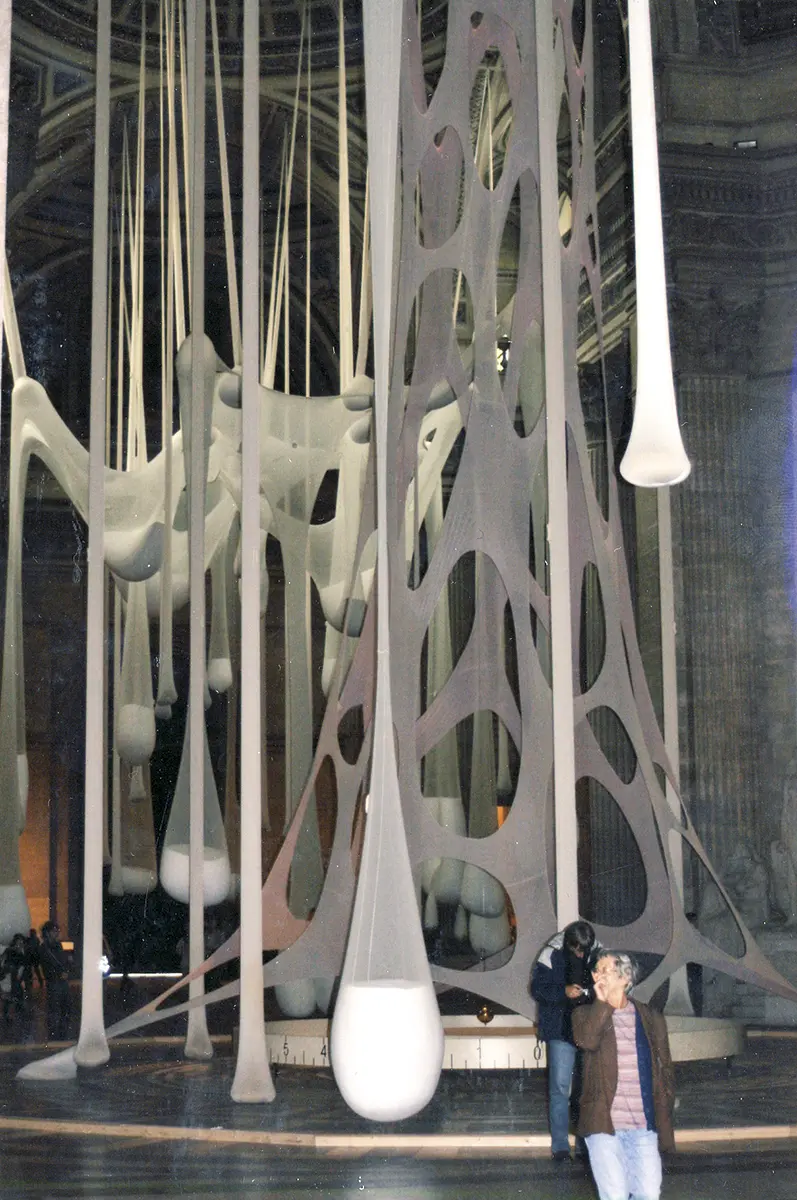
The Leviathan, the biblical sea monster, was known for its monumental size, its ferocity, and its ability to twist itself. Neto’s work hung from harnesses at various heights and with various shapes, becoming a form of great participatory intensity for the viewer as it excited the senses of touch and sight as well as a spatial feeling of monumentality. At the same time, the organic voluptuousness was notable for its equilibrium expressed in its relationship with the architectural space and the balance between weight and levity. The alternating use of sand and small polystyrene balls inside the cloth generated a weight-scale effect and made it possible for Neto to play with the different heights. Neto distributed the shapes and the materials in a balanced way throughout the building’s wings, which gave his installation an ambiguous quality: it wasn’t mobile, yet it wasn’t entirely static. It seemed to swing or to move slightly following the direction of the wind. This, added to the height and the weight that was felt overhead, generated an enormous tension. Other shapes fell all the way to the floor or hung at eye level, making their presence something more usual.
The material, volumetric, and soft nature of the work possessed great sensuality. Body fragments, bumps, elongations that resembled ligaments, orifices, and fallen masses were some of the qualities that turned this into an “anthropomorphic” work. This “spatial body,” as the artist calls it, contrasted with the verticality and the rational nature of the architecture surrounding it and acquired both male and female symbolic connotations. The presence of binary elements was significant in this work: heavy and light, static and mobile, male and female. But these meanings did not obscure the fact that this was one of the greatest challenges in Neto’s career: to turn a pre-established and determined space such as the Pantheon into his own work. Despite his commitments to official institutions, Neto created one of his most complex works, which will be a referential landmark in his career. He created, at a monumental scale, an impeccably balanced system of shapes and of force relations that at the same time propitiated the interplay of tensions that produced an alarming instability. It was also an entirely carnal, sensual, and quasi-erotic work of art.
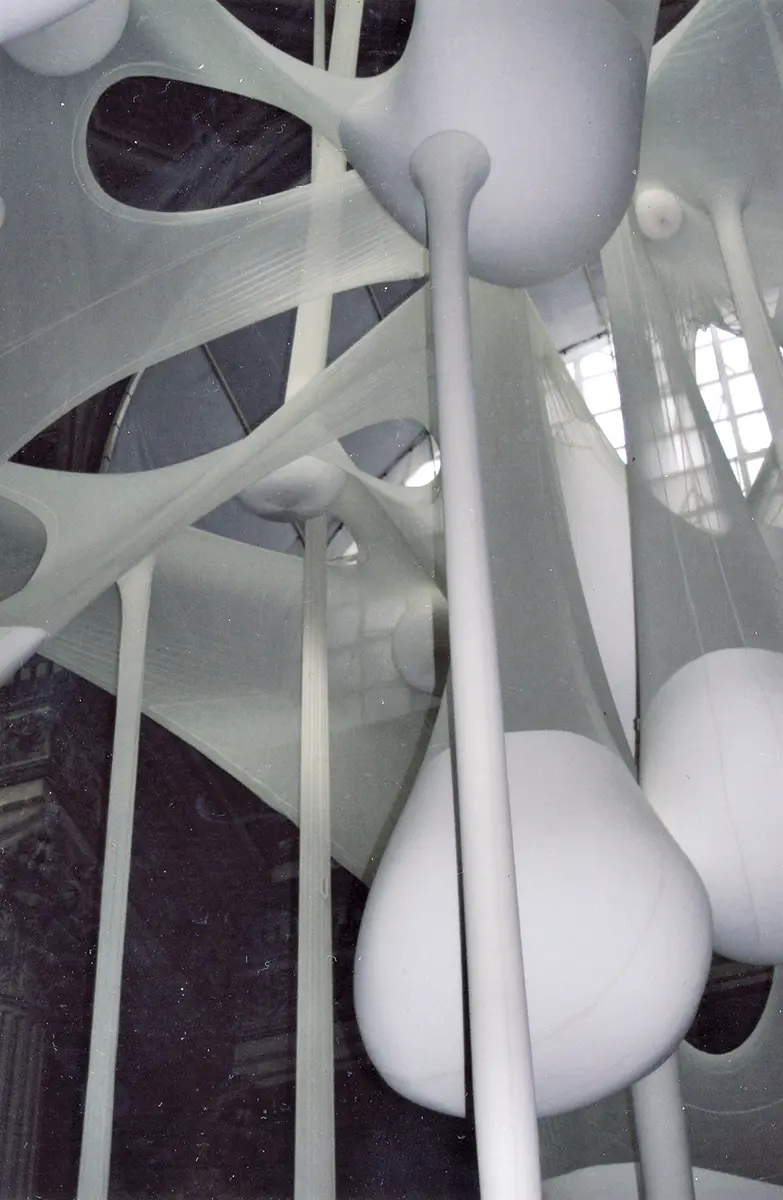
The shapes’ voluptuousness didn’t seem to be the product of chance. They were distinctive not only of Neto’s oeuvre (from his small-scale works with nylon hoses to the different environments he has created) but also of Brazilian modernity. The idea of “anthropophagia” came through in this case as to “devour” or to “invade” not only the space of the Pantheon but a whole culture inherited from Europe. But France returned that space to the public by inviting a Brazilian artist to create such an important intervention. This was an acknowledgment of the other, understanding the event as the generation of possible space for cultural diversity.
In the middle of the Pantheon is Foucault’s Pendulum, oscillating according to the Earth’s gravitational pulse, a material and visible confirmation of equilibrium. Leviathan Thot kept pace with it, silently.
SUSANA BENKO
Art research scholar. Editorial Coordinator for ArtNexus in Venezuela. Museology Manager at Museo Alejandro Otero and AICA member.