
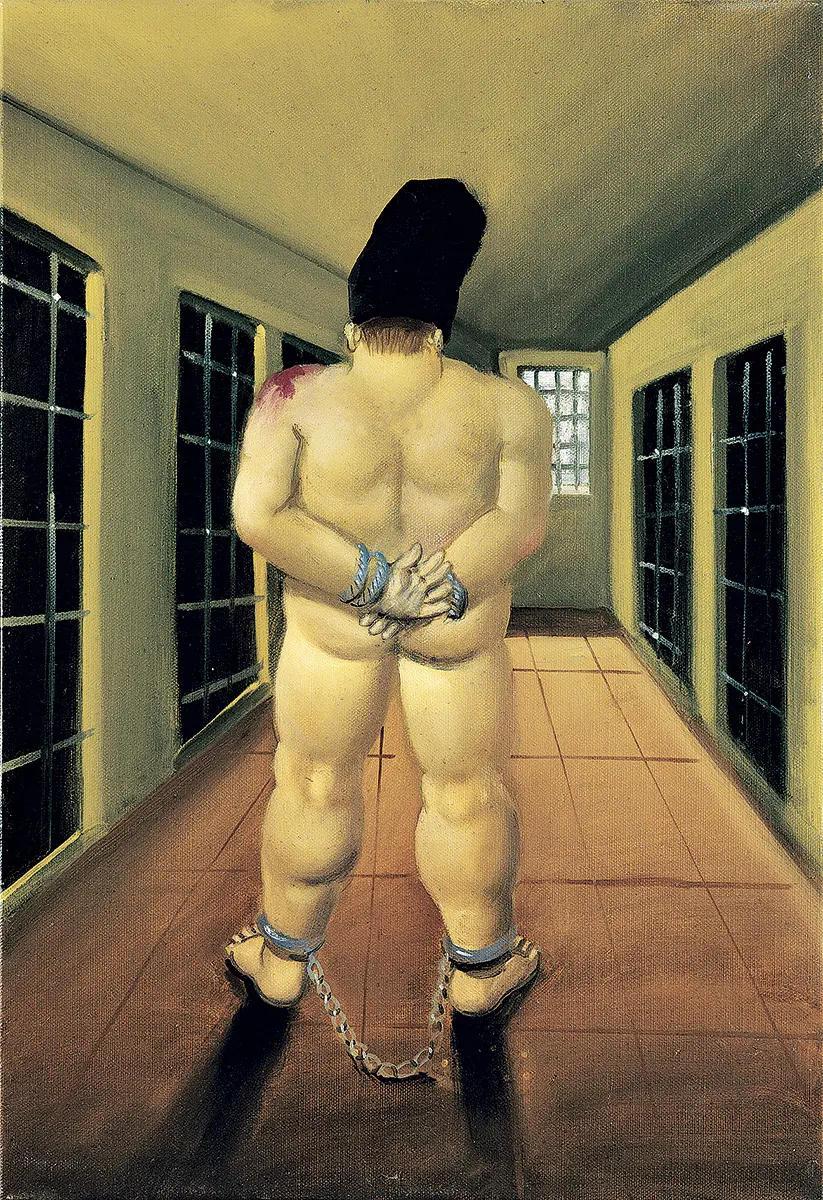
The exhibition of Fernando Botero’s work at Marlborough Gallery in October was a surprise and a shock, for it was totally different from the usual joyful, placid, rounded figures that one has become accustomed to seeing in his works, whether sculptures or paintings.
Botero’s work has become so well known from his many international exhibits that one cannot think of a major cosmopolitan center that has not yet presented a Botero exhibition. Because of the wide reach of his art, and the popularity of his subject matter, he has also become one of the most easily identifiable artists of the last century. The work of Botero has carved out a place for the Latin American archetypical characters in art history: the vacant and disdainful stare of the all-powerful military rulers; the voluptuous nude beauties enraptured in narcissistic admiration or reading love letters as voluminous as their thighs; the comical old maids confined to bitter grimaces and ridiculous clothes; the surreal aspects of Catholic saints, miracles, and rituals; the overblown kitsch of first ladies, courtesans, and generals; and the still lives in which the presence of the tropics is revealed through the persistent buzz of flies. His parody of the stereotype is an effective comment on the stereotype itself.
In the past, Botero successfully approached the theme of violence in his work. His series of works executed in the 90s on the Colombian drug war is well known, as many of these works were donated to the Antioquia Museum in Medellin and The National Museum of Colombia in Bogotá.
The entire exhibition at Marlborough Gallery was dedicated to the prisoners at Abu Ghraib, the infamous American prison in Iraq where Iraqi prisoners were tortured and humiliated by American soldiers, a dark episode in the war in Iraq that made shock waves in the news when the scandal broke in 2004. Botero’s paintings on the subject were monumental. Even on the small canvases, tortured bodies occupied the entire picture plane; the helpless positions of the victims were underscored by the booted foot, the gloved hand, or the ferocious attack dogs of their captors.
Some of the smallest canvases were the most powerful as if the artist concentrated the spiritual and aesthetic force of the idea into one strong image, similar to the effect that Russian icons have on believers. Two of these paintings depicted the same martyred face, one frontal and the other in profile, blindfolded with a red cloth and a profusion of bleeding that was reminiscent of Ecce Homo images. Another portrayed a single foot, swollen and mangled with ropes around the ankle that recalled saintly relics of martyrdom. Like the famous Rodin bronzes of single hands, two drawings portrayed the single hand of a captive opened in a tense gesture of despair, also roped at the wrist; both drawings were extremely eloquent in projecting the pain and despair of the victim with as much intensity as if the entire tortured figure had been portrayed in gruesome detail.
Other drawings were equally accomplished. They were shown in a side gallery and displayed the same theme of prisoners being attacked by ferocious dogs and cruel guards. In some of them, the selective and sparse use of color highlighted the tension. In one, a prisoner hung suspended from his bound hands; only a streak of reddish color coming through the blindfold and the rope around the wrists suggested the victim’s horrible pain. In another drawing, the bound prisoner kneeled naked, while a uniformed brute urinated on his back; here, the yellow liquid was the only color in the entire work. As in Egon Shiele’s drawings, the limited color on a mostly uncolored drawing altered the impact and mood; in this instance, it emphasized the vileness of the deed by directing one’s attention to the humiliating process.
Clearly, Botero was inspired by the German Expressionist painters Otto Dix and George Grosz, who depicted the victims of warfare in the early part of the last century. But Botero’s technique also recalled the Colonial artists that depicted bloody martyrdoms and scenes of crucifixion in his native Colombia. In particular, the greenish tone of the skin of some of the victims evoked the famous Death of St. Francis Xavier by the greatest of Colombian Colonial painters, Gregorio Vazquez de Arce y Ceballos. Botero’s pictures, however, achieved a level of expression that has not been present with such force in his work since the early 80s; in this respect, the exhibition was a high point in his long artistic career. The technical quality of the works was extraordinary and the expressiveness surpassed anything he has yet produced.
The entire series was completed within a little over one year (2004–2005) and had been a traveling exhibit, shown at Palazzo Venezia in Rome, the Würth Museum in Künzelsau, Germany, and the Pinacoteca in Athens. The artist decided not to sell the works and is in search of a museum that will acquire the entire series.
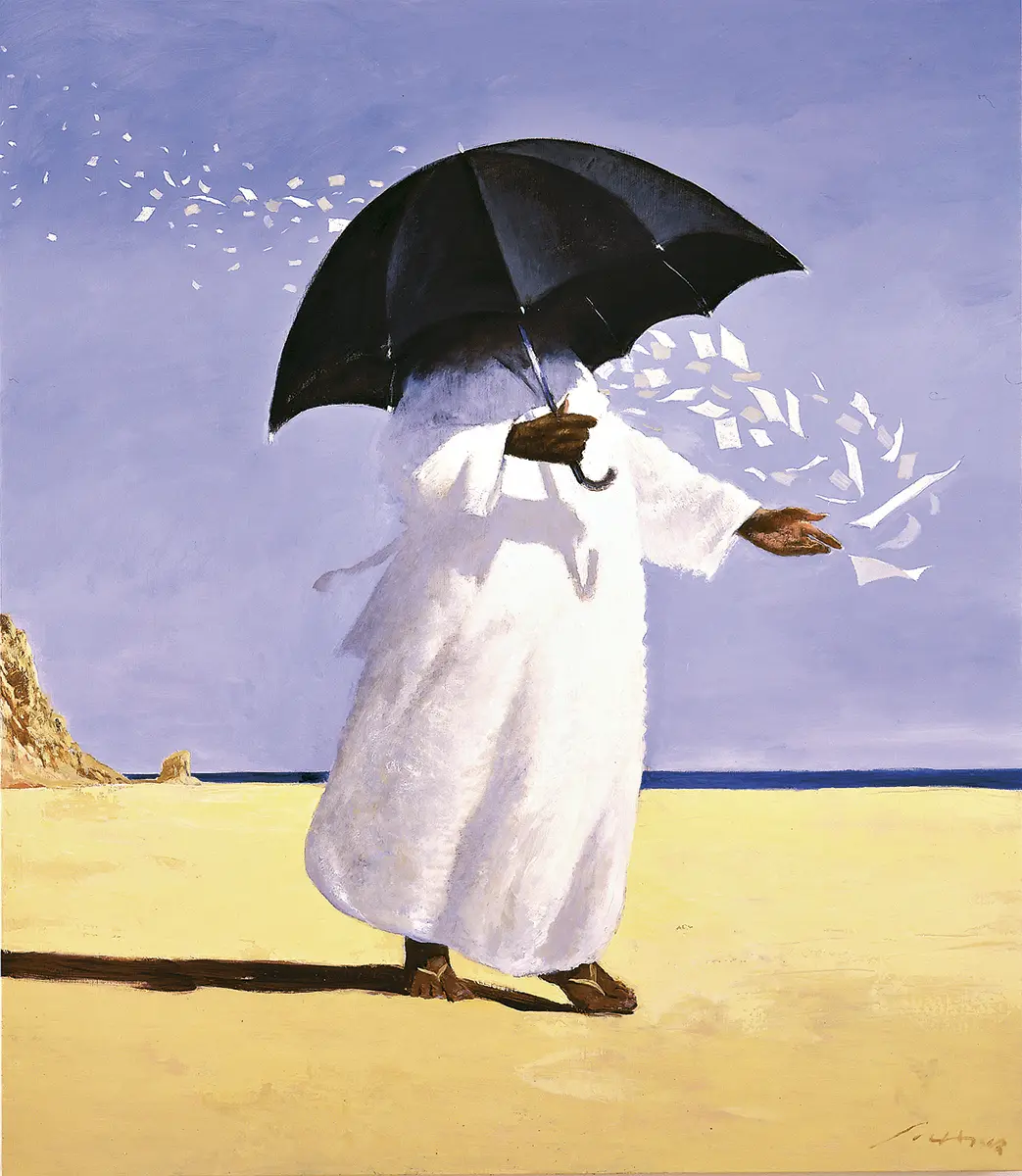
Immediately following the Botero exhibition, Marlborough presented a selection of Julio Larraz’s latest work. The painter continued the political discourse initiated by the Botero exhibition with a series of canvases that depicted the very ambiguous relationships that exist in political power centers in third-world countries. Some of these topics had been touched upon during Larraz’s previous show at the gallery, but the themes were amply explored in the recent exhibit.
One of the best examples was a large canvas titled The Benefactors, which portrayed a group of politicians or investors surrounded by military men, overlooking a map on a table on which military positions were represented by toy soldiers and ships; the entire landscape was barren and brown, suggesting the Middle Eastern terrain of the current conflict. The imperious attitude of the principal military men were underscored by smiles of greed and the gesture of the main character, with the face of a politician and the dress and demeanor of a banker or tycoon. The whole atmosphere implied secrecy, the group was huddled together as if in a box at a sinister theater, and one of the most menacing in the group, with a profile like that of an angry bulldog, had diverted his gaze to the side to check for approaching intruders. Behind the bold head of the general, the piercing eye of a security agent shot a piercing glance that was almost a silent interrogation.
Another painting, titled The Covenant, was a take on the unholy alliance of the power of military might and capital wealth. Under the shadow of the blades from a private helicopter, a group formed by men in suits and military commanders wearing rows of medals and fanciful epaulets convened with a figure shrouded in a traditional Arab costume. One of the generals stood slightly apart from the group, with his eyes shielded by imposing dark glasses, obviously on the lookout for any possible intruders to this impromptu power meeting. The atmosphere was saturated with tension and projected danger to the onlooker; as a group of crocodiles in the placid water of a pond, this gathering was powerful yet slightly repulsive.
The catalog had an excellent summation for these specific paintings: “Much of Larraz’s work possesses a political edge, and this aspect has clearly become more dominant in a number of recent compositions. The contemporary audience is, of course, increasingly accustomed to finding art married to politics. In this respect, the visual arts have come full circle since the start of the Modernist revolution almost exactly a century ago.”
A couple of paintings depicted a profiled face that is familiar from the field of international politics. In one of the paintings, the man looked sideways at the shadow of his figure underneath the shadow of gaping dinosaur jaws (the beast’s skeleton was portrayed behind the man in frightening detail); this painting was cryptically titled The Bone Collector. The other painting was titled Man Talking to his Shadow and portrayed the same figure sitting in an empty room and turning his head toward the darkness. Both paintings had as many interpretations as the darkness that the character seemed to exude. A subtle and ironic commentary on international politics was the salient characteristic in Larraz’s exquisitely rendered canvases.
ALBERTO BARRAL