
The first impression one had upon entering the temporary exhibition gallery at the Museo Nacional de Bellas Artes, where José Manuel Fors’ Historias Circulares was on display, was that of being in front of a cosmic detail. The exhibition was comprised of five untitled installations, specifically created for the show.
The first installation was arranged on a glass wall, right before entering the gallery, which offered a view of the landscape outside the museum’s building. In this way, the light of day, the varying intensities in the sky, the clouds, the darkness of the night, the presence or absence of stars, and the lights of the city provided a changing background for the composition. Starting at the center, Fors had juxtaposed tiny rectangular photographs that formed a circle, whose irregular borders brought to mind the image of a celestial object.
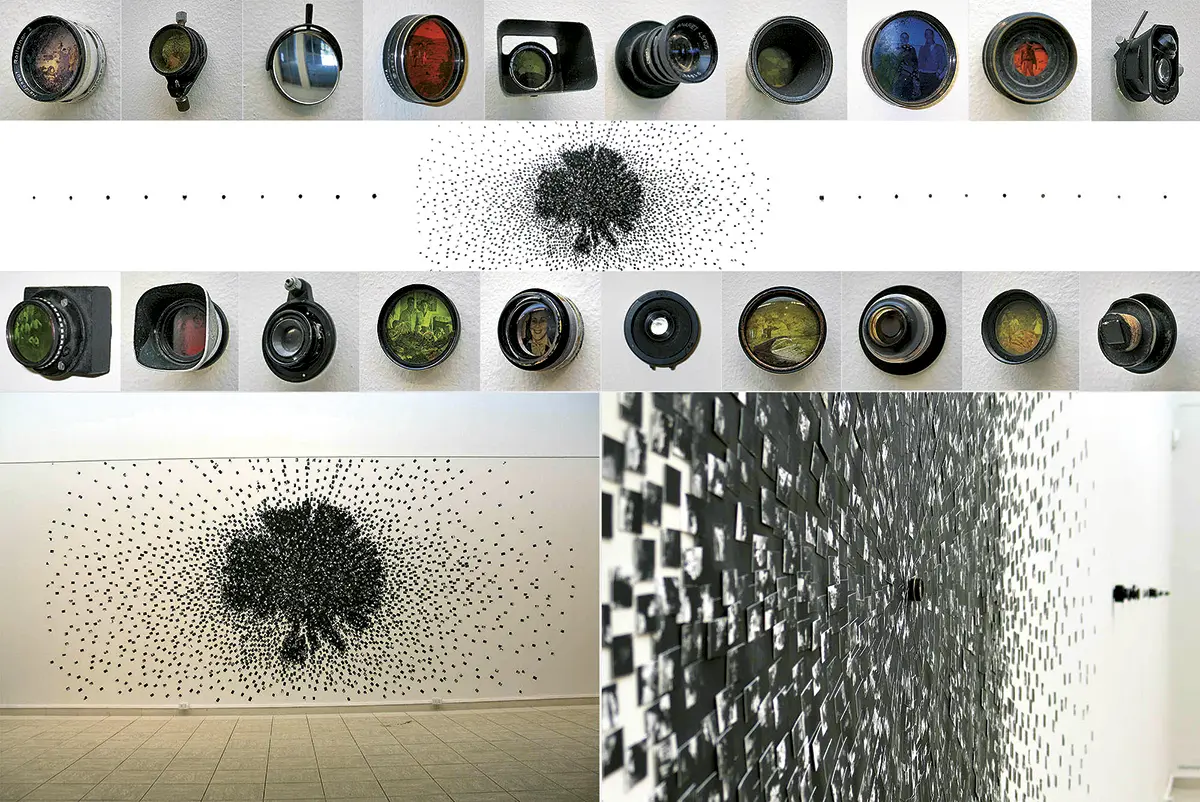
A similar work, but in a larger size, seemed to expand inside the gallery, as we proceeded with our tour of the exhibition. This installation was of subtle, limpid beauty, and while we could be driven to see in it a kind of cosmic explosion, a galaxy, or a portion of the infinite cosmos, it was impossible not to note the abstract nature that Fors installations reach. That shape that seemed to jump at us started at the center of the wall with a circular dilation that reached the floor and the ceiling, while on both sides then lenses of various kinds prefigured a line.
To the side, another installation was drawn upon the basis of three circular images, the centers of which were marked by small, simple lenses. In the circle that centered the group, the entire surface was covered with sepia-shifted impressions documenting the existence of multiple objects; solitary miniatures repeated time and again in the same composition: a doll’s head, a pair of scissors, a fork, a corkscrew, a snail, the face of a boy, etc. Two circumferences completed this construction. The curve of its contour had been achieved by the gradual superposition of photographic images that played at hiding, letting us see what was in them only partially.
On the floor and towards the back of the room, an accumulation of leaves traced another circle. Metaphorically, it alluded to the tools that are needed to identify our spatial or temporal location (astrolabe, compass, solar calendar, among others.) On this work the artist placed five markings, like points of reference: the center and four more that could be an analogy of the compass directions; clockwise, e identified a weight, a lamp, a mortar, and a lantern.
The installation comprised of a wooden tripod, entirely open and arranged on the wall, was extremely significant. The place, where the camera or telescope would attach, was occupied by a lens. Behind the glass, we saw the photograph of a child. This tripod signaled an observation point, and in José Manuel Fors’ always enigmatic proposal this conferred upon this point an element of transcendence, from which one could “distinguish” in his exercise ungraspable portions of matter in time, the alchemy that illuminated a fragment of the text of Paradiso, placed, in vinyl letters, as part of the exhibition.
Fors is a maker of groups, whose central tropic has been nature, presented in an innovative way with respect to the Cuban visual arts in the 1980s. So far, the course followed by his work essentially reiterates his interest in time as a dimension; the extension of that totality through a kind of archaeology that connects him to personal memory (or history) and at the same time with life immeasurable patrimony.
In the context of Cuban photography, Fors’ posture is supported on the conceptual and almost always made concrete in accordance with minimalism. The different levels of appropriation of that matter that photography is for the artist, allow it to be the mediator for new manipulations each time the images are repositioned in different circumstances, places, and times.
On these occasions, the stories were told with a portion of the many pieces of evidence gathered and selected by the artist from a universe that exists around him and has been and will be imperturbably another’s. All of these instances come together in complete cycles, like impassive circles that repeat in the midst of that nature we inhabit and also are, in a whole that transcends us in its immensity and infinitude.
CARIDAD BLANCO DE LA CRUZ