
In her series A través del cuerpo, Espinosa seems to work around the concept of negativity, understood as suspicion in the face of any categorical assertion, rather than its contradiction. In that sense, the artist, more than recovering the memory of certain events, takes as her starting point facts that have been obscured or condemned to oblivion: more then alluding to events that outline stories, she contributes to the construction of a narrative, articulated by episodes of silence.
In these drawings, the artist perforates carefully the surface of a cotton paper sheet, tracing a schematic that refers to fragments of press photographs. In the process, she cleanses those images of all excesses that manipulate perception, both in the formal area —line, color— and in the narrative area —drama, anecdote—. In that regard, the artist says: “It is important to detect the obscenity and the political use that some media make of those photographs that make evident the impotence of those who cannot speak up, of those who have no voice. Only by unloading from each one of these representations the intention that was imposed on them can we recover the human condition that originated the image.”
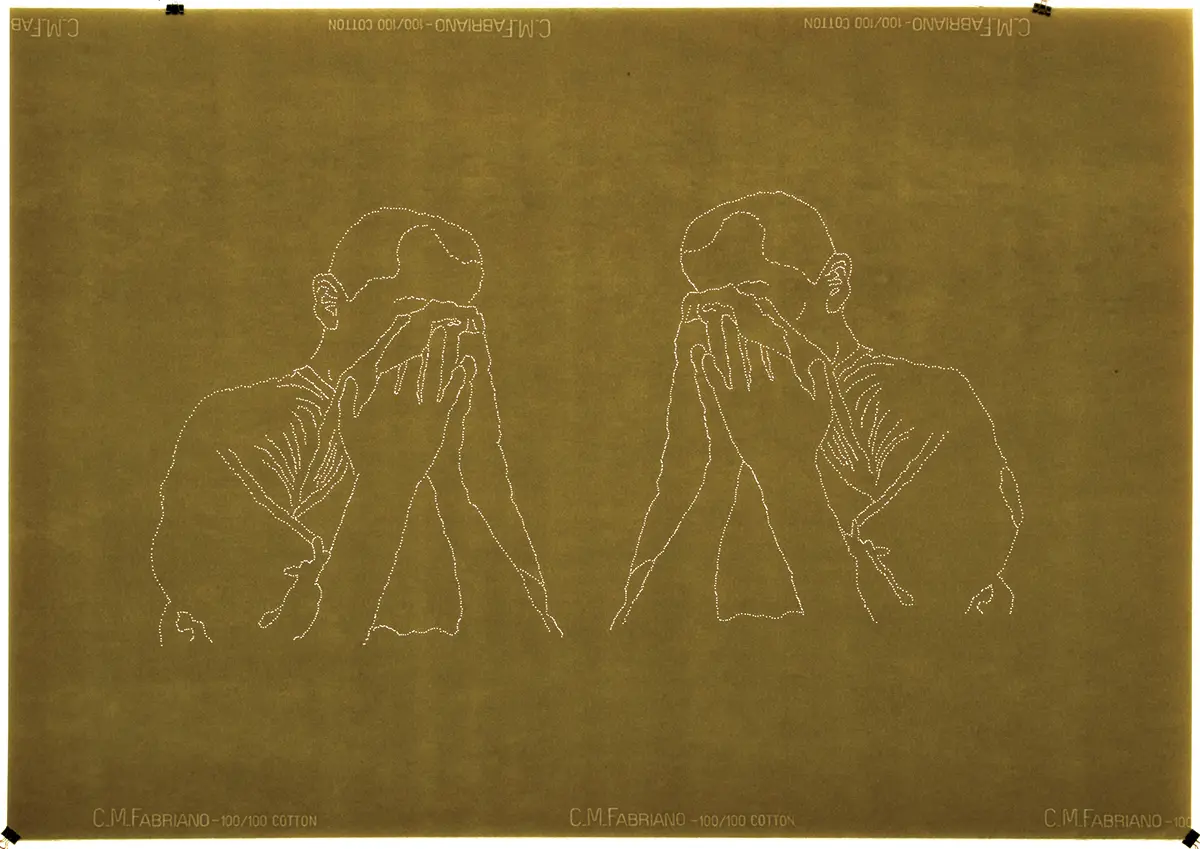
The notion of negativity that has been alluded to before appears also in the formulation of the images: the faces are not portraits, the scenes are not anecdotes, the indications are not judgments. It is also visible in Espinosa’s approach to draftsmanship: perforation appears as an indeterminate state; it comes so close to schematics that it reaches the point of becoming a map, or the preparatory phase of embroidery or a coloring page. Such a state of suspension moves away from any strident assertion or an allegorical response.
In these works, the drawing —traced using a needle, without the thread of memory— can only be made visible by the light projected from behind. If drawing, by tradition, makes borders visible through a process of abstraction, so as to construct shapes in space, in these works Espinosa examines and fragments those borders. Not only drawing itself —the negative line— is what lacks matter, but the light source that renders it visible is also immaterial. Unlike frontal lighting, which contributes to the perception of volumes, in these works irradiation comes from the “reverse” of each work. Espinosa’s drawings, then, do not represent light; rather, it is light that renders form visible, moving from the idea of illusion to the idea of reconstruction.
CARMEN MARÍA JARAMILLO