
The recent exhibition of works by the young Venezuelan artist Mariana Monteagudo was held between the months of July and October at the Museo Alejandro Otero (MAO), a beautiful building in southwest Caracas. In a way, the exhibition’s title, Idolillos y Fashion Victims, summarized the essential aspects of Monteagudo’s work: for several years, she has distinguished herself through the creation of solemn and disquieting totemic figures.
For this occasion, a special environment was created. MAO’s Gallery 6 is a small triangle-shaped room, with a semi-circular front wall. There, the artist created a stage on which she placed figures at various heights. Coming into this space, viewers found a number of small, characteristically inscrutable idols watching them. Each one of these works presents an aura of strong energy that comes from the intensity of its gaze; moreover, many of these small idols have red eyes, a gaze that fluctuates between naïveté, candor, and the demonic. Not by chance was the gallery painted entirely in red.
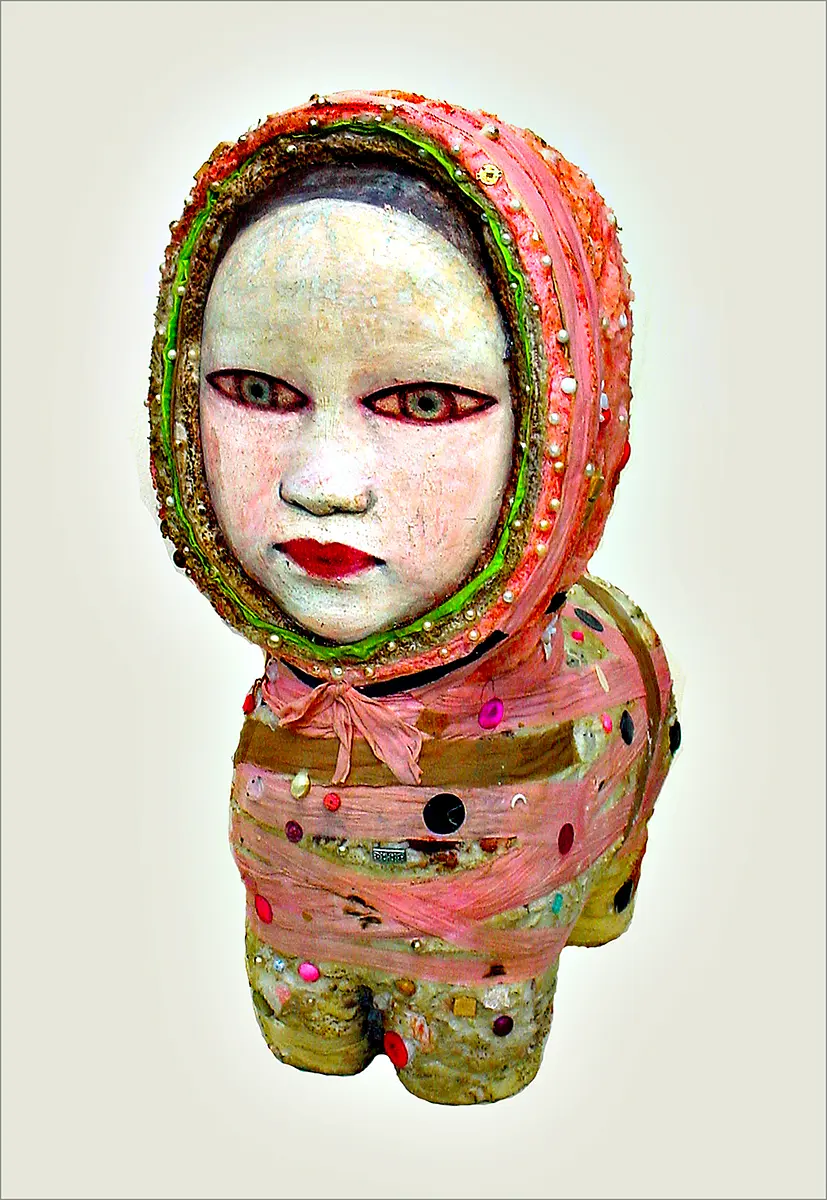
On several occasions, the artist has expressed her intention to create hybrid beings that possess a duality between the seemingly infantile, with warm colors and sweet faces, and the opposite, with disconcerting and aggressive elements. As she has pointed out, she wants “for the terrible and the kind to cross paths in a single identity.” Simultaneously, she has appealed to the collective cultural memory to induce what she conceives as “a mental collage,” so that viewers can associate each of these creatures with a variety of referents, such as pre-Columbian ancestors, Egyptian mummies, Barbie dolls, or comic-book figures from Japanese manga.
Monteagudo seeks to give her figures a timeless character, like that of small idols from ancient cultures, which were objects of cult and veneration despite their profane nature. They were made to be idolized; thus Monteagudo makes idolillos. For the artist, idolatry and veneration are part of the human condition, and this is why humanity creates idols through a variety of media like technology, fashion, advertising, show business, etc. One could wonder whether veneration is not another form of artistic contemplation.
Monteagudo’s technical solutions materialize these ideas because the artist uses ceramics, painting, drawing, collage, and design to connect her figures both to the old and the contemporary. Such eclecticism, or “three-dimensional collage” as she calls it, is made possible by a technique developed by the artist over time. First, she creates an initial ceramic model for the basic volumes, which is then covered with plaster. Next, she carves them, paints them cold, and adds all sorts of materials—hair, natural fibers, bugle beads, beeswax, etc.—to achieve the patina that brings to mind ancient ceramics, while retaining a contemporary, culturally mediated character. The reference to mass-media culture is not only evident but also very enriching in the creation of these small idols.
In this exhibition, Monteagudo wanted to touch on the theme of the feminine through a reference to fashion or through the intimate and solitary labor involved in sewing and embroidering. Thus, her pillows and accessories such as purses were decorated with myriad bugle beads and various other materials. All of these objects explored this universe with great detail and coquettishness. In a way, the connection with fashion is at once naïve and perverse, as in the dolls or idols. Monteagudo’s two-dimensional collages made with drawings and cut-up pieces of paper and cloth, however, express the candor and naïveté that are characteristic of children’s imagination.
Fifty-six works of figures, pillows, accessories, and two-dimensional collages were included in Idolillos y Fashion Victims, all related to the mass media, are products of a mixture of different ancestral or mass-mediated cultural icons. They had a “multicultural” character, to which the artist refers. Just one of these works is intimidating alone. When they are presented as a family, as a collective, as was the case in this exhibition, the energy of these small idols is condensed and becomes unsettling. They look with such fixity all at once, always immutable and silent.
SUSANA BENKO