
The recent exhibition of works by Minerva Cuevas (born 1975, Mexico City) at the Juan José Arreola Lakehouse in the Chapultepec Woods brought together works created for other locations and in different periods, which gained a renewed freshness by being contextualized in a university museum within a Mexico City public park. Piratas y héroes, 2006, for instance, presented only a fraction of what the installation was in Los Angeles: five pedestals with TV monitors and speakers and a newspaper ad with a casting call: “Seeking actors and people with the physique and the mental attributes of a superhero...” The chosen wore a cape-like those of fictional superheroes and answered questions: “Do you identify with a superhero? Do you think piracy helps superheroes become more popular? Do you go to the movies often or read superhero comics?”
In another gallery, Overseas, 2006, was composed of several blankets hanging from the ceiling and drawings of the idyllic landscapes pictured on the nameless labels of the more than seventy brands of bottled water sold by Nestlé. To the side, on the wall, one read: “All the enchantment of Nestlé has been achieved by means of the systematic destruction of the world’s landscape...”
Cuevas is committed to denouncing the unfair policies imposed by the great powers on the countries of the Third World, as in Del Montte, 2004, which consists of a mural painting of a hand holding bananas with a sign reading “Criminal Del Montte, Guatemala fights for its land.” On the side, 130 cans arranged in a pyramid atop a table carried the label Del Montte Criminal, Pur Meurtre, which refers to homicide. On another wall, one read that Del Monte manages unfair landholding systems that marginalize Central American populations, as well as a reference that one of the owners of Del Monte Fresh produce is George Bush’s brother.
Donald McRonald, 2006, is a video recorded in the Chapultepec zoo, where the famous clown, fattened for the occasion, presents a performance in front of a group of casual viewers. Using a microphone, he confronts issues such as the fact that the fast food enterprise does not offer benefits to its employees or its consumers. Some of the phrases uttered by the actor are: “Don’t ask me for a union... I need you to help me with money so that I can fill your bellies and you can fill my wallet... we are all for ecology: our packaging is 1% recyclable.... don’t worry about obesity... all the vegetables we use are preserved for months in the refrigerator, because we use fourteen or fifteen preservatives ... I spend two billion dollars in my image, so that everybody knows me... we use old chickens and crush them for our McNuggets...” A group of policemen approached him and drive him away, ending the 17-minute video.
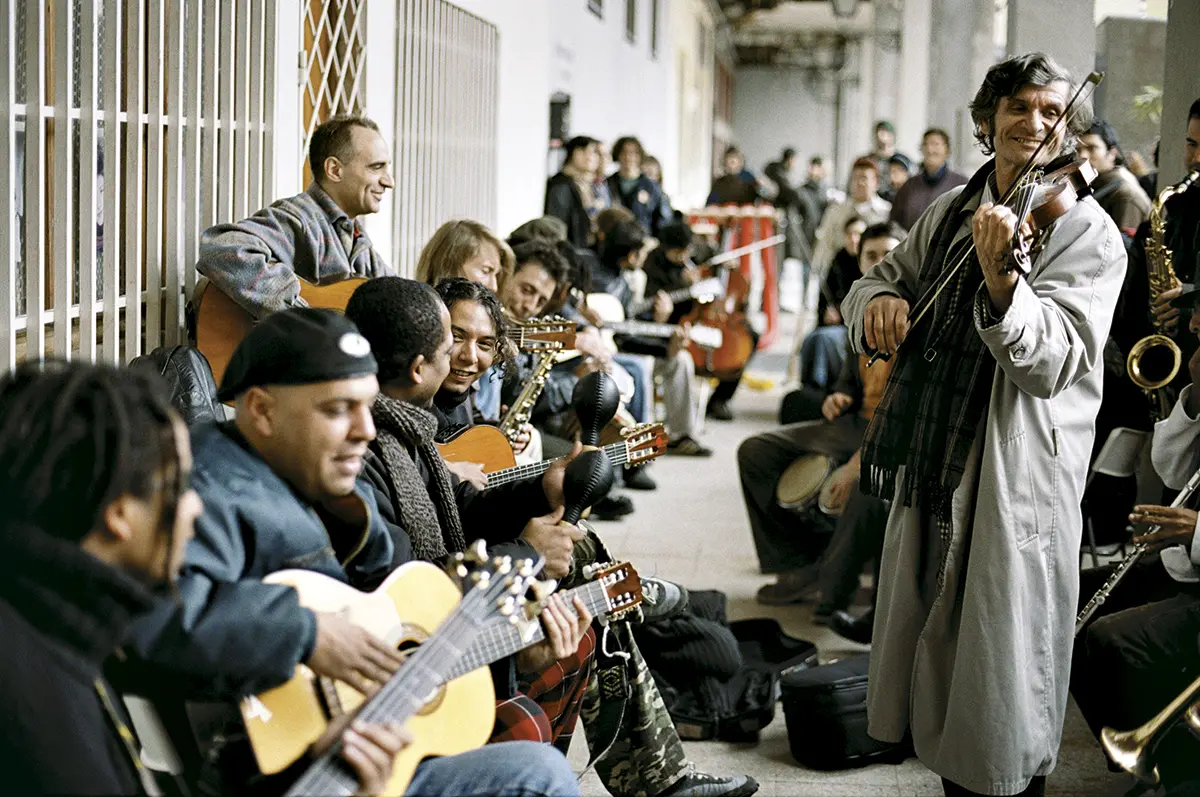
In response to the slogan of her “company,” Mejor Vida Corp., where Cuevas asserts she works “for a human interface,” the video Concierto para Lavapiés shows the voluntary congregation of a group of musicians in a Madrid neighborhood, who responded to a flyer that called for people to bring their instruments. Without rehearsal, fifty musicians gathered in a display of cultural integration, joining guitars, maracas, violins, and drums in different styles while people danced. The video is three minutes long; the musicians played for over an hour although the flyer announced only a thirty-minute concert.
Two large-format photographs and a circular map of the area compose Schöeneweide Walk, 2004. On the banks of the Spree River, in an industrial area south of Berlin, the artist found the graffito Ich Liebe Dich; on the other side somebody wrote, in English, “I love you, too.”
Tatanka Iyotaka/Not Impressed by Civilization, 2005, is an edited video projected on a large screen. In it, the artist enters a forest on a dark, silent, cold night. One sees a small deer lying down, relaxed yet vigilant. Suddenly the animal hears a noise, stands up, and runs away. Meanwhile, the artist fixes her sleeping bag with several blankets, gets under the covers, and goes to sleep. Only after several minutes of watching her sleep does a sign appear, indicating that it is 5:30 in the morning and that the temperature is below four degrees Celsius.
Cuevas offers services to society without expecting compensation. She starts with an investigation of political, social, or economic topics and uses her work as a tool to generate awareness or to trace an alternative to the discriminatory hyper-capitalist system that dominates globalized societies.
LUZ SEPÚLVEDA