
“It seems like a mockery of the concept of style often displayed by art experts and commentators, in their attempt to discover pathways,” León Ferrari said regarding the work of Oscar Bony (1941–2002). A show of works by both artists inaugurated the Pan American Art Projects space in Miami. Bony was part of the Instituto Torcuato di Tella, a disciple of Antonio Berni, and a winner of the Ver y Estimar Award—which revolutionized the perception of art as a nucleus for experimentation with various realities—in 1967. Ferrari has written articles for Página 12 and has been censored and exiled for the satirical tone of his work on religious themes.
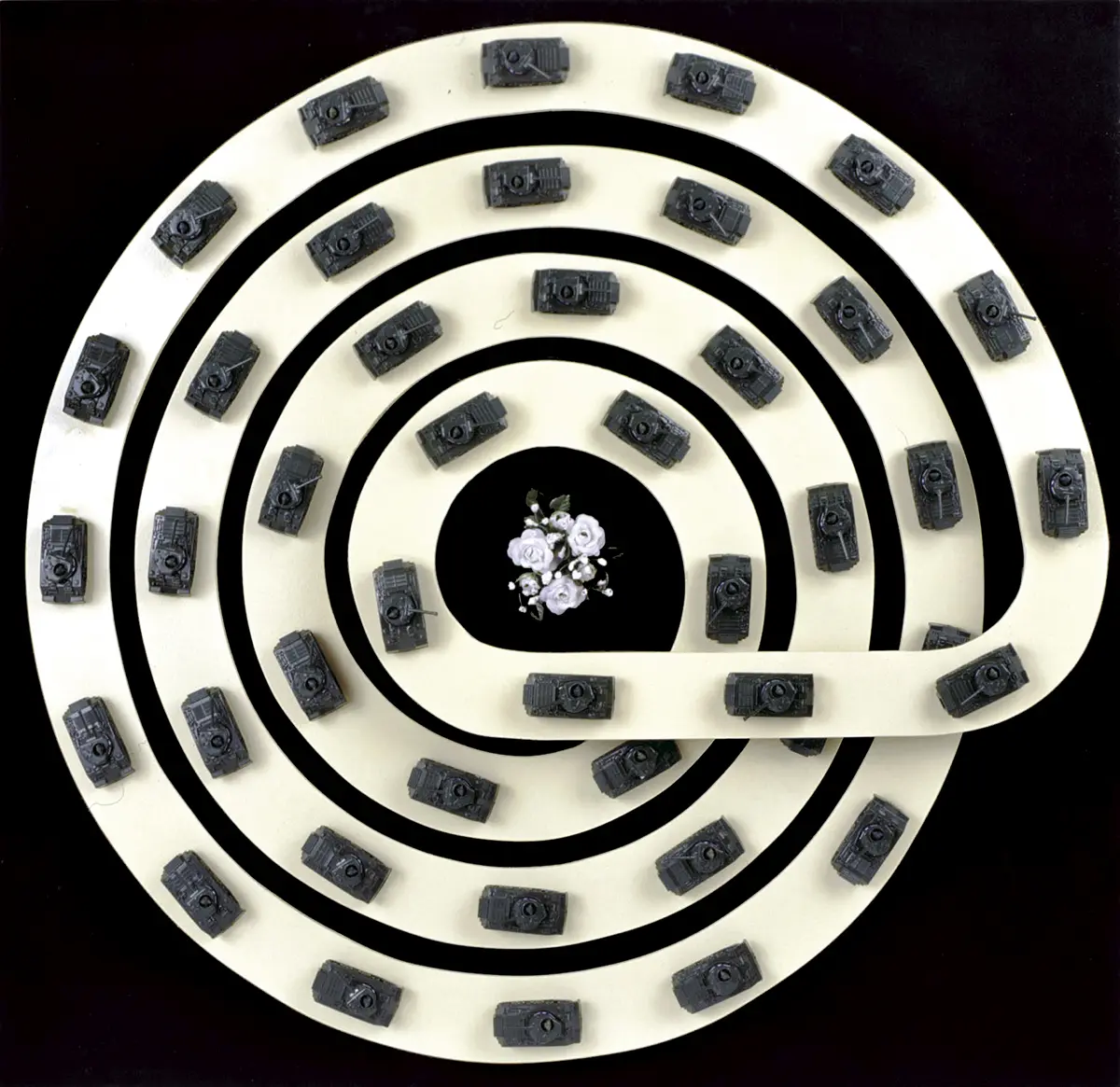
Although the above-quoted article emphasized Bony’s work, also noted the irrevocable visual impetus of Ferrari’s art. His drawings, for instance, displayed frantic calligraphy and at times allowed the viewer to see readable words that evoke feelings: fears, anxieties, rancor. The crisscrossing lines resembled chain-link fences, imperfect and convoluted textures on paper that tickled and disturbed the senses. His sculptures and installations possessed the lacerating impulse of his drawings—circular, asymmetrical structures populated by objects that one picked up easily: flowers, birds, plastic armored vehicles, toy planes, colored feathers. The agonizing sensation of the enclosure was transmitted to the viewer, making one a participant in tormenting experiences from the past. Included from the series Ideas para Infiernos were works with an ostensible critical bent that represented religious icons being cooked in a frying pan.
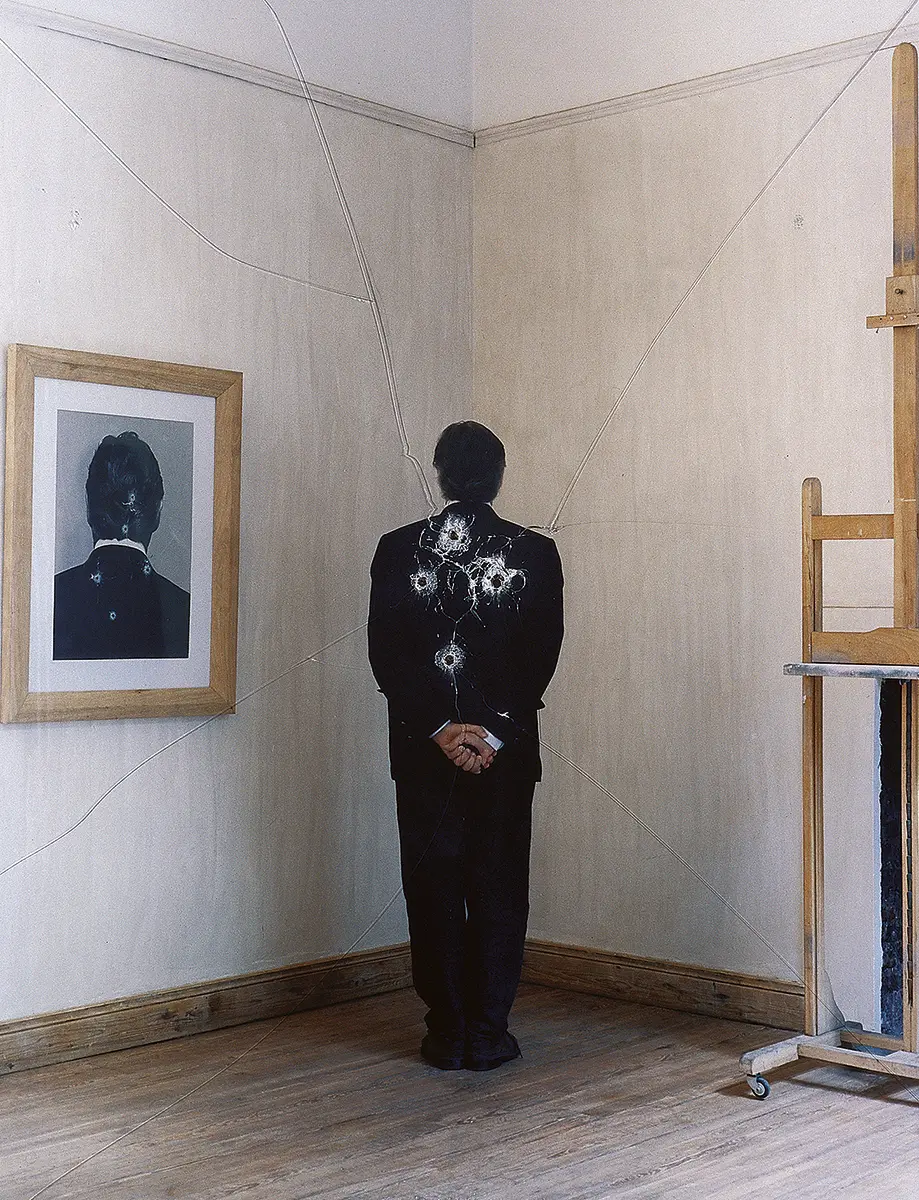
Bony’s works questioned and marked an ethical/aesthetic justification for death. The glass that protected the photographs was perforated by bullets, which delineated drawings of an undefined nature. The visualization of the destroyed object produced new branches of meaning, which propitiated, in turn, a journey to the execution process in situ, originating an opaque sound, muffled in memory. The drama of death made an ironic metaphor of the effects of violence through an intense theatricality of composition. The camera acted as a weapon that destroys, a homicidal tool that carries out the crime. The photographs perpetuated death’s meaning and symbolism: good death, perfect death, “death in the line of duty.”
The series El triunfo de la muerte (1998) formulated the personification of the concept. Six black-and-white photographs contained images of the artist leaping into empty space, which referred to Leap into the Void, Yves Klein’s iconic 1960 work. Bony parodied the commotion caused by bullets that appeared to penetrate different parts of his body, forming a rough, grooved texture that became, perhaps, an allegorical proof of the homicide. The artist’s supposed corpse navigated an indeterminate, confused space that highlighted his sharpened contractions and accentuated his contortion. The notion of suicide as an inherent part of representation ceased to be considered a vicious serial activity and became a motif that seduced and exposed the dynamic—perhaps the mimicry—between life and death.
Bony assimilated different contexts, stories of poor neighborhoods, and situations where innocent people, country landscapes, and buildings were transformed into targets for his bullets. In these images, there was no divining the interplay of the model and the camera; many of the subjects ignore their fate. The apparent impression of repose was accompanied by an inexplicable feeling of pain and agony. Age and social class cease to matter when one must play the role of aggressor or victim thanks to the rise in the levels of violence whether political, social, or domestic. The pictures of children and workers had an internal motion that expanded with the action of the shot. The composition of the perforations resembled celestial constellations, interrupted lines, reliefs that cannot dissolve, and gestural abstraction—like that of Pollock—on glass.
Fair is Foul and Foul is Fair I (1996) reproduced the World Trade Center’s twin towers under a cracked glass with two bullet holes. Bony claimed to be the perpetrator of this act. In the second part of this work, Bony attributed the creation/destruction that took place to Osama Bin Laden: Fair is Foul and Foul is Fair II (2001) presented the televised image of a tower that disappeared in the midst of several layers of smoke while the shadow of an airplane approached the location of the event. The series contained a premonitory air that warned of the path toward social convulsion, agitation, and catastrophe. (Welcome to a land of freedom, threatened by bombs, artists, and terrorists.)
The selection of space emphasized the photographs’ theatrical character. The corpse lying on a staircase and the bullet-hole-ridden body in front of the firing wall were images that grabbed one’s attention. Bony avoided making public the face of the victim killed from the back—his massacred portrait, representation within representation. The artist disappeared forever without a sign, abandoning us on the verge of a sigh.
DINORAH PÉREZ-REMENTERÍA