
Pedro Friedeberg, the intellectual enfant terrible, presented an exhibition at Mundo Cuervo. Entering the space, which was densely inhabited by paintings, armchairs, and sculptural objects, was an exercise in delectation. Friedeberg created a climate of contemporariness and included a number of “retro” accents; in “the Friedeberg way,” he integrated European baroque and Mexican handcrafts, without forgetting quotations from Eastern mythology and from architecture. The exhibition also included “small hands” in gold, traditional Mexican blankets that articulated a large couch, paintings with flowers in a Mexicanista vein—joining inside and outside, bricks and sea, meat grinding machines, ships, and birds. In summary, the fantasy, the visual excess, and the elegance that characterize this artist’s work were present. Friedeberg’s world-famous hand/chair displayed his skills honed in the applied arts since his youth; in this discipline, the artist has created figures with clocks, lamps, room dividers, tables, and myriad artistic expressions that are also utilitarian.
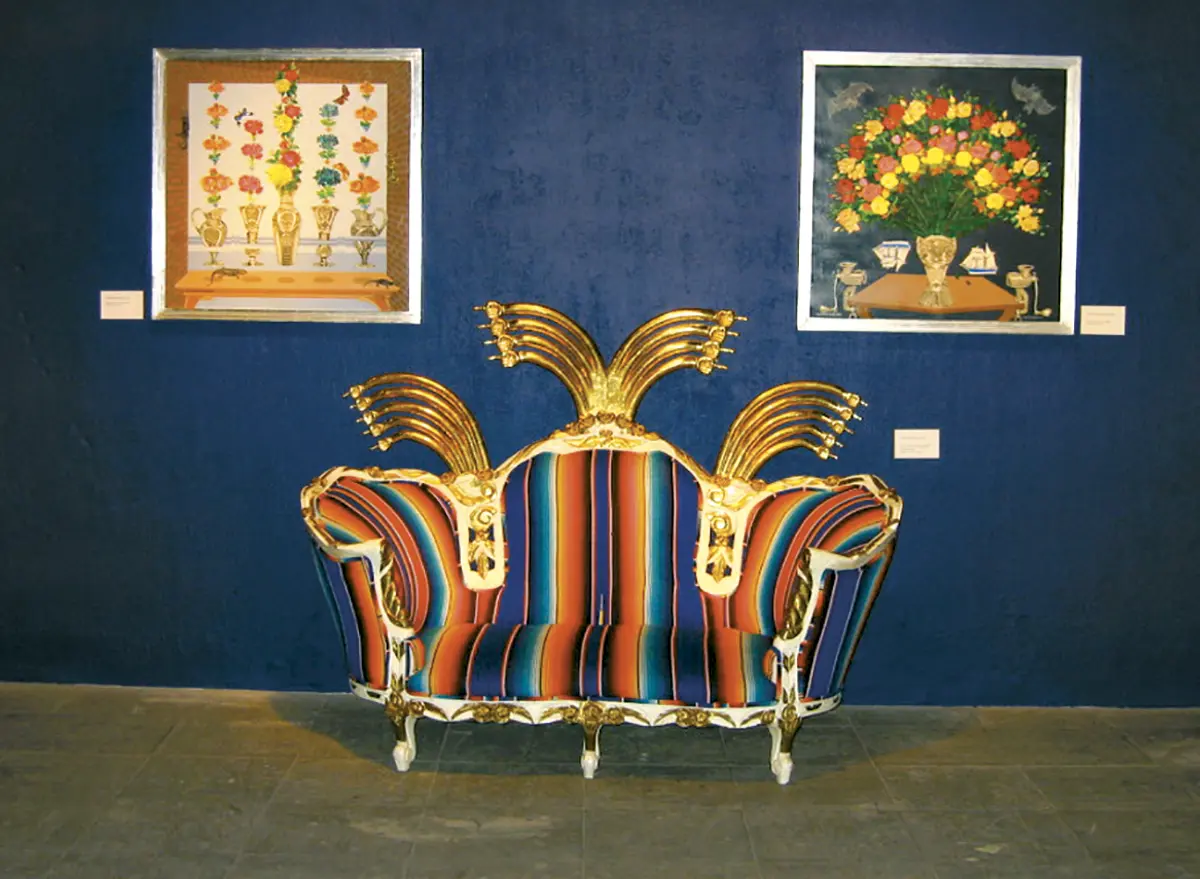
The artist’s eccentric creativity is not shallow. Friedeberg is an intellectual who does not follow the fashions of the day; he follows only his ideas and is unique and artistically opinionated. His works are appealing not just because they grab attention but also because he has something to say, something to bring together, or something to confront. This is how the hand/chair emerged. The richness of Friedeberg’s work offers playfulness to the viewer. In his labyrinthine paintings, prints, and drawings, the artist reveals his education as an architect. The ability to trace lines, while inventing and reverting perspective, creates an interesting vision inside a closed space such as Mundo Cuervo, or any other museum or gallery. Integrating the pyramid with the ziggurat, the serpent as mythological and comical, and the Parthenon with the Tower of Pisa, Friedeberg also creates complex trajectories in the outlines of his works. In the gallery, a predominant square format alternated with rectangles and with the aforementioned irregular formats that appeared as reliefs rendered in wood. Toward the inside and toward the edges of his paintings, the baroque was in full splendor.
The world described by Friedeberg is a baroque and surreal illusion, one that can be compared to Escher, but the foundations of the two artists’ works are very different. Friedeberg’s work covers several worlds, not only that of the graphic arts. He develops the positive/negative minimally and is an exceptional colorist, as confirmed at the Mundo Cuervo exhibition. Among his resources are designs or patterns. Friedeberg describes Mexican reality on the basis of the popular and the urban. He is an avid reader and conceives the integration of the intellectual with the quotidian, assumes challenges, above all the challenge of being original, and is consistently critical in expressing the incoherence of the world. He creates and recreates icons, includes Pop Art, works with the human figure, animals and insects, incorporates the force of liturgies from various religions, and appreciates wood and paper as his most frequent supports.
It should be noted that Pedro Friedeberg used quotations and appropriations before they became popular themes of artistic practice. Something similar occurred with his performances and installations. Being an early forerunner of aesthetic movements is an appropriate description for Friedeberg, the most beloved disciple of his teacher Matias Goeritz, who also was ahead of his time. Alongside Goeritz, Friedeberg traversed the territories of an elegant irreverence, and he continues on the same path. The mocking tone, the delicate irony, the ornamental, the Egyptian, the imperial—all coexist with ease in Pedro Friedeberg’s work. He is unorthodox in terms of his techniques; this is why many of his prints are not colored by hand, being numbered base originals that become unique works. In contrast to the singular aesthetic irreverence he brings to bear as a brilliant character on the cultural scene, he has created an ironic language of mundane decorations. The torso of a mannequin, dressed with medals and carefully coiffed, interrupted the solemnity of the gallery.
Each year, the Cuervo company invites a different artist to create a limited-edition box; Friedeberg’s brings together drawing, architectural plans, and buildings. The box he created for Tequila Cuervo is the synthesis of the development and integration of a contemporary and timeless oeuvre. Mundo Cuervo is a touristic and cultural development promoted by Juan Beckmann in what used to be a tequila manufacturing plant. There are stores, galleries, and workshops teaching three old techniques: silverwork, traditional embroidery, and ceramics. There are also two museums, the Museo de Arte Popular and an old colonial-era house devoted to collecting and exhibiting contemporary art. By choosing Pedro Friedeberg, Gómez Maqueo, the director of Cuervo Cultural Promotion, selected an artist who understood the conjunction of an ancestral European family with more than one hundred years of Mexican roots, who integrates the cultures of the world within the national space, and who has offered one of the few exhibitions where high creativity is not associated with tragedy but, rather, dresses in humor. The exhibition was a constant toast.
GRACIELA KARTOFEL