
At the renewed La Cuadra Gallery in Caracas, the exhibition Recent Works by Alfredo Chacón, comprised thirteen acrylic-on-canvas works. The set made it possible to review the artist’s production of the past two years. In this show, Chacón exhibited continuity in his artistic exploration, which has been committed from the beginning to an idea of painting that is openly differentiated from traditional categorizations.
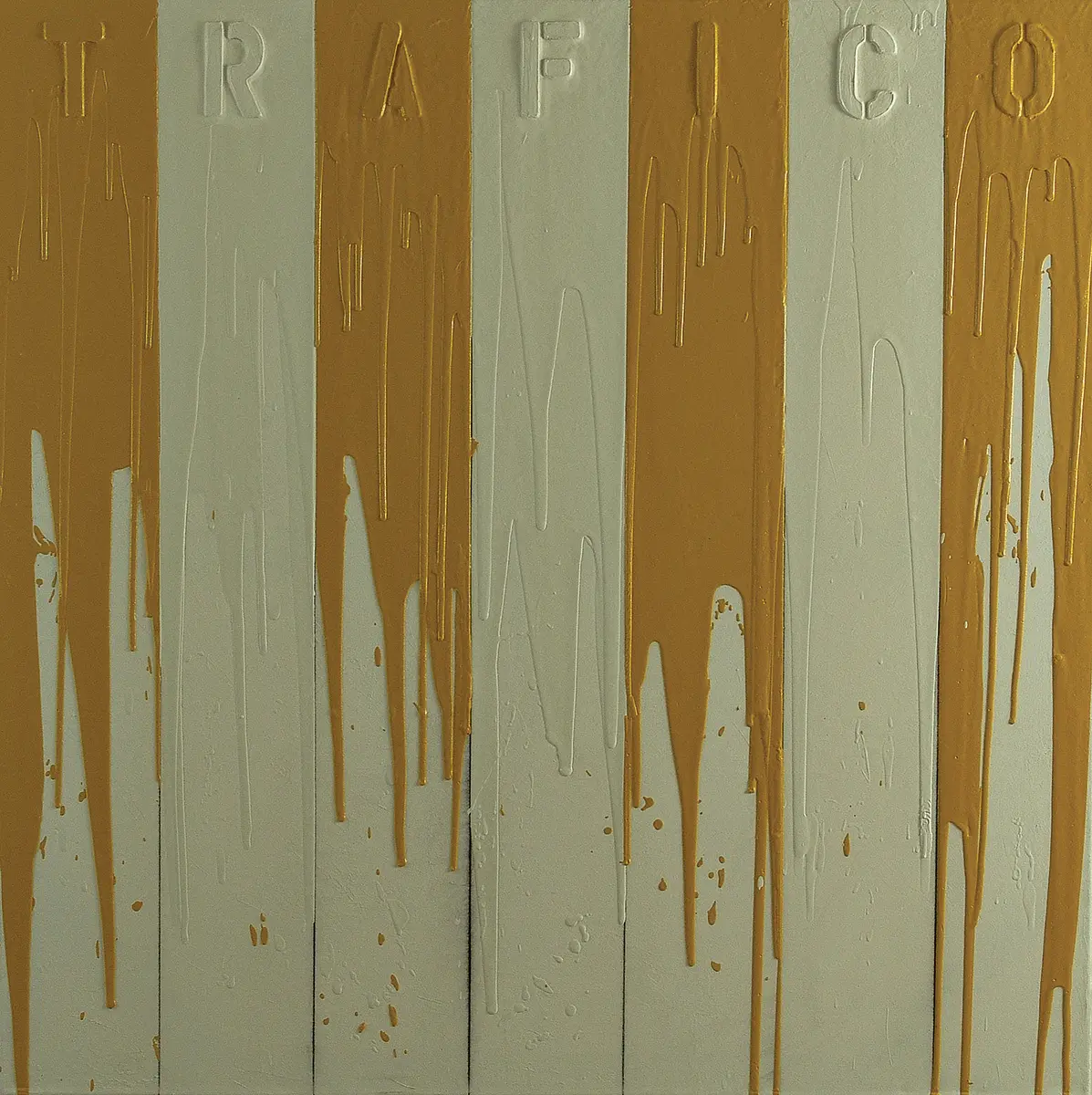
Beyond his important work in design, Chacón’s trajectory exemplifies a kind of painting that reveals itself essentially, as painting. That is, it is an expressive resource devoid of emotional and subjective valuations, a craft in which the creator assists, as if in a ritual act that is ancestral and eternal, in the unique revelation of form on the support—usually a canvas that has not undergone any special treatment before the application of color. This notion of making art, in broad terms, responds to the ideas developed in the 1950s by Clement Greenberg, for whom “painting should discard everything except for the borders of the support, the properties of the pigment, and the bi-dimensional character,” which are, indeed, the visual values sanctioned by Chacón as fundamental to his work. The preeminence of the plane given by the regular, generally square shape emphasizes bi-dimensionality, and a palette restricted to white and black and the tonal scale, to which Chacón occasionally adds primary colors, completes his tool box.
But Chacón has committed himself not only to painting as a craft in which formal components count but also to abstraction as a language that dissociates the pictorial event from the dramatic and emotional contents of the figure. From this perspective, Chacón can be considered an active militant in the most radical language of the visual, which he explores from a variety of angles. One is guided by rigor, balance, and rationalism of geometry, and another is marked by freedom and expressivity that is not dependent on the gesture but derive from matter itself, in an act of de-personalization that places his work within the framework of conceptual art. In a work that illustrated the first angle, Serie Karuko, the reticule became the form’s organizing principle, the plot that regulated the presence of chromatic matter, the generating model for a space that was not made evident but was nevertheless suggested or announced, at the same time as its utility was negated in a medium that openly proclaimed the dominance of bi-dimensionality. In those precise spaces, outlined by the encounter of horizontals and verticals, black was contained and remained inalterable, but it was an accumulation of contained energy that “struggled” to free itself. In other instances, Traffic painting (Pinturatráfico 1 and 3), the reticule dissipated, was extended, and became a linear regularity that left behind the orthogonal posture to make space for the dynamic of a greater angularity, an intention that “overflowed” from the work’s format.
Breaking the regularity of geometry, an undeclared informality was on display in the other line of Chacón’s inquiry and confronted the creator’s intention with its freedom; what was pre-established as a fundamental reference was the result of a rather aleatory, spontaneous act. The artist still guided and regulated it, but its shape did not depend on him, it was subject to material “action,” its fluidity or pastiness, and chromaticism. In Finished, for example, the dense “drippings” that formed a kind of theatrical curtain along the upper part was organized according to a vertical structure of columns that compartmentalized the surface of the work. A controlled informality resulted, managed in its descending performance toward results that the artist often anticipates but cannot expect. In Reinhardt, a work that could be understood as a tribute to the American artist, based on its rectangular bands and the use of values within black that fell on the raw support, one discovered that there were borders in the dense layers of dark paint that dominated the upper section. In other works, such as Unfinished, the black color was invaded by an intense yellow, creating a strong vibration between chromatic antagonists.
In the context of the continuous controversy that modernity has made of painting, parallel to the contemporary languages of the visual arts and despite the significance of its proposals, Sigfredo Chacón’s work has not achieved the popularity it certainly deserves. The proposal, however, is there; it has remained important and persistent, and it joins the many important contributions by Venezuelan creators to twentieth-century art.
FREDDY CARREÑO