
It is rather uncommon these days for an art exhibition to distinguish itself for its beauty and refinement. Zulema Maza’s position, already seen in her earlier prints and installations, has always been to suggest reflections filled with complexity and acuity. Aside from their evident power of seduction, her current works prod the viewer who is forced to abandon any banal interpretation and enter the labyrinths of an indeterminate but deep connection to our times.
Through exceedingly harmonious images, the disquiet and conflict of today’s world seep through unexpected paths. Do women and nature continue to exist symbiotically in defense of elemental life, as in Maza’s work in which woman and grove fuse together? And why is the greenhouse, also devoted to saving a life, menacingly covered in a tragic relationship of hiding and death? The garments that cover or replace the elegant and empty bodies—the phantasms of artificially beautiful, distant, and almost unreal women so absent from today’s tragedies—nevertheless display Jewish, Arab, and Christian designs. These are two opposite worlds, implied by means of subtle allusions. They seem to float in a parallel space that leaves out pain and blood.
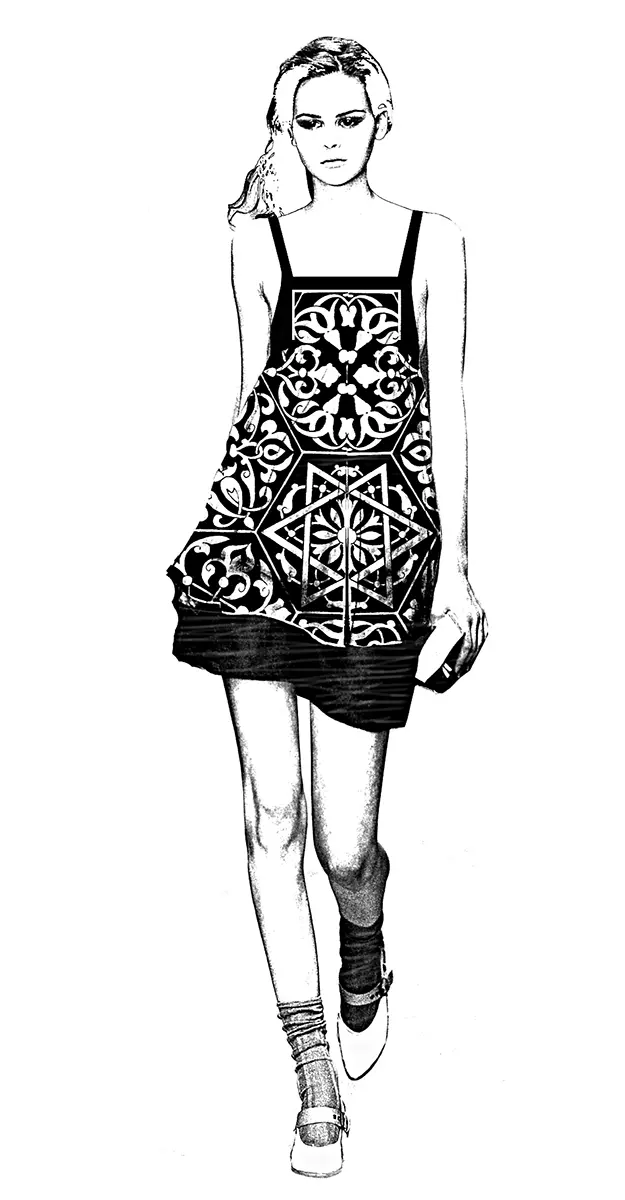
The artist’s technique, which is as much photography as it is printmaking and drawing, modifies the intensely gazing female faces. Maza underlines the importance of breasts in a society that values the caricature and the quantitative and has no qualms in sacrificing women to that model of beauty.
Maza fascinates us with what fascinates her. The mother of three women as modern as they are different from each other, she is always bewildered and always analytical, discovering new and different facets of femininity. She attempts preservation with her affection and defines herself by defining them. In proposing a detour of the gaze from the merely formal, Maza attempts to conjugate the poetic with her experience of today’s women’s struggle between professional accomplishment and the demands of splendor, beauty, and youth.
This show is arranged like a large installation; with its proposal of trajectories and readings, it generates a very special climate. The exclusive use of whites, blacks, and grays contributes to a feeling of entering a beauty-filled realm that is nonetheless distilled and makes no concessions. This artist does not admit excesses. The terror of the sinister invading the greenhouse as a source of the endurance of life is minimalist and rigorous. The sensuality is intellectual and distant. Maza argues in favor of the possibility of stopping in the face of beauty, levity, and grace, even in the midst of the devastating atrocities of the day.
NELLY PERAZZO