
From May 16–28, 2006, MALBA received a great exhibition titled Alfredo Volpi. 50 años de pintura (Alfredo Volpi. 50 Years of Painting), an exemplary anthological selection that brought together more than 80 works of one of the essential figures of Brazilian esthetic modernity, with truly expert and erudite general curating by Olívio Tavares de Araújo. It is noteworthy that the first foreign tour of these pieces by Maestro Volpi (Cabe Lucca, Italia, 1896–São Paulo, Brazil, 1988) was organized by the Museo de Arte Moderno de São Paulo (MAM-SP), given that the works had been previously exhibited in their original setting from April 5 through July 5, 2006 5 under the title of Volpi. La Música del Color (Volpi. The Music of Color).
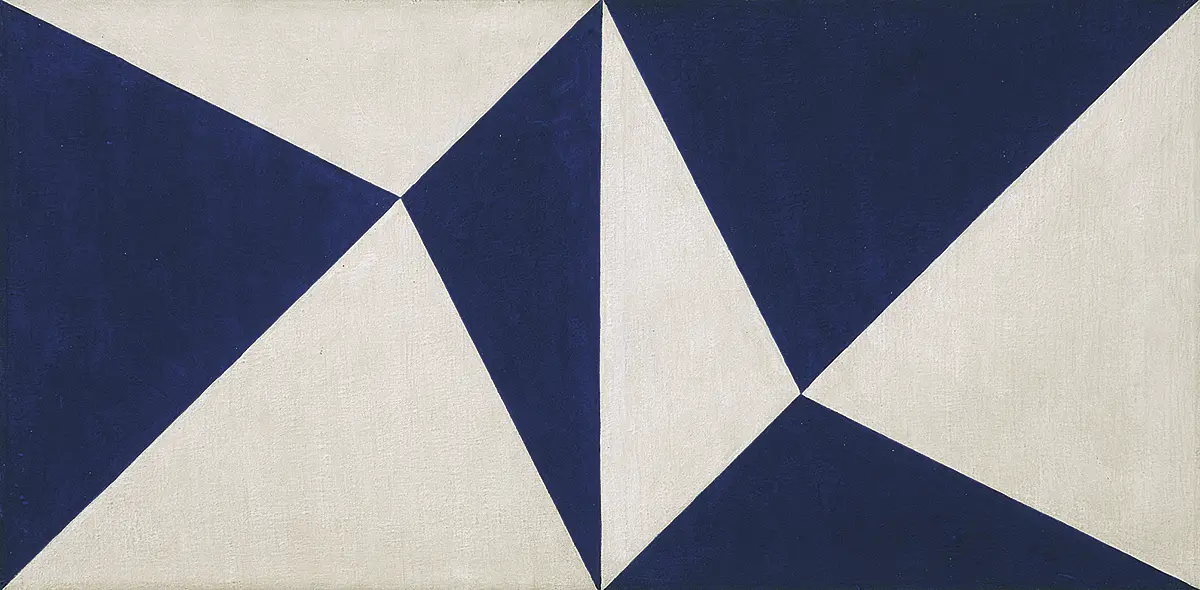
The body of exhibited pieces, on this new occasion is divided into sub-series that initiate from the decade of the 1940s, through the artist’s thematic cycle of oil graphic pieces on the landscapes and marinas of Itanhaém, later to pursue tempera paintings devoted to a most particular iconography of religious themes and motifs, naïf in appearance, such as figures of Christ, madonnas, children, young women, and townswomen. He continued with his operistic complex of homes and celebrated façades that come to introduce the artist into the coordinates of a geometric abstraction, unique, very sui generis, of his 1950s concrete period. Later, pieces can be appreciated that contains his famous portals, which exhibit colorful banners (bandeirinhas, banderitas) dating from the end of the 1950s, in which this iconic reference is solely employed by the artist as a formal excuse to achieve a novel manner of spatially organizing the bidimensionality of his pictures. From these frontal constructions to the concretist phase, with singular works like Composición en azul (Composition in Blue) circa mid-December, 1950, and Composición en rojo (Composition in Red) circa late December 1950, Maestro Volpi would advance toward the final syntax of his works of the 1970s and 80s. But it would be fundamental that the series of concrete pieces reveal certain hybrid behaviors that do not follow the platforms of expression typified by the majority of the generic aspects in the framework of this type of opus, but rather, completely contrariwise, they tend to become assimilated into the vital and intuitive condition marginalized by the very persona (prósopon) of the artist, with a prolific production of varied typology. In this regard, the passage through this type of operation in the visual language, abstraction as purely lacking in reference, constituted for Volpi a process of liberating ascesis, which can be likened to a transitive experience. On approaching the peripheral nucleus, where the transmission of the concrete and neoconstructive vanguard was found diversified and expanded, Volpi’s artistic praxis would later appear converted into naturally spontaneous and lyrical esthetic substance.
On target, Tavares de Araújo underscores that Volpi’s work “is born figurative, becomes abstract, again figurative, but this time passing on to conceive the same figuration in another way”. In this regard, it is interesting to point out that the poetics of this artist of the Group of Santa Elena is “read” in the form of a mixture of signs, with inserts dilated in time, these supplying very proper and personal elements and norms for the same logic that the artist converts into “his” system of painting.
His models of reference or mixed paradigms obtain from cenacles, groups, movements, associations among artists, creators, and intellectuals of all kinds. All these contributions imply a fine assembly of poetic experimentations constructed at the foot of the easel, of the artist’s “office”, but always with the intent of promoting consolidated standards of independent and very original behavior. The well-known phrase of Willys de Castro, the eminent figure of Brazilian vanguard concretism, sustains that “Volpi paints volpis”. This is true because the artist was never invited to be an official member of the Brazilian Concrete Movement, although he did participate as an invited artist at the National Exhibitions of Concrete Art of São Paulo in 1956 and Río de Janeiro in 1957.
The desideratum of grasping, exposing, synthesizing elements of the real world by means of the narrative space, which is also synchronic, has been one of the great concretions of Alfredo Volpi. Thus, his reformulated paradigm overcomes the antinomies, the influential methodologies in that so-typical landscape that runs from the theoretical postulates to the sensitive application of ideas, sifted through the sieve of his proverbial sensitivity for the paintbrush, almost velvety, as can be detected in works such as Composiciones con Banderitas con Ogiva (Compositions with Banners with Ogiva) (circa December 1970). The work comprises four monumental temperas on a canvas 136 ◊ 67 cm in size, in which essays of blue, red, and high- and low-grey monochromes are mixed together, like mosaics with pregnant colors that penetrate the color pathway in the conformation of new senses for the discourse of modern painting. Here, abstraction and figuration dissolve into a cooperative kind of relationship that extends further than the simple inventory and systematic description of the codes to which the artist arrives for operating on the canvas.
Volpi has known, perhaps as no other artist of Brazilian modernity has, how to understand the different “signals of time” that was his to travel through.
CLAUDIA LAUDANNO