
It was a festival of fairs: seven—count them—seven art fairs in five days, hundreds of galleries, and thousands of artists. But remember Pablo Helguera’s argument, that art is an “entrepreneurial religion.” This was a corporate festival. The art gathered here reflected on sales more than contemporary culture. The less market-friendly collectives and post-colonial discourses that define a large part of the emerging contemporary art world had no voice. Latin representation was low, although the good news continued to be the integration of Latin artists into the mainstream art scene. A quick survey of the almost 2,000 artists at the Armory Show revealed that around one hundred Latin artists (or five percent of the total) were distributed among many galleries. Maybe that’s why it was harder to find the critical edges that so much Latin art presents.
The Armory Show
The major venue was newly unified onto one Hudson River pier, and it was the most publicized, with thick crowds and lines several blocks long. With 52,000 visitors and total sales in excess of $85 million, the fair had a surprisingly large, the young crowd who did not buy but treated the fair as a serious cultural event, not simply as a place to be seen.
The fair was dedicated to new art by living artists with approximately 150 galleries from thirty-eight international cities and twenty-two countries with another 400 gallery applicants not juried in. Around half were from Europe, with most from the expected centers of Berlin, London, and Paris. Thirty percent were from New York City but, with another eleven percent from outside the city, the U.S. galleries totaled forty-one percent. There were surprisingly few Latin artists among the twelve Los Angeles galleries. Only one gallery was dedicated to Latin art, Enrique Guerrero from Mexico City.
Most of the work was characterized as “very been-there-looking,” meaning that well-established artists and trends continued. The large amounts of photography celebrated traditional modes of portraiture, landscape, and fiction with less fantasy and more edge than previous years. The small, imagined fantasy worlds seemed to shift from escapism to warnings.
Formalist art (never dead) returned, often through abstraction, with nature and science (and likely the tastes of the art market) as sources. I liked it best when there was self-conscious play in the work. The Gering & López Gallery mounted a green lightbox by Leo Villareal opposite a green acrylic field painting by an older Spaniard, José Ma Yturralde, which very neatly probed the modernist questions of aesthetics, absorption, and spirituality.
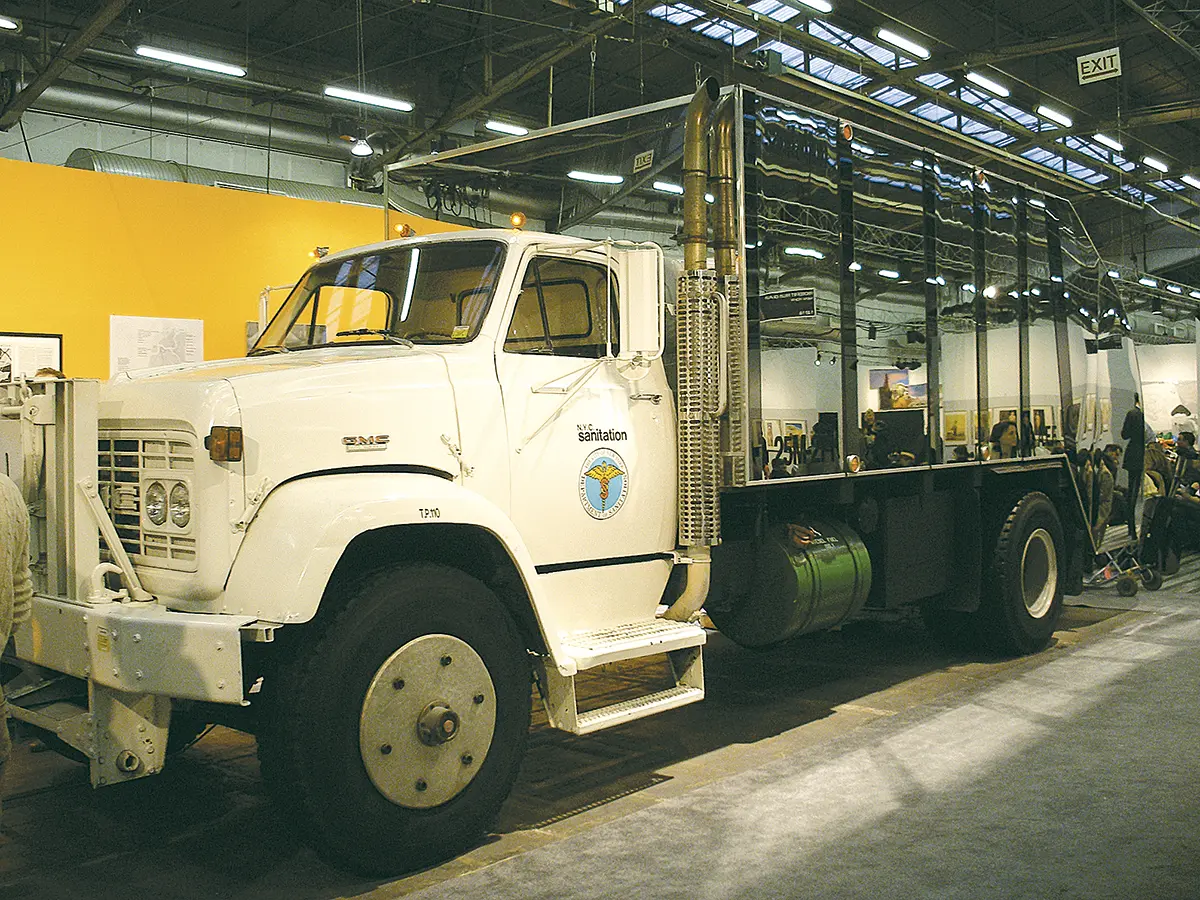
The many individual artist displays worked best as installations. Yayoi Kusama’s 120 boxes of stuffed fiber phalluses covered with polka dots (Repetitions) created a wall of stares and pokey fun at the Robert Miller Gallery. Parked literally opposite was the most sensational and most reported piece: the large (twenty-five ton) New York City garbage truck covered in hand-fitted, tempered mirrors by Mierle Laderman Ukeles at Ronald Feldman Fine Arts. The title Social Mirror spoke of the intent, and sanitation workers were available for conversations with the public, along with the artist.
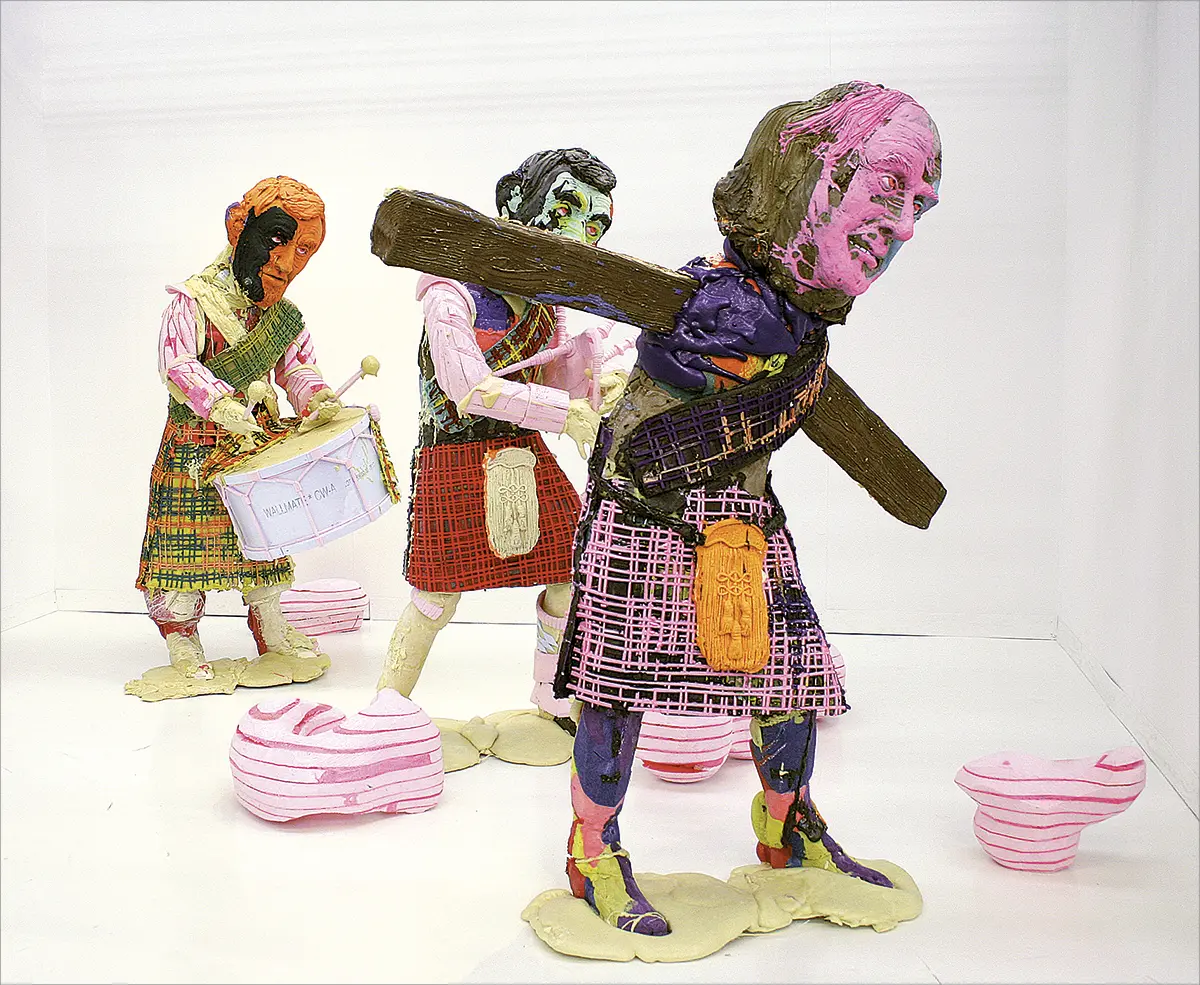
At Galerie Enrique Guerrero, Enrique Jezik’s Practica struck home with ten life-size shooting-practice silhouettes of black paint on white wood, each with five shotgun blasts through them. At the same gallery, Pablo Helguera, another specialist in social unrest showed sample collages from his Pan American Suite; they addressed the realities of life around us, like little postcards that bombed the brain. The Dutch artist Folkert de Jong’s life-size figures, The Death March (at James Cohan Gallery), had the historical faces of American freedom—Abraham Lincoln and Benjamin Franklin—and limped under the weight of a decidedly contemporary and unheroic historical burden, like wounded ogres in confectionary, expressionist colors.
The Art Show
(Organized by The Art Dealers Association of America)
The upper end of the art market was palpable in the seventy galleries here, ranging from late nineteenth-century American Impressionism to early European modernism to a solo show by Anish Kapoor (at Barbara Gladstone) and new works by Kara Walker (at Sikkema Jenkins). This fair featured a wider aisles, more space, fewer crowds, and it was so quiet you could hear the dealers on their cell phones.
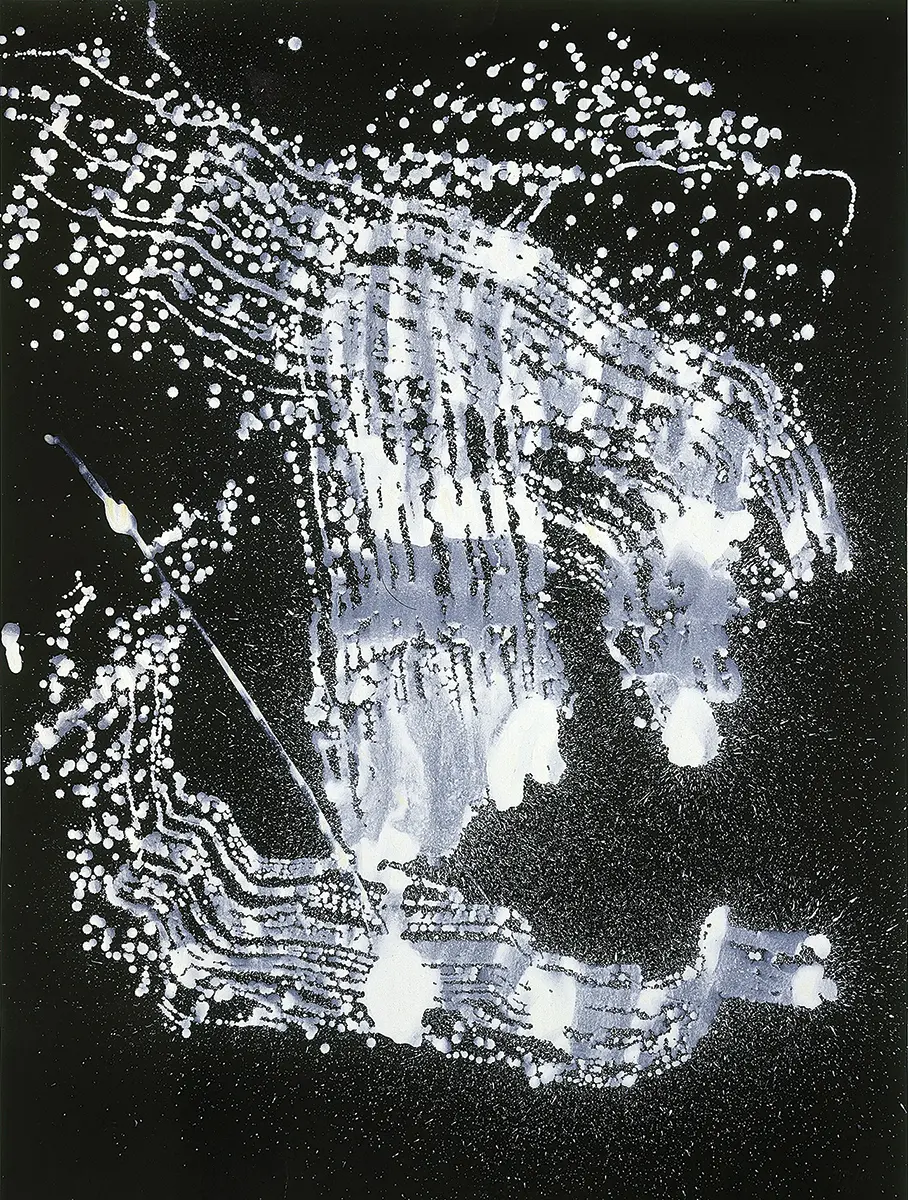
As with The Armory Show, the numerous solo shows (thirteen to sixteen) were a new development, often with spectacular results, such as the large, boisterously fluid, and layered paintings of the London-based Taiwanese artist Suling Wang at Lehmann Maupin and the large, abstract white gestures on black paper from 2006 by Sigmar Polke at Michael Werner. Whether Wang’s works truly reflect socially destructive forces at work or if Polke is still relevant, I leave the judgment to each viewer. But they testified to the return of beauty and splendor. By the same standards, the seven-feet-tall, gilded bronze Diana from 1886 by the Irish-American sculptor Augustus St. Gaudens (1848–1907) was posed in front of Conner-Rosenkrantz, which provided a nice counterpoint to the nine-feet-tall Mr. Pointy by Takashi Murakami at Greenberg Van Doren.
Thematic exhibitions were also prevalent. Lillian Heidenberg mounted a survey of contemporary Chinese paintings and photographs. Mary Anne Martin Fine Arts were about the only place one could find Latin art and it was classic modernism: drawings by Wilfredo Lam, a very nice Tamayo painting, a Kahlo watercolor, Siqueiros, and six Riveras, one of which was remarkable. Suburbs of Paris (Draveil) (1918) demonstrated a turn to Cézanne, but Rivera rendered the Frenchman’s lessons of transparency in his watercolors as highly colorful planes of oil. The sand-cast glass pieces by the Panamanian Isabel De Obaldía (born 1957) were too romantic for my taste but are valued by many for their fusion of expressive color and spiritual power.
LA Art Fair
This fair’s focus is on the Los Angeles community of established and emerging artists. There were several but not many of the best-known West Coast artists represented, and there was an opportunity to examine many lesser-known artists. Unfortunately, one might conclude from the representation that it is very little or no Latin art emerging on the West Coast. Thankfully, OMR from Mexico City was present.
West Coast funk was everywhere, beginning at the door, where a twenty-five-foot-long wall of drawings by fifteen artists greeted the visitor. Mounted by the Daniel Weinberg Gallery, they ranged from Robert Crumb’s psychosexual comics to Alan Saret’s abstract watercolors. There was not much evidence of the West Coast abstract color school of painting so heralded in the 1990s, but the luminous abstractions of Ed Moses, the long-standing secret of the West Coast, were abundant. Tony de los Reyes’s Approach (2) at Carl Berg Gallery was a gorgeous color field diptych of bister on paper; its romanticism was offset by its source in Melville’s novel Moby Dick.
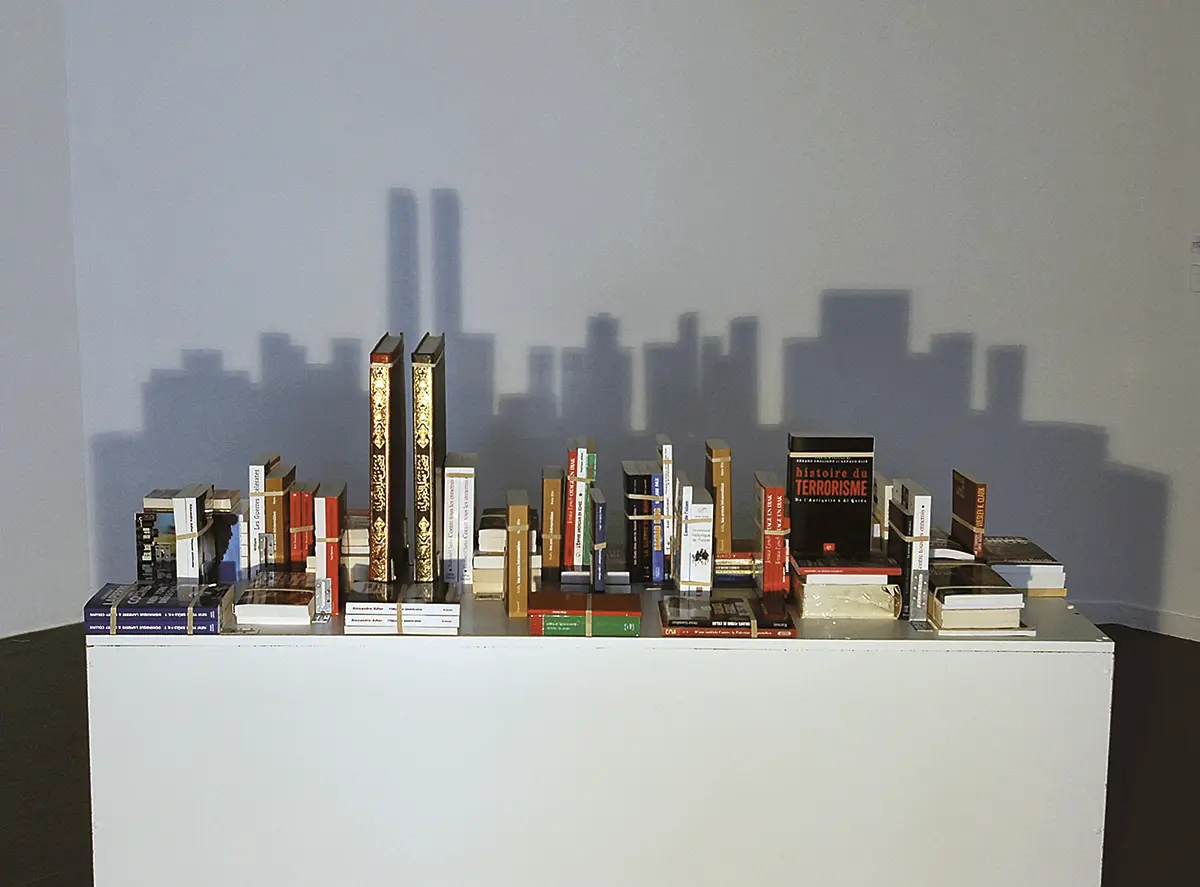
The fantasy school was everywhere, selling well, from fantasy for delight in Erin Marie Dunn’s work or morphing into dystopic destruction, as in Nathan Redwood’s acrylics, both seen at Carl Berg. I liked it best when the imaginative was applied to social realities, as when Ruby Osorio’s gouache drawings and paper works (at Cherry and Martin Gallery) correlated her use of ephemeral media to a journey of liberation through female fantasy. At Shoshana Wayne, the Morocco-born Mounir Fatoni led one’s imagination with his conceptual work Save Manhattan; he stacked a table of books dedicated to the terror and horror of 9/11 around two large Korans and lit them so that the wall shadow presented an image of the Manhattan skyline with the twin towers restored.
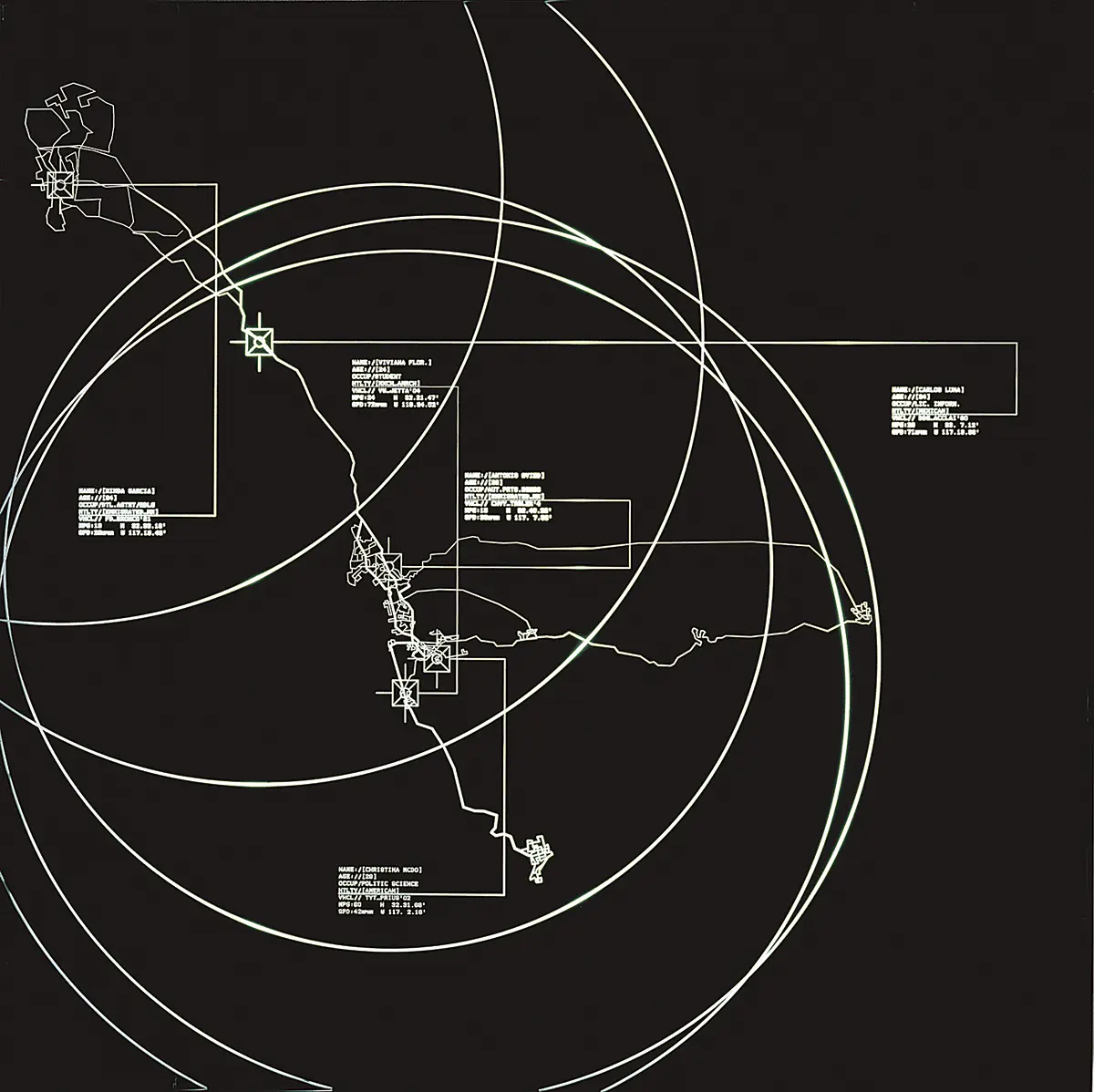
Torolab’s (a.k.a. Raúl Cárdenas) Síntesis (at OMR) was a black-box diagram with overlapping circles on maps; printed data traced the lives of five people—one American, one Mexican, one Mexican American, and two immigrants—as they traveled between the U.S. and Mexican borders wearing pants with special sensors that the artist designed. The relevancy of the border was both real and non-existent, and I kept thinking of Carola Suárez-Orozco’s writing on the difficulty of formulating identity in a globalized world. A different light was cast on the topic by Rafael Lozano-Hemmer’s Extremity (also at OMR), using an interactive software screen that carried small (less than one square inch) images of people gesturing at the viewer, arranged in rows of twenty by forty for a total of 800 individuals. As you passed in front of the screen, the surveillance camera used your body’s form and position to highlight certain people while others remained darkened, leaving you to ponder your movements in relation to the world.
Scope
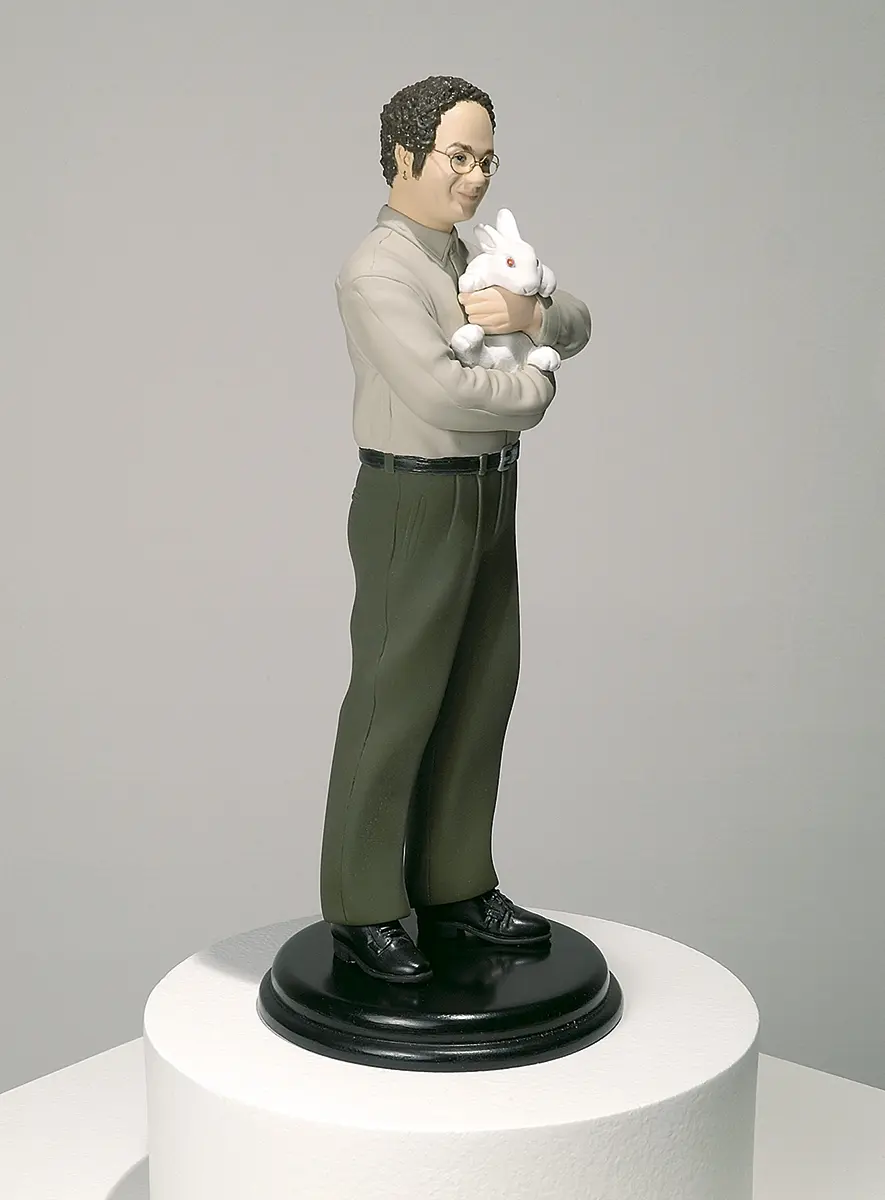
Advertised as an alternative art fair for emerging artists, Scope has staged seventeen fairs since its inception in 2002. Here, sixty-five galleries from twenty countries gathered under a 25,000-square-feet tent behind Lincoln Center. Photography, figurative and narrative painting and drawing, and the influence of media culture were strongly represented. The paintings and drawings frequently shifted from the fantasy escapes of past years to mysterious or foreboding scenes and ranged from loose expression to tight rendering, often combined in one work. But there were a few works with a difference. The bio-drawings of El Soca (a.k.a. Adrian Soca Beltran) at Magnan Emrich employed cockroach wings to add to his work’s fragility, and Eduardo Kac (at Ashley Gallery, Philadelphia), best known for his conceptual project of making a genetically modified fluorescent-green rabbit, showed a video and drawings that used the rhythms and abstractions of nature to create form.
Culture on the Verge and Cinema Scope greatly enlarged the range of available art by presenting numerous special projects, bands, performances, and screenings. The emphasis on actions and interactivity with people and within the fair itself was refreshing. Everyone’s favorite was the British performance artist Mark McGowan (at Charlie Smith, London), who as part of a “therapeutic engagement” dressed as George Bush to literally crawl on his hands and knees on the streets of New York for seventy-two hours, wearing a sign on his posterior saying “Kick My Ass.” Lee Wells assembled 1000 videos by over 600 artists from sixty countries and allowed viewers’ votes to decide which works were previewed at the art fair (www.perpetualartmachine.com).
Only a few galleries specialized in Latin artists. Léo Bahia from Brazil was back for his second year because he finds the energy in New York unique, and he reported good sales, changing his display of artists daily. In sharp contrast, Antoinette de Stigter of Art Affairs (Amsterdam) refused to bring saleable objects to better present works dedicated to the most pressing issue of our time: war (and peace). Half of her booth was given to Mary Younakof’s walk-in war-zone installation. Magdalena Fernández (Venezuela) and Tomás Rivas (Chile), recipient of the Scope emerging artist award at Scope Miami 2006, showed with Douz & Mille. Fernández’s two videos continued her recent extensions of modernist 2-D planarity of line and geometric painting into 3-D but now set in motion and time and played against nature. The hard-edged planes in 1pm006 ‘Ara Ararauna change color and movement in relation to the cry - and the colors - of the Amazonian guacamaya (Ara Ararauna). Rivas’s wallboard sculptings carve images of classical architecture from the paper surfaces in order to counter their past colonial weight with a transitory fragility that literally and metaphorically hang there in the balance of present to past. Rody Douzoglou, the founder of this conceptual gallery, is foresighted in fusing the consequences of the digital and physical worlds. Her gallery does not exist as a physical space until such times as she implements it, at occasional temporary exhibitions that she stages and at the art fairs. Difficult balancing act! Wave of the future?

Pulse
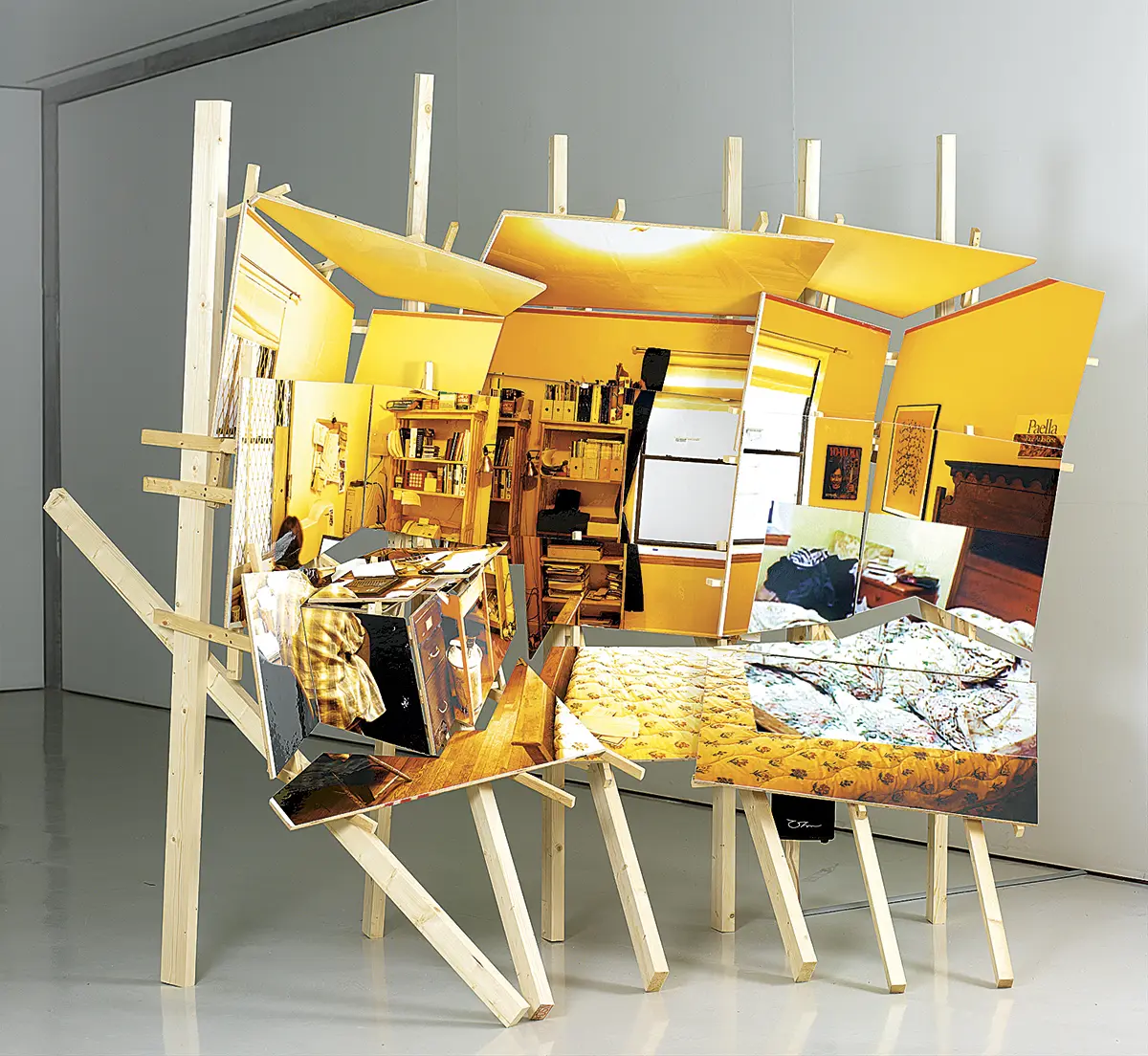
This fair, in its second year, did try to fulfill its promise “to bridge the gap between established and alternative art fairs” with its sixty-three galleries from fifteen countries. Baró Cruz from Sao Paulo was the sole representative from South America. But here, too, Latin and Spanish artists were integrated throughout the fair. Isidro Blanco, the architecturally trained photographer who lacerates and mounts split photos on irregular wooden frames, was shown in adjoining galleries, with Subway with Explosion at DCKT Contemporary (NY) and Side Building with Explosion at Galeria Fúcares (Madrid). His quirky work stood in my mind as a metaphor for the fair; it had more odd bits and pieces than the others. This is where the art students gathered.
Rafael Lozano-Hemmer, who will represent Mexico in the 2007 Venice Biennale, showed documentation (at Bitforms, NY) of his large-scale interactive public art installation from Yamaguchi, Japan, Amodal Suspension; via a website, people could send text messages that were rerouted through twenty robotically-controlled searchlights, turning the sky into a giant switchboard.
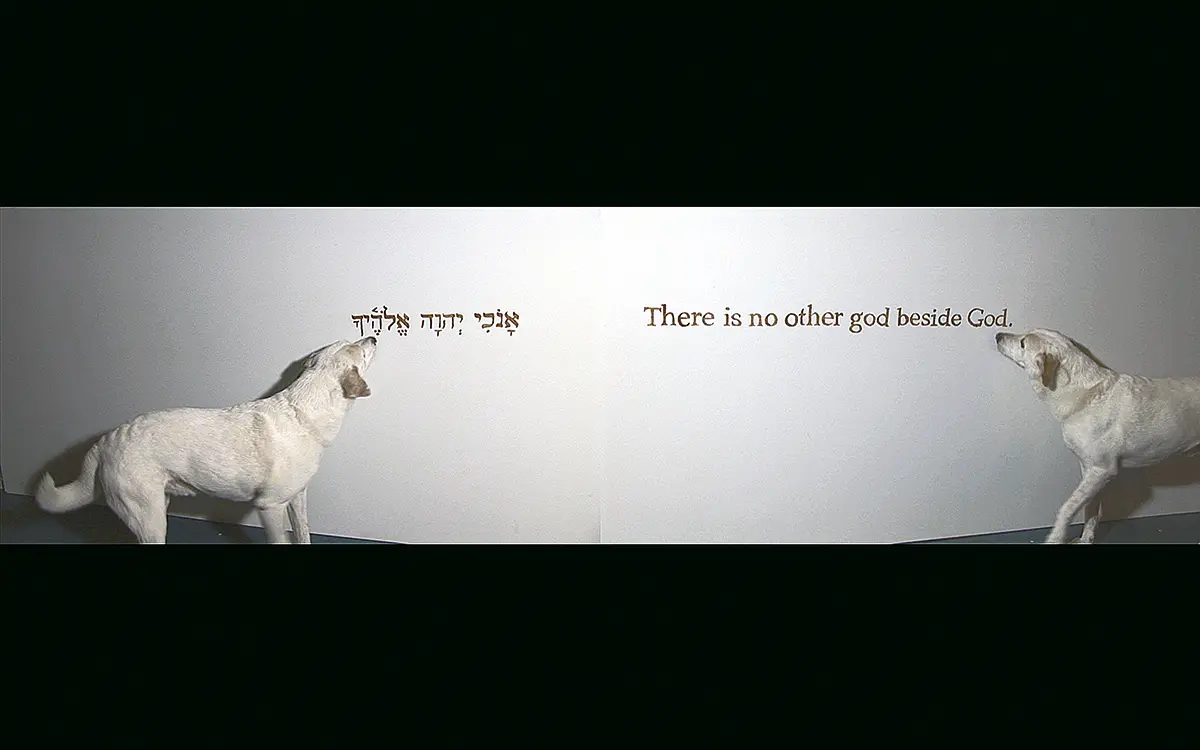
I fell in love with Hung Chih Peng’s video series titled Canine Monk (at Virgil de Voldere Gallery, NY). Peng wrote religious scriptures on a wall with dog food and videotaped a dog licking them off; with the footage played backward, the dog appeared to write the holy texts. “Dog” backward is “god.” When Peng combined texts in translation—say, the Christian Bible in Arabic, with subtitled translations—one was provoked to realize shared simple truths about religious and cultural similarities.
DiVA
The digital-video fair was small and restrained, although it did place ten shipping containers in the streets of New York to show experimental video away from the hotel rooms converted to temporary galleries. Most dealers brought short videos of two to seven minutes in length, but there was often far less information than needed. Unfortunately, this article cannot do justice to the wide variety of works presented. There was a great deal of video incorporated with objects as hybrid video sculptures. I particularly liked the work of the Belgian Hans op de Beeck (at Ronmandos Gallery, Rotterdam). His The Stewards have a Party showed family members slowly walking to join one another in a clinically white environment, donning party hats, holding balloons, and then slowly leaving. Odd moments of normal life were made visible against the sterile environment. My vote for the most enterprising videographer went to the Lebanon-born Yasmine Chatila, who sublet a rear portion of one room to show her own work (which can be seen at www.Yasminechatila.com). Stolen Moments featured re-enactments of the artist’s almost two years of watching people in New York through their uncovered windows, with sound added. Chatila, the voyeur, directed the viewer into a forbidden zone, one now opened by the people who lived their lives in front of their windows. Hitchcock’s Rear Window must have been the inspiration.
Only a few galleries specialized in Latin American artists. Léo Bahia(Brazil) was back for his second year because he finds the energy in NYC unique, and reported good sales, changing his artist's display daily. In sharp contrast Antoinette de Stigter of Art Affairs(Amsterdam) refused to bring saleable objects to better present works dedicated to the most pressing issue of our time, war and peace. Half her booth was given to Mary Younakof’s walk-in war zone installation.
The new entry Red Dot was filled with mostly conservative objects displayed in hotel rooms. I found little of personal interest, but the crowds were both terrific and horrific, meaning the fair was overcome with success and needs to change its future venue to allow more people into the spaces. But remember: The Armory Show began in 1999 in such humble surroundings.
RICH LESLIE
Historian, art critic, and curator.