
The day after returning from the city of Cartagena, I watched a video about Alexander Calder in which it was remarked that he was among the first artists to “intervene in space.” This made me think about the character of the contemporary interventions I had just seen at the Cart(ajena) event.
In conceiving his sculptures, Calder very carefully studied the space in which he was to “intervene.” His conversations with I. M. Pei for the installation of his large mobile in the modern art wing of the National Gallery in Washington are famous; it was evident that the dialogue between the work of art and the architectural space was a vital matter for both the architect and the artist, and the issues taken into account were in large part related to form. Minimalism expanded this dialogue by radicalizing the relationship between form and space so that interest is displaced toward the viewer’s perception; the austerity of minimalist objects interrogates the viewer, returns one’s gaze to one’s own body and the relationships established with the object and space, in such a way that the phenomenological influences the installation. The interventions of Cart(ajena) inherited their logic from these last practices, but with differences.
The event’s curators, the Spanish commissioner Jorge Díez and the Colombian curator José Roca, conceived the Cart(ajena) project as a parallel activity to the Spanish Language Congress that was held in the city of Cartagena de Indias during March 2007. They selected eighteen artists from Latin America and Spain whose work was in some way connected to language and addressed how “the inscription of the individual in the social occurs at the moment in which he has access to language, which allows him to name, apprehend reality, and communicate with others. In consequence, language becomes the territory for an encounter between individuals, a public space, a site of negotiation. And in the same degree, language can be an instrument of exclusion, the manipulation of reality, and imposition.”1
In these interventions, as in Calder’s, the link between the work and the site was essential. The group of artists stayed for a week in Cartagena during October; besides touring the city, they had a series of conversations with historians and sociologists, which allowed the artists to know and understand the spaces in which they were to intervene: “Cartagena’s historical center, which displays all the social and economic virtues and contradictions.” At this point, it is important to understand one of the many displacements that have occurred between modern and contemporary art practices. The city of Cartagena, thanks to its beautiful architecture and its historical value has become an agent of “patrimony of humanity” and a tourist destination of the first order but, beyond its form, it is assumed by artists as a site defined by its cultural and socio-economic marks. The city, in reference to the Language Congress that framed the event, became a large text highlighting its “virtues and contradictions.” Thus, as the curators pointed out, in these interventions, the word was “a meeting point, but also a site for the investigation of communicative possibilities and the limitations of language from a contemporary visual arts perspective.”
The event’s title, Cart(ajena), was itself a linguistic intervention that affected the name of the city, its sound, and its meaning. Here, the work of the graphic designer Aitor Méndez contributed significantly to the construction of the project’s meaning. The signage was based on the textual conventions of a dictionary. Half of the logo, in faint letters like a watermark, was the definition of the word ajena, which refers to otherness, to exclusion, to that which belongs to other people, other classes, and other groups. The word also alludes to acts of renunciation: to be alien to oneself, to be unmoored from oneself or one’s self-esteem, to be alienated from something, to not have news from something, to be excluded, outside something. This renunciation, the otherness, and exclusion can perhaps allude to the various realities that coexist in Cartagena, realities that in a conscious way exclude and ignore one another.
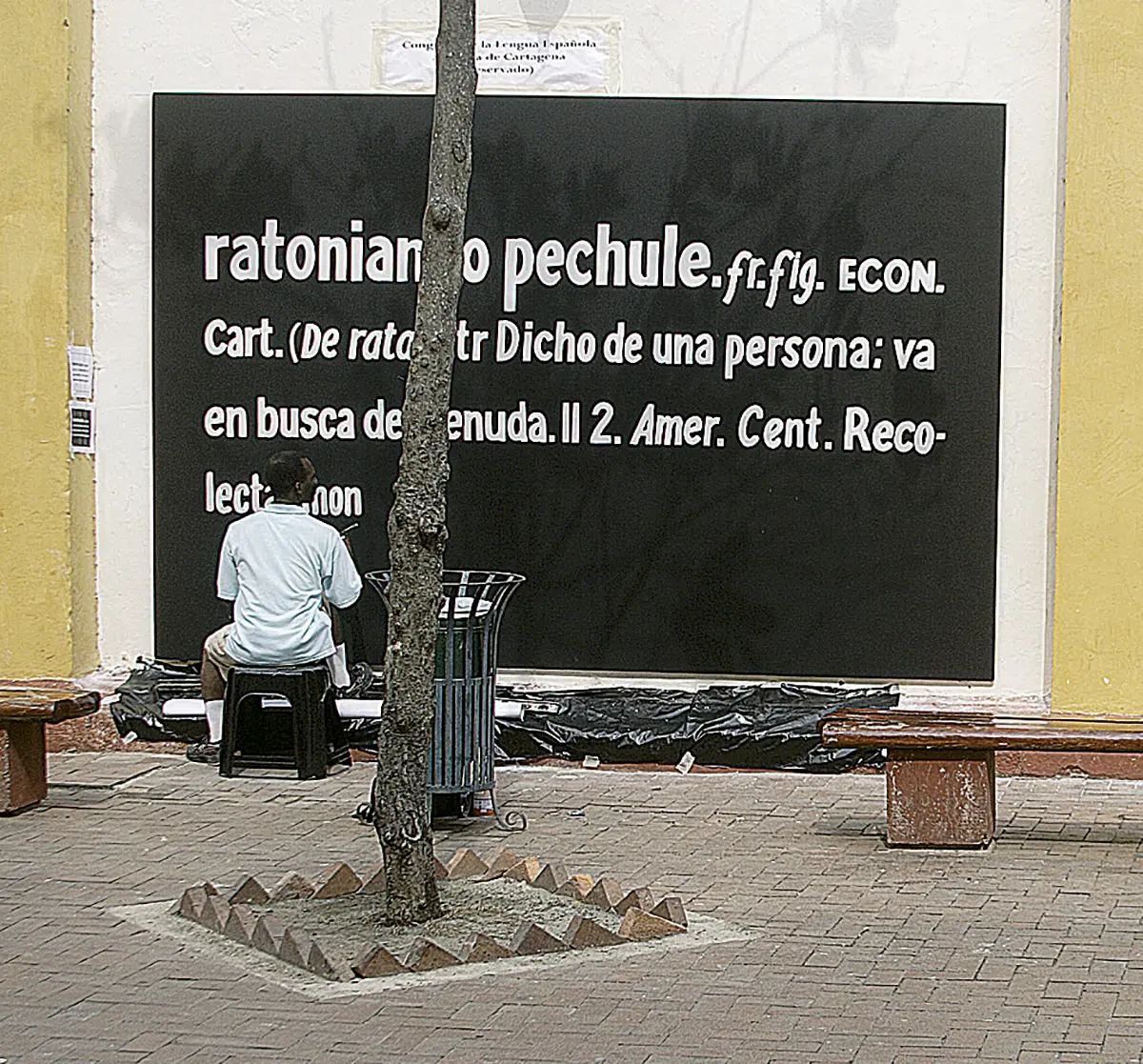
The interventions were connected to the city as a horizon of language. If Cartagena presented itself to the artists as a large-scale text, their works functioned as footnotes, marking voices that are alien to the official narratives and the city’s image as a tourist attraction. One of the most effective “footnotes” was the one presented by Rafael Ortiz and Wilder Sotelo. The former is a Bogotá artist who has lived for years in Cartagena, where he has participated in several collective projects, and the latter is a Cartagena native and a student in the city’s art school, who took part in the Coastal Regional Salon with a work that used images and words. They conceived several interventions on the walls of different city streets. On these, they painted black rectangles and wrote in white letters some local terms alluding to economic situations and the definitions of these terms in the style of dictionary listings. Aguantando cable alludes to a critical economic situation, ratoniando pechule is an expression for somebody who seeks a small amount of money, and mondao y limpio describes a penniless person. Several times, I saw viewers stop to carefully read and even write down the terms and their meanings. This work reminded me of Joseph Kosuth’s definitions for the neutrality of the medium used, the aseptic technique, but, unlike Kosuth’s terms, which came from art and philosophy, Ortiz and Sotelo’s definitions referred to a language that is marginal but widespread among the lower strata of the city’s population, those alien to historic Cartagena’s benefits. Thanks to the artists’ intervention, these voices became visible and present on the city’s walls.
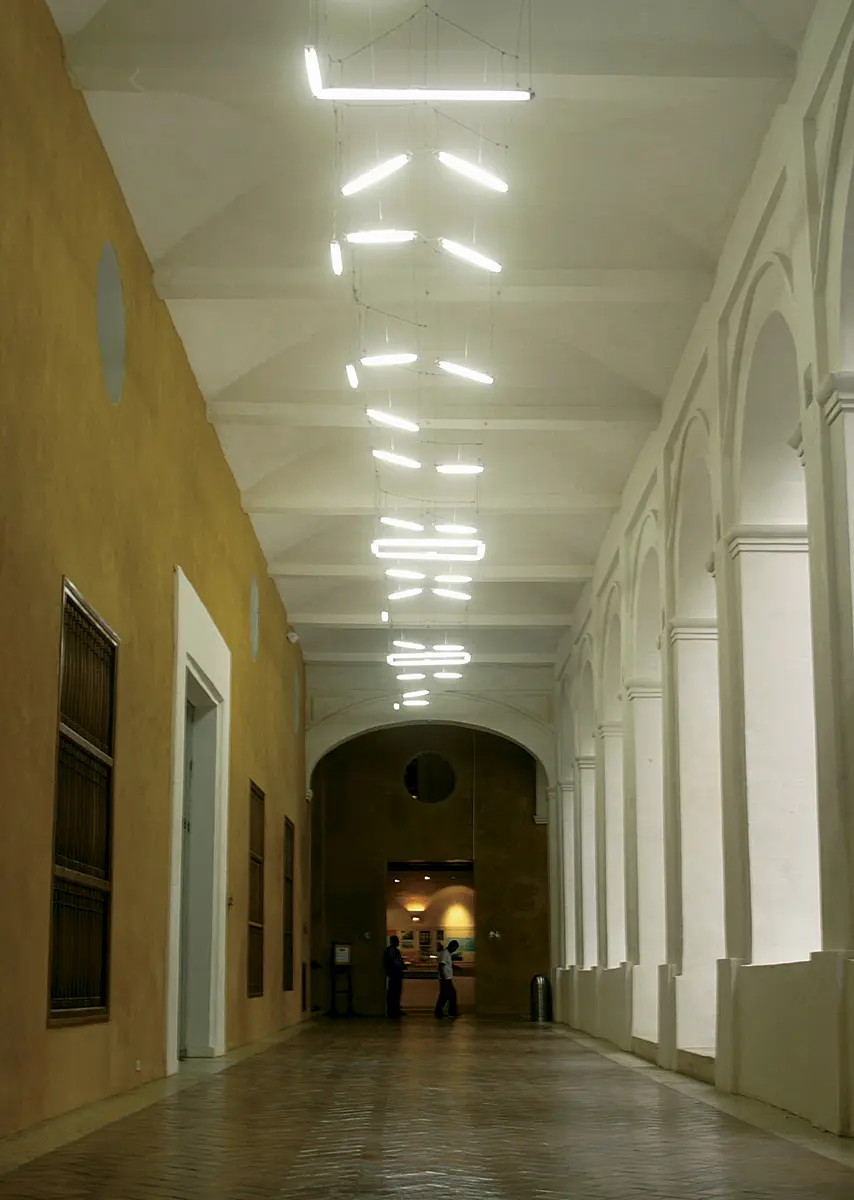
Fernando Santos Castillo, from Madrid, also used the written word in his work. One of his interventions was on a balcony, where he formed with lightbulbs the phrase Todos somos indeseables. This is a highly charged phrase in the context of a city like Cartagena, where foreigners and local citizens are beings who repel one another beyond mere appearances. Ángela Detánico and Rafael Laín, from Brazil, created Braille ligado, which also used light to allude to a different kind of writing, text for the blind. These words were written using fluorescent light tubes, creating a paradox: the term for writing for the sightless that must be perceived through sight.
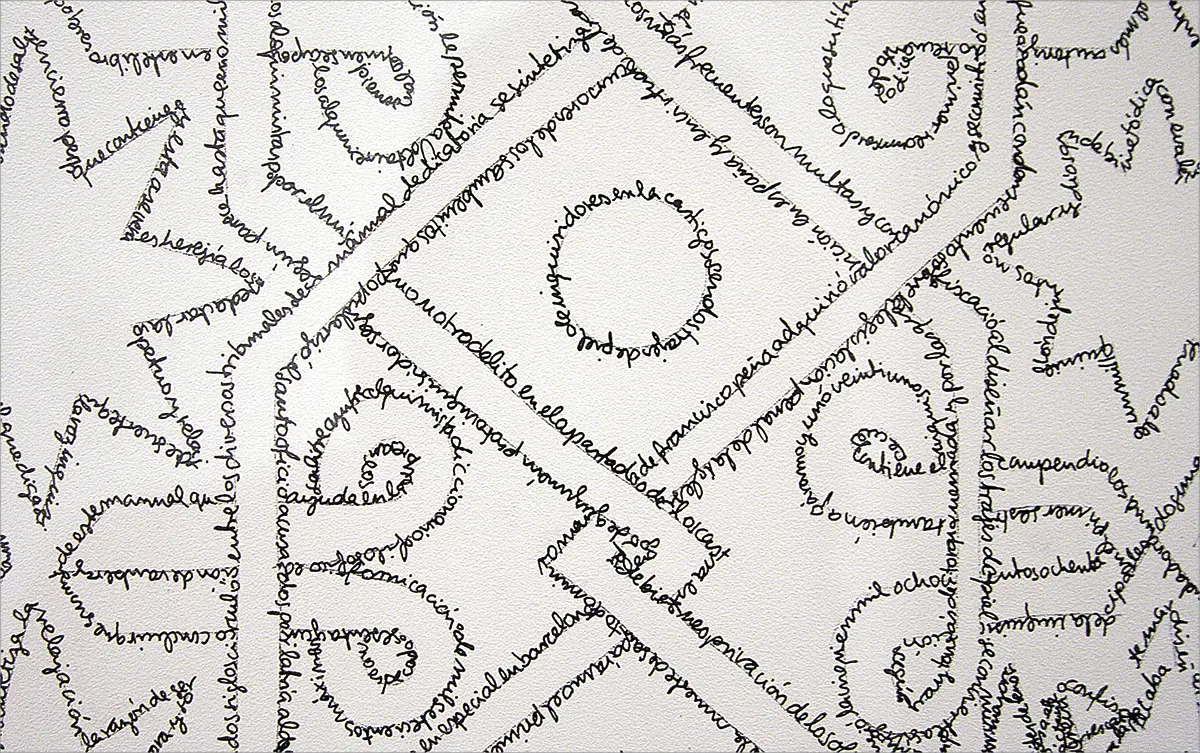
The Colombian artist Johana Calle and the Mexican artist Pablo Helguera intervened in the Museo Histórico or Palacio de la Inquisición. Calle made two points about Cartagena’s buildings with her work Chambacú Abdalá, one of them with small-format ink drawings and the other with wire sculptures. Her drawings referred to the Moorish presence in the historic city’s architecture, by replicating Moorish designs using delicate and very small handwriting instead of lines. These drawn structures broke at certain points; the letters became entwined and generated gaps or discontinuities in the design. The wire sculptures evoked an unstrung, crumbled language; these were small birdcages that alluded to the houses of Chambacú, precarious constructions hidden from view by the city’s visitors. As the curators pointed out, “present in both works [was] the will to introduce breaks and anomalies in the structure, signaling that the apparently well-ordered and rational is loaded with inequities.” Pablo Helguera intervened in the Sala de Indias with a recording: Suite Getsemaní, which could be heard through earphones. The insertion of this work in this site was particularly interesting, and it prompts me to reiterate the idea of the footnote. The recording was placed next to a panel and a painting of St. Pedro Claver. The panel explained the African influences present in Cartagena’s culture, gastronomy, and music, and the painting depicted the saint blessing a black child, beatifically welcomed into the Catholic religion. Helguera’s project presented a different face of history, according to the curators: “For several years, Pablo Helguera has assumed for himself a singular task: to preserve languages that are in danger of extinction because the human groups who speak they are forced to learn hegemonic languages in order to survive... For Cartagena, Helguera recorded sounds, voices, and interviews in the low-income district of Getsemaní.”
At the Art Cartagena gallery, the Spanish artist Isidoro Valcárcel Medina erected a sound column, a black speaker that reached from the floor to the ceiling, from which several voices of different origins emanated while being methodically ordered and interrupted so that one only heard isolated words; the lower portion emitted a continuous discourse at a very low volume, so that what was said was not fully perceived. Next to the column was a ladder for viewers to better access the different levels of voices and discourses. The general effect was a sound texture that “intertwined everything from babble, Americanisms, archaisms, and current words, through the transparencies of possible words developed by the artist in a 1970 work.” This column highlighted the roots of language: “The roots from which the Spanish language emerges and the branches into which it expands are subsumed in that common stem in which the echoes and expressions of men and women who have transformed our language for centuries coexist and struggle.”
Dora García from Spain also presented voice recordings, which she titled Rezos. With them, she drew a virtual link between Cartagena and Madrid by replicating an experience she carried out in the Spanish capital, consisting of recording the voices of passers-by who described a given part of the city. In this case, Cartagena was presented in the audio narration of common voices and the many city sounds recorded in the background.
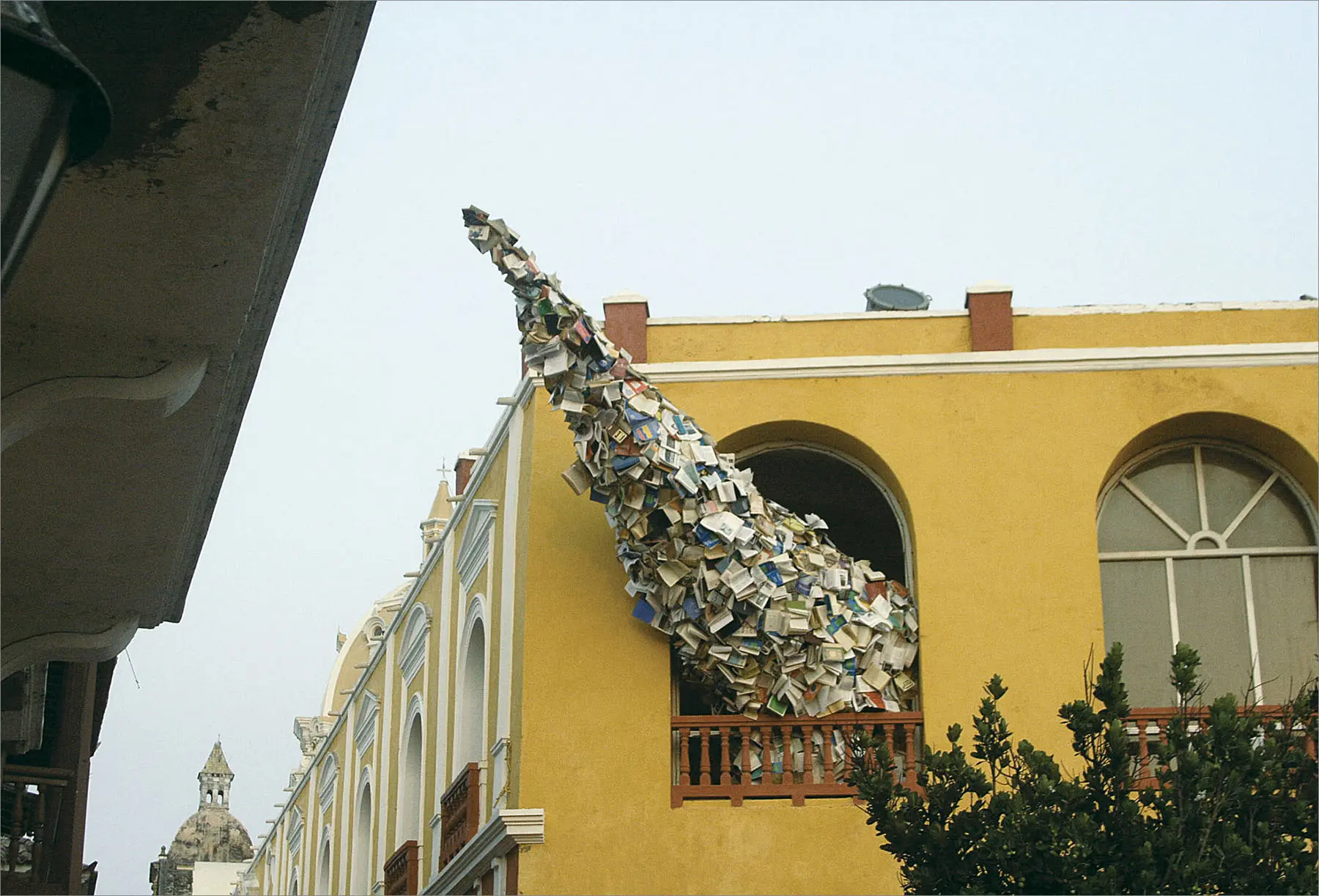
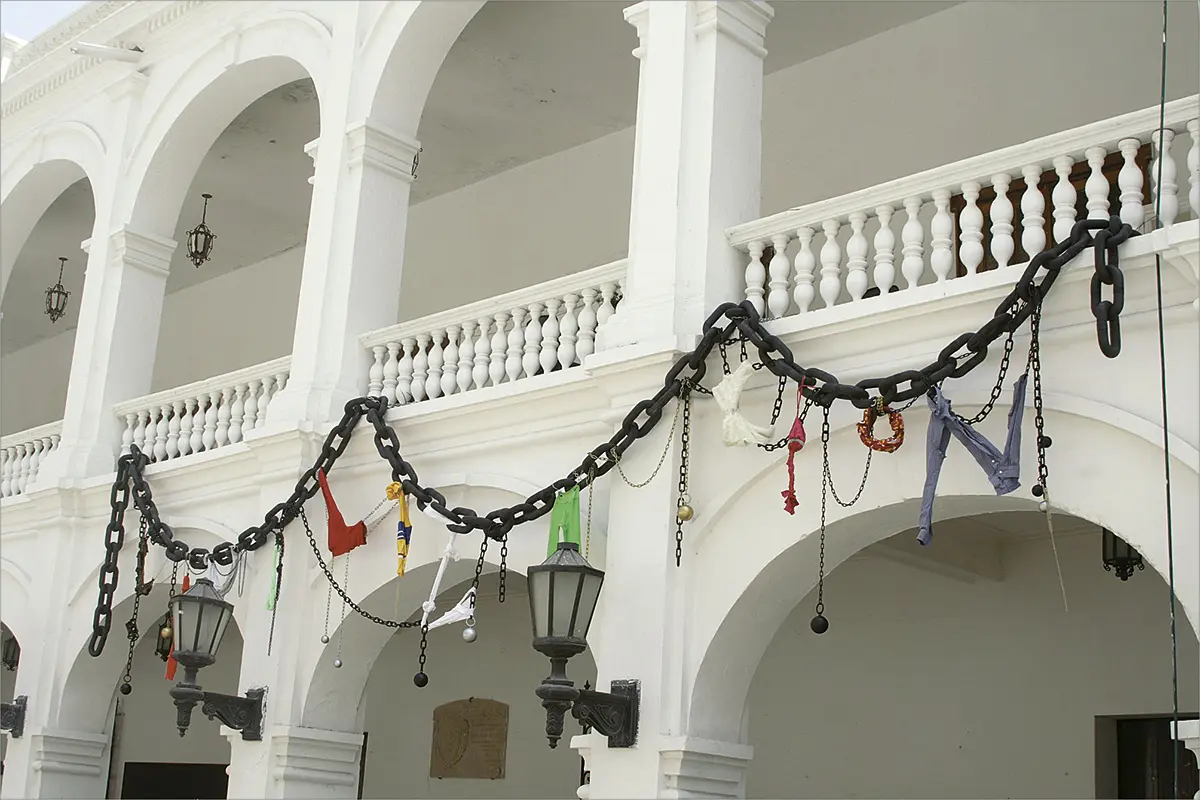
The Cartagena artists Oswaldo Maciá and Álvaro Restrepo were also present. Maciá intervened in the Museo de Arte Religioso’s choir with his work Calumnia, underscoring “the vices of Power” through a total sensory attack that included sight, smell, and sound. Restrepo made a presentation at various sites with the group Colegio del Cuerpo. Frank Kalero, from Barcelona, created his own text. He created a book that referred to a text written by Colombia’s William Ospina, around which Kalero gathered diverse images and narratives about various aspects of Colombian reality. Juan López intervened in the display window of the Museo de Arte Moderno’s store with two videos. In one of them, a Spaniard spouted insults; in the other, a Cartagena native did the same. The lexicon of each of these characters, despite both belonging to the Spanish language, was unique; the enraged tone and the gesticulations made their actions similar. One viewer felt deeply offended by the work and demanded that the videos be turned off, proof that words and art are not innocuous. Alicia Martín from Madrid commented on the efficacy of books against the power of war, creating the form of a large meteor of books that pointed through a window in the Museo Naval. Ester Patergás from Barcelona made a point about the word “civilization,” which was understood as its opposite, an act of barbarism when associated with the chains that hung from the balcony in the Gubernatorial Palace. Raymond Chávez from Colombia commented on Cartagena and “the ways of saying and of hiding that characterize the press,” with a newspaper he titled La Verdad de Cartagena, in the search for news. Chávez printed a tabloid that omitted words and used images to offer his own version of events. The Venezuelan artist Luis Romero made a point about the polysemic character of street posters. As on other occasions, he worked with other artists who manipulated posters on different walls throughout the city, generating images and sounds that are uncommon for this kind of printed material. The Basque artist Jon Mikel Euba presented an installation at the Escuela de Bellas Artes, part of a project about Velásquez’s iconography that he has been developing for some time; the process of this work involves the relationship between text and image.
I cannot begin to imagine what “intervention” Calder would have made in the beautiful city of Cartagena, and I have the vague idea that intervention by Serra could work. What I know for certain is that Cartagena offers itself after this event as a transformed, annotated text, one that is open to a new reading, one whose meaning is synthesized in the felicitous title of Cart(ajena), which precisely preserves the nature of these artistic interventions.
NOTE
1. These are the words of the curators in the flier that accompanied the show. All the quotations in this article come from this document.
MARTA RODRÍGUEZ