
From Concept to Context
Claudio Perna was born in Milan, Italy, in 1938 and died in Holguín, Cuba, in 1997. An artist of many interests, he frequently used the most diverse creative media: photography (including Polaroids, slides, etc.), video, photocopying, objects, painting, installation, live-action, and collage, among others. With the same intensity, Perna devoted himself to teaching, ecology, and art, touching on aspects connected to the individual, the environment, and society. In that sense, Perna’s oeuvre is heterogeneous, often contradictory, and difficult to classify, which has generated various interpretations that, regardless of their pertinence, make an integrated view of his artistic legacy and his creative program especially difficult.
Settling in Venezuela at the age of seventeen, Perna began his architecture studies at the Universidad Central de Venezuela in 1958; after traveling to the United States, he reoriented his education toward geography and graduated in 1968. Starting that year, he worked as a professor in the country’s most important higher education institution.
From his first artistic attempts in the mid-1960s, Perna moved rapidly from one medium to another, from photography to video, from drawing to collage, from objects to performance. Yet, there was always a fixed objective in these explorations: the subject and its surroundings both urban and natural, motifs that persisted throughout his career. Even with the apparent variety of his work and his penchant toward emotions and affections, Perna remained loyal to those postulates. His appeal to art that invokes thought as much as emotion subverts the methodological neatness promoted by orthodox conceptualism, while at the same time transgressing the illusory separation marked by disciplinary boundaries. His perspective was that of an incessant and irreverent explorer who proposes a permanent dialogue between subject and situation, who moves between the singularity of vernacular topography and the symbolic pregnancy of global culture.
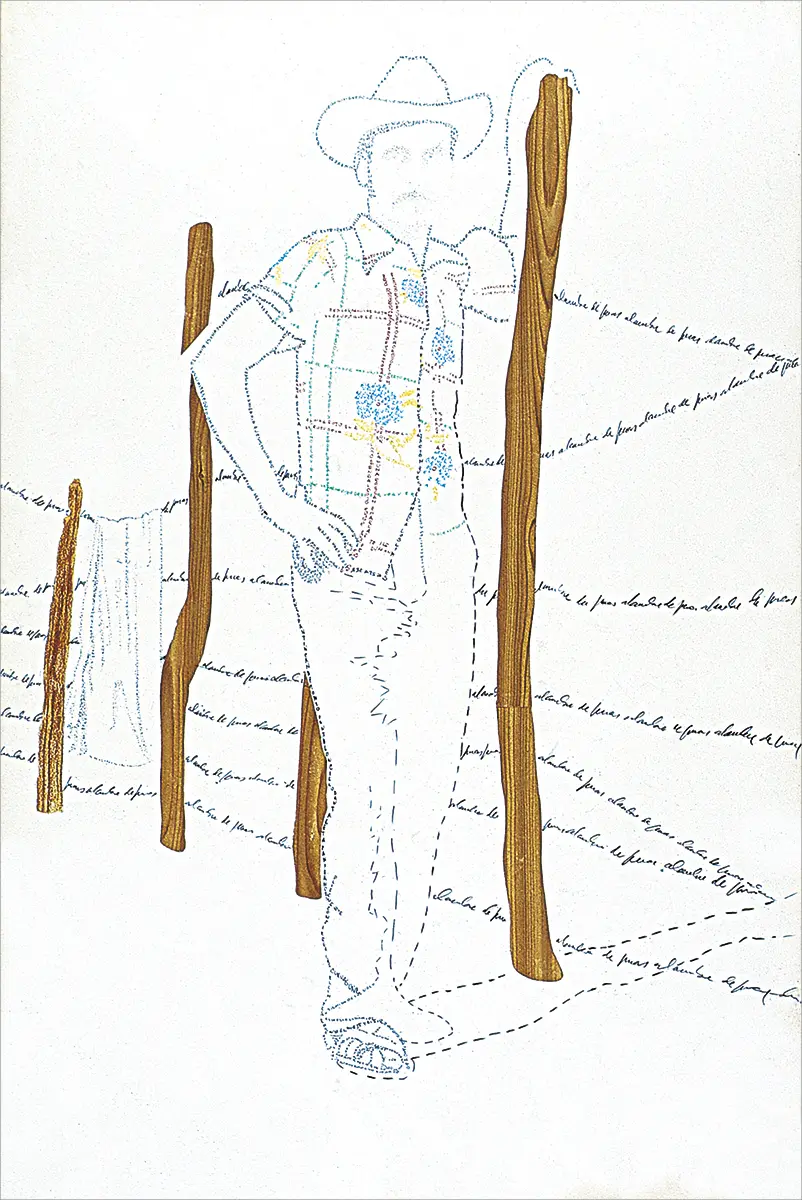
Perna offered his own contextualized solution based on the precariousness of the material and the preeminence of the idea, simultaneously marking his distance from the linguistic speculations of metropolitan conceptualism and the playful asceticism of local constructivism. This is why the textual elements in his drawings of the 1970s do not propose a univocal or strictly analytical meaning; rather, they are part of a destabilizing move filled with symbolic suggestions. In Witch of the Yaracuy State (1978), for instance, the script forms the contours of a rural character leaning against a lamppost. The calligraphy here is small but precise, intensified in the folds, and respectful of the vectors suggested by perspective. The words flow from above and toward the background until the outline of a man standing on the earth emerges.
Perna’s strategy moved “from concept to context,” seeking a common horizon where art and everyday life can meet. Here, experience is the determining factor and, in many cases, the material for the creative action. More than postulating an irreducible confrontation between writing and image, or between form and content, Perna worked from the metaphorical conviviality of languages, exploring their symbolic and configurative connotations.
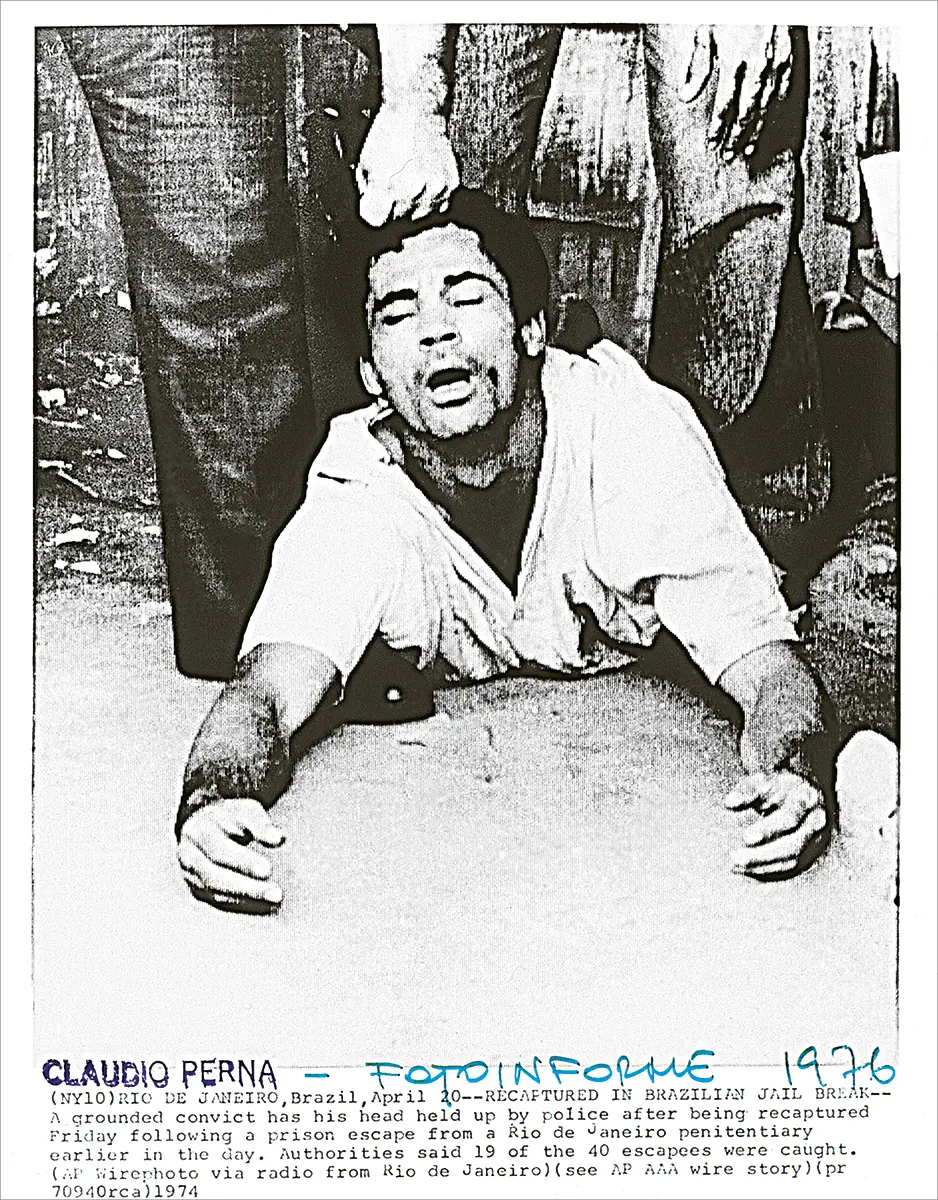
The flexibility of this point of view brought him to a broader idea of art, where the social plays a decisive role without falling prey to the redemptive temptation of the early-twentieth-century avant-garde. Politicians, criminals, and popular characters took the places in the art that earlier were reserved for heroes, princes, and saints. Among the many examples of this exchange is The Highest Virtue: Precission (1969/1974/1990), a photocopied work in which the face of the Venezuelan ex-president undergoes a drastic deformation, and Election Campaign 1978 / Corporeal Work C.P. / JOE, a series of four photographs of electoral propaganda from MEP, PCV, AD, and COPEI on walls, rocks, and highway billboards. But while these works critique the ethical inconsistencies of the political apparatus and its leadership, there are others that refer to law-breakers and police identification and incrimination techniques. In Untitled: Vandals (August 27, 1975), Perna built generic portraits of subjects sought by the police through the superposition of newspaper photographs, and in Sin título, from de series Fotoinforme (1976), he also used the journalistic record reviewing the apprehension of a dangerous escapee in Brazil.
However, the social elements of Perna’s work appear in different degrees, encompassing the discreet humanity of simple people, as seen in Fotografía anónima de Venezuela (GAN, 1979), a show based on cataloging and archiving techniques of the museum and curators, directed to the recuperation of amateur photographers for the “sacred” space of the national arts.
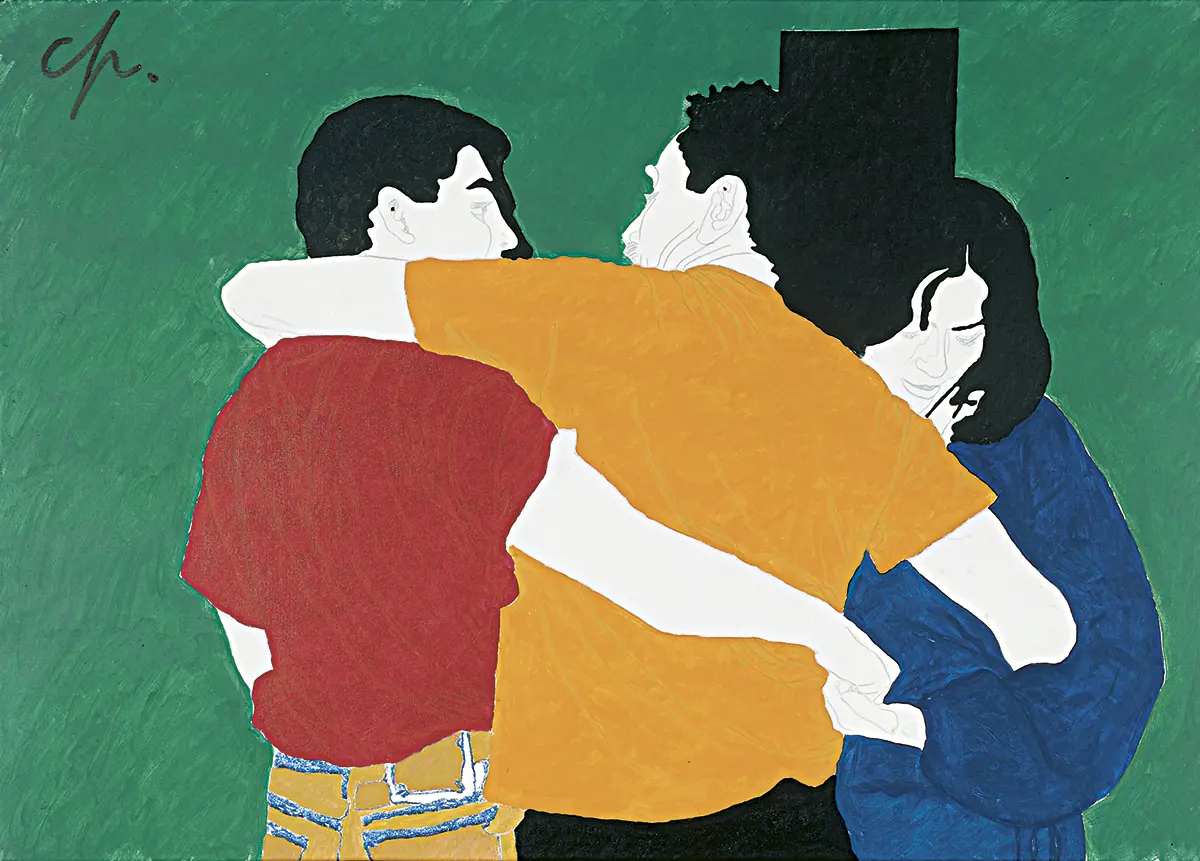
Despite all this, Perna’s entire production displays a marked autobiographical and intimate quality, featuring his friends, students, collaborators, artists, etc. Among them are the American video artist Charlotte Moorman, the Colombian conceptual artist Antonio Caro, the researcher Zuleiva Vivas, and the Venezuelan artists Eugenio Espinoza, Sigfredo Chacón, and Héctor Fuenmayor, who not only appear or participate in some of Perna’s works but also maintained a significant and friendly exchange with him. This apparent contradiction is resolved when one understands that individuality and intimacy were also collective matters for Perna.
Public Art: In Search of the “Mythology of the Instant”
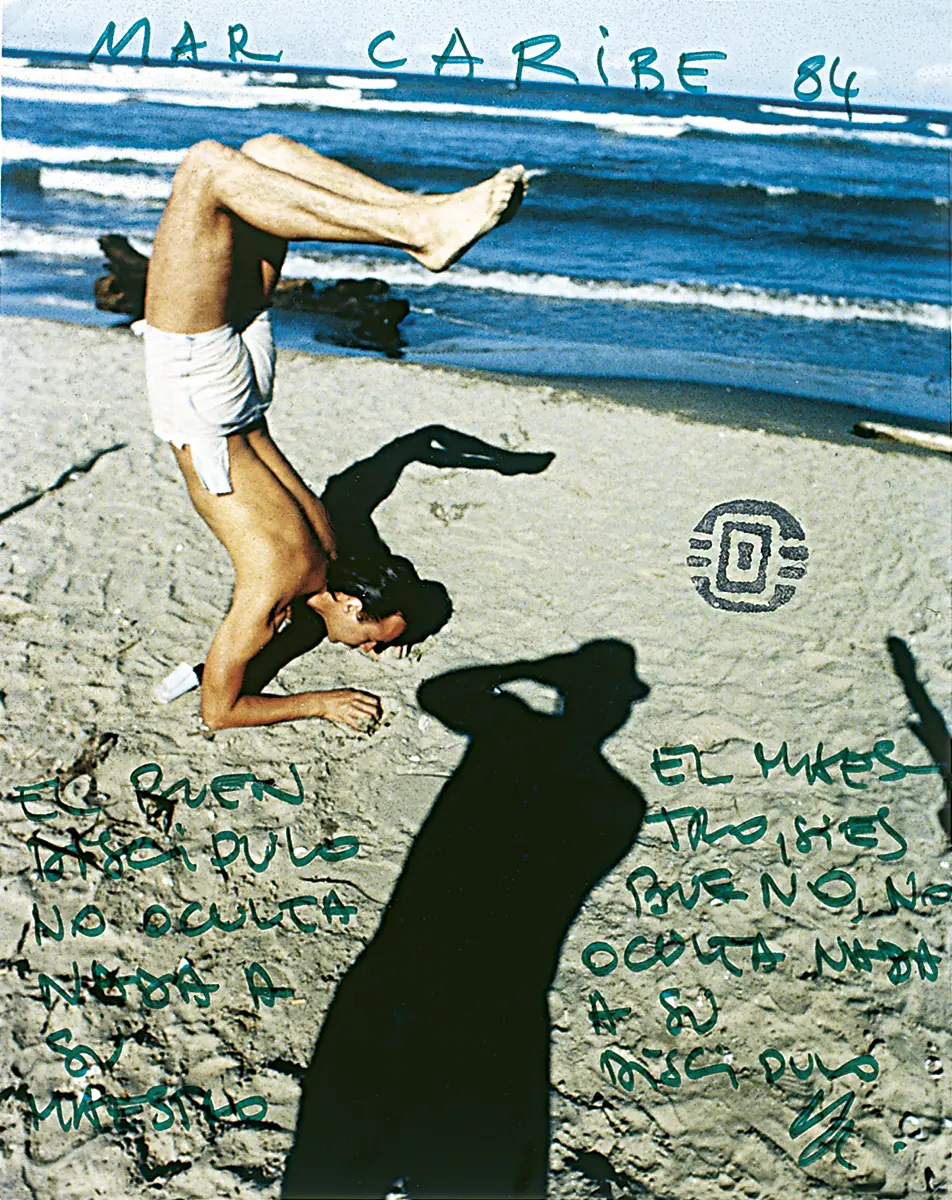
In April 1975, Perna used Polaroid photography to record a series of ephemeral events that point toward a revision of the concept of sculpture subjected to the notions of action, situation, and temporality. Two Sculptures for an Action and Sculpture for a Sidewalk (destroyed) are both registered in drawing notebooks. These works capture a sequence of images of characters posed in closed and open stages, like living monuments. Next to or under each photograph, the artist made some notations, adding his “password,” i.e. his signed seal, the date, and even his fingerprint. The series closes with Escultura en movimiento, in which the subjects have almost disappeared into the vertigo of the urban landscape, and all that is left is the prismatic trace of the moving image.
What is transcendent in this proposal is the idea of sculpture as an ephemeral act, without a definitive location, in opposition to the volumetric object occupying the public space. Consequently, Perna moved the creative operation to the moment of its conception, dismissing the moment of material manipulation. In the immateriality of thought, there is a transformative impulse that can impact the environment.
Rudimentary means and the temporal immediacy of the Polaroid coincided with Perna’s goals. “For Perna,” writes Roberto Guevara, “photography is only a means to capture the mythology of the instant.” The work of art is assumed to be an event and must not be extended beyond the circumstances in which it appears. The civic space, then, is presented devoid of solemn observations, subject to the positions and displacements—by foot or by car—of the individual.
“Ethnotopic” Vision
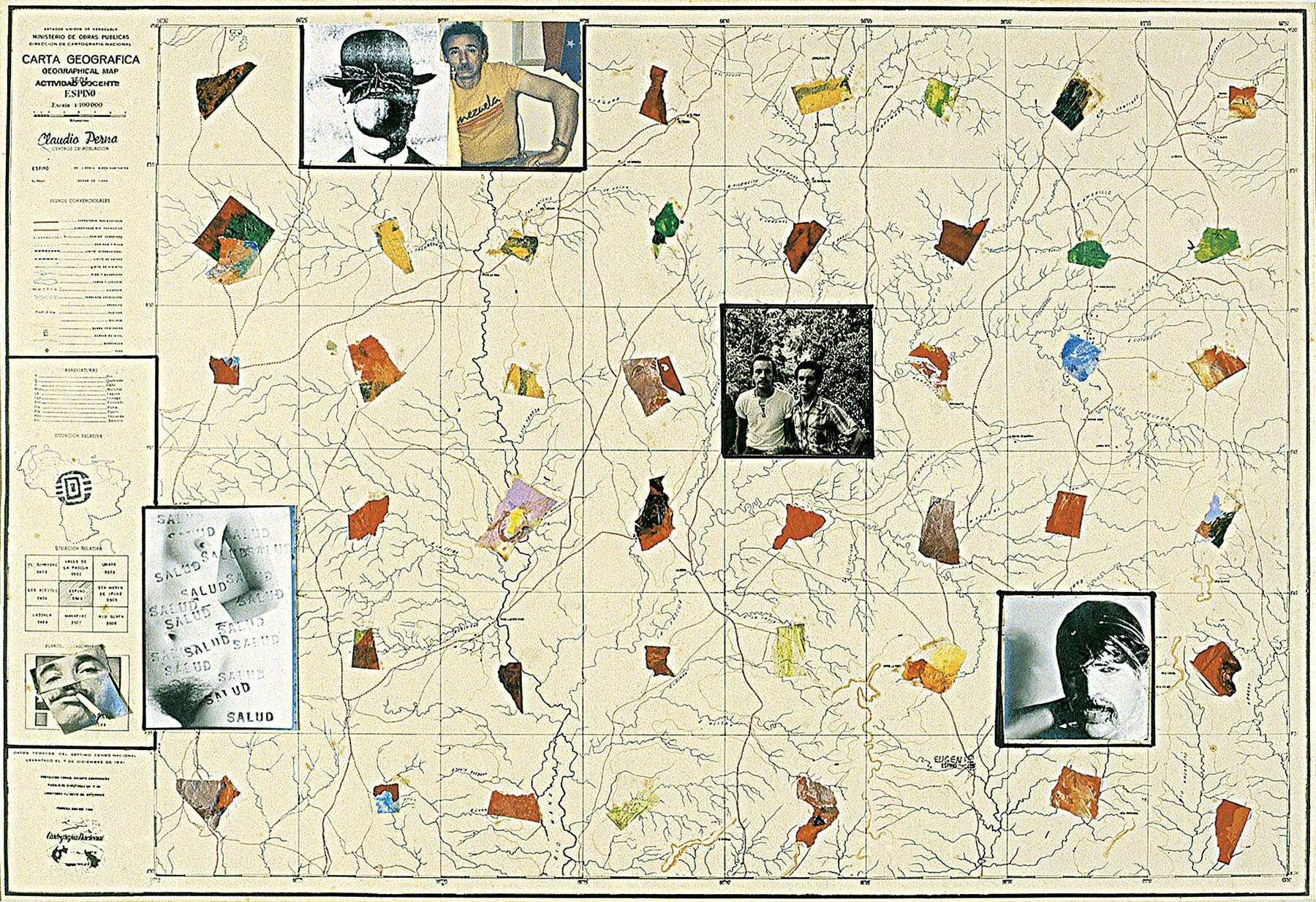
The strong contextual gravitation of Perna’s work refers to a concrete spatial and affective realm, forming a grid of situations and arguments that converge on an “ethnotopic” vision where “being” (in essence) and “being there” (or being as a temporary condition) are homogeneous categories. The figure and the landscape, two deeply-rooted genres in the Western pictorial tradition, meet in a unique way in Perna’s collages and intervened maps, fostering not a substantial but an ecumenical view of identity. This is what differentiates his approach to the Arcadian and idealized landscape painting cultivated in Venezuela during the first half of the twentieth century.
As a professor of geography and as an artist, Perna was interested in the convergence of nature, life, and creativity. “I discovered,” he said, “that there is no difference between geographic postulates and artistic postulates.” This indissoluble relationship between an individual and his environment dominates Perna’s maps combined with photographs, drawings, and annotations. These works were conceived from the point of view of a “cultural geographer” whose goal was to explore a “being in situation” that was at once unique and plural. This is why Perna’s maps of Venezuela while indicating specific locations, are filled with multiple cultural references, both local and foreign, combining personal and collective, past and present, natural and urban reminiscence.
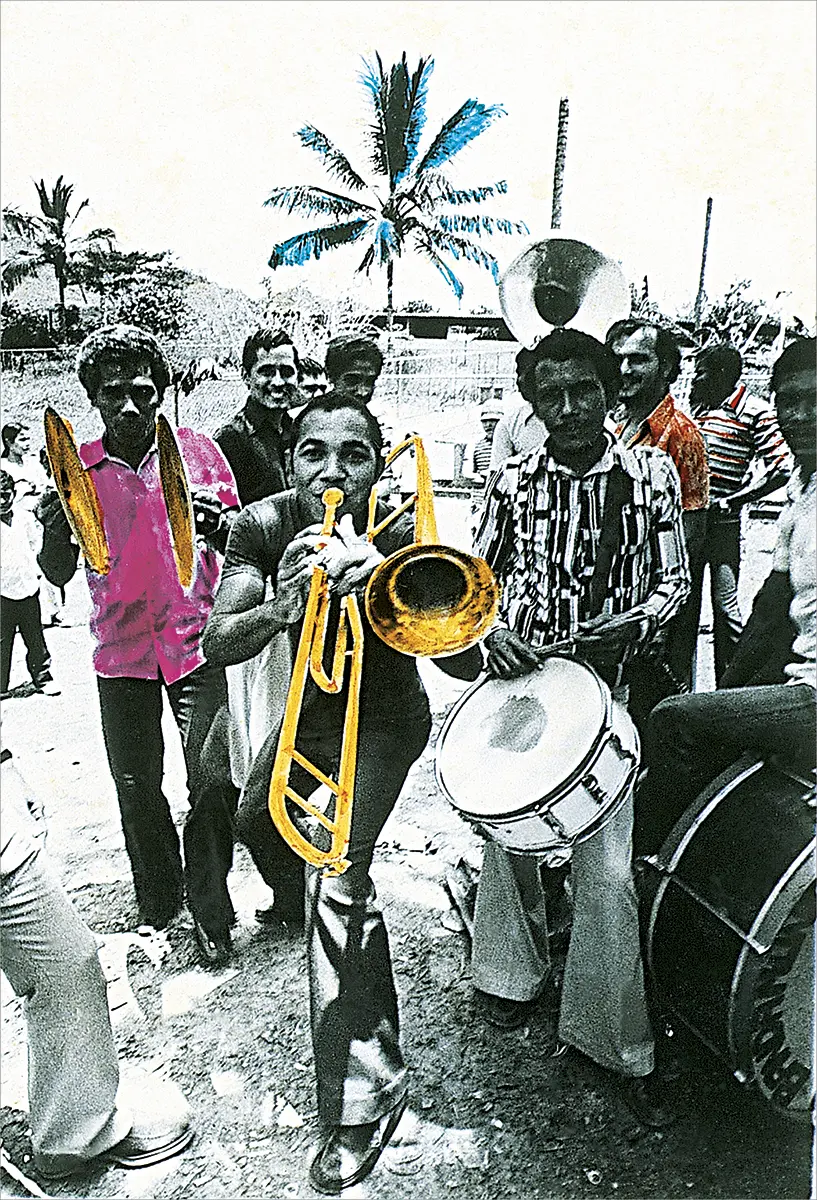
Yet Perna’s works are neither portraits nor landscapes; neither do they contemplate the expressive and atmospheric effects that often differentiate these genres. In truth, they are evocative, elliptical propositions that push forward an “ethnotopic” vision based on physiognomic and spatial investigation. “Venezuela,” the artist wrote, “is a large territorial unit composed of multiple physical and cultural realities, of populations and activities, of perceptions, of treasures that bear witness to the continuity of ideas.”
The artist emphasized the experience of reconnaissance as a means to know the territory. “A knapsack and lights are our first necessities,” he declared, paraphrasing Simón Rodríguez. The knapsack, like a snail’s shell, is the indispensable accessory for survival; a mobile home that guarantees the exploratory behavior toward the topographic reconstruction of a space that is not only physical but also mental. Just as there is an ecology of the material world, there is also one that responds to ideas—to the way in which concepts interact, where synergy and dialogue allow access to a new epistemological paradigm in which reality is no longer a pre-defined and external entity but a construct being constantly reshaped.
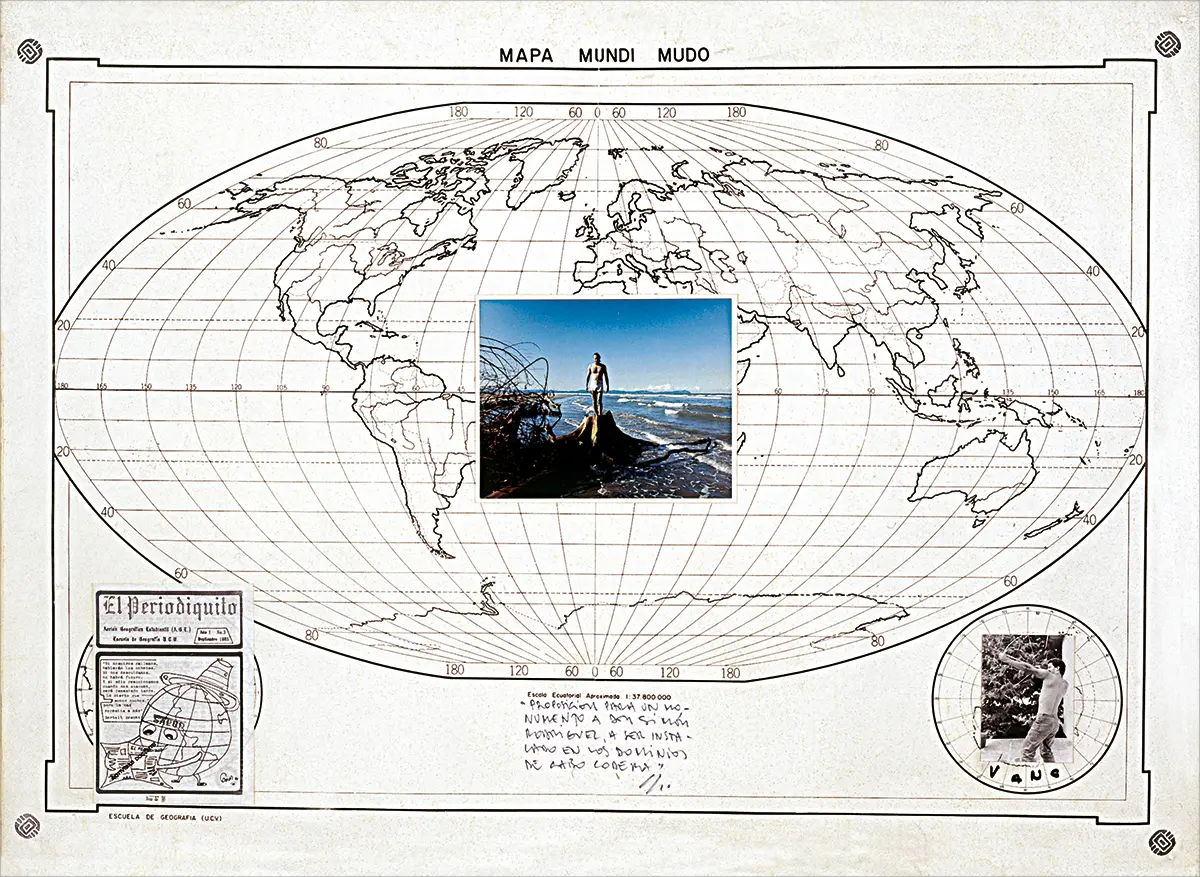
In Venezuela and its Details (at GAN, December 1991–February 1992), an installation recreating a classroom of manipulated maps, student desks, and a teacher’s desk on a podium, Perna’s proposal acquires an explicitly “ethnotopic” character. Among the work’s constituent elements is General Culture, Introductory Class, from the series Caribbean Sea (1991), a collage of images with photographs of the artist in his library, in the Parthenon, and a pre-Columbian mask, among others. The supporting map is one of Macuro, a town in the Paria peninsula in northeast Venezuela. This region was christened “The Land of Grace” by Christopher Columbus during his third journey to the Americas in 1498 when he found continental terra firma. Thus, this work refers to a place, Macuro, whose geographic singularity is tacitly subverted by a variety of cultural and historical patterns.
Instead of seeking the proportion between map and territory, between physical space and abstract space, Perna’s proposal attempts to establish the human and cultural meaning of geography. Framed within this concept, collage is not only a technical procedure but also a way of taking advantage of the fragmentary, accessing diversity beyond the univocal character of objective judgments.
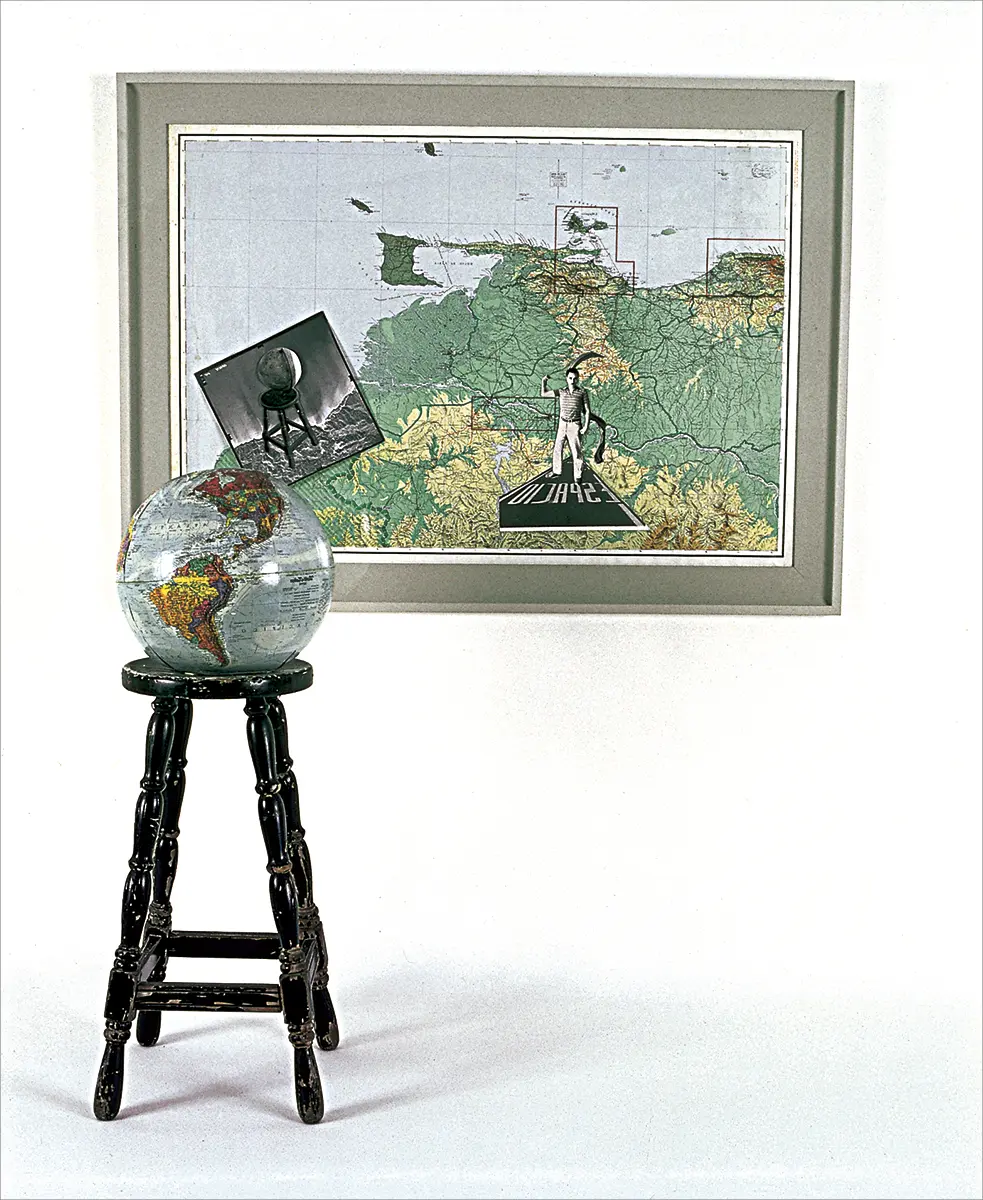
However, Perna didn’t limit himself to the ties established by individuals with natural or urban landscapes. His interest reached the planetary level, a vaster and more challenging territory than the country’s geography or the continent’s coordinates. In Not Another Word (monument to the Geonaut) (1967/1973/1990), an installation comprising a stool, a globe, and a manipulated map, the problem is no longer the individual and its environment but the species and its habitat. From satellite maps and photographs, Perna moved to astronomical diagrams, widening the perspective of his observations. Ethnic nuances dissolve into the anthropological question. The Earth is then a survival module involving animals, plants, people, rivers, mountains, and seas equally.
FÉLIX SUAZO
Research scholar.