
Ernesto Deira (1928-1986,) a lawyer by the Universidad de Buenos Aires and practically self-taught painter began his artistic career at the age of 25, finding in expressionism and informalism the possibility of offering a heart-rending vision of contemporary Man.
The vast retrospective exhibition held at the Museo Nacional de Bellas Artes recapitulated the most significant moments in the career of this renowned artist, from his early works of the 1960s to those dated a year before his death in 1986.
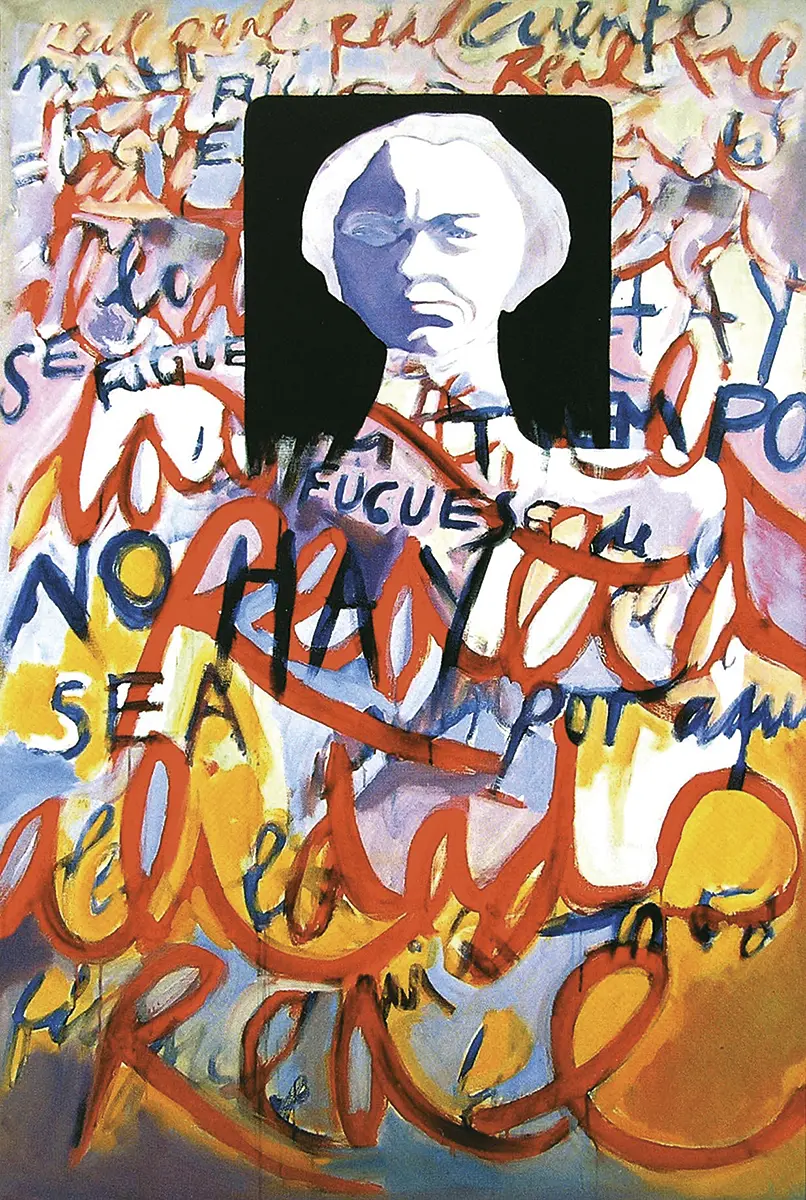
Supported by rigorous research, curator María José Herrera says, “Informalism, new figuration, new dance, new abstraction, new music, new design… new. The 1960s obsession with newness accompanied a society that saw its economic and cultural horizons expand.” It was precisely in that expansive cultural scene, marked by a neo-Avant Garde spirit, that the first period of Deira’s career took place.
In 1958 Deira presented his first individual show, at Rubbers gallery. It made evident that, like some of his cohorts, he ha sensed new winds blowing in the region, not only in art but also in politics and society. We can conclude, thus, that the spirit of the 1960s was felt already in the late 1950s, encouraged, at least in part, by the effects of the Cuban Revolution.
The historic exhibition Otra Figuración was held in 1961 at the Peuser gallery, and included Deira, Luis Felipe Noé, Rómulo Macció, and Jorge de la Vega. It was the calling card of the group later known as Nueva Figuración, undoubtedly one of the most influential in the history of Argentinean art. It was characterized by inconformity, anti-academicism, anti-rigidity, a dismissal of “good taste” and (Macció) “rose-colored bom-bom painting.” The group was characterized, on the other hand, by its rejection of the hegemony of abstraction, which some critics considered the highest point of artistic freedom. Unlike the abstracts, these artists were united by the need to reintroduce the image of man, to be treated now with the same freedom found in abstraction. They incorporated writing and graphics, as well as elements of expressionism and informalism, valuing matter, dripping, and blotching. The resultant was a vigorous painting that displayed not only the human drama but also painting itself as violated, dragged beyond its limits.
Like the rest of his neo-figurative companions, Deira doesn’t just represent; he also presents painting itself as it occurs. Self-referential, his works show materials and supports, while situating at their center the subject/artist as an unrepeatable individuality. It is not by chance that the cover of the catalog for the Deira, Macció, de la Vega y Noé show, presented at the Museo Nacional de Bellas Artes in 1963, featured a large fingerprint.
To account for the world’s contradictions, Deira goes beyond words and concepts. Some of his paintings were made from the back, as if blindly, in order to capture in them, directly, the essence of their action. Influenced by Wittgenstein —a philosopher concerned with the issue of language in relation to things—, one of his series is titled En torno al pensamiento A (1964.) It refers to the thinking that precedes words and names and is revealed in incomprehensible writing that accounts for the chaos previous to words.
Complemented with an excellent catalog, the show is organized in seven thematic axes: war, portraiture, drawings, neo-figuration, writing, the 1970s, and the 1980s. Recalling Michael Seuphor’s distinction, we notice that in the last stage of Deira’s career, painting as scream recedes and gives way to style. If at first the vital Dionysian scream was what exploded, towards the end there was an Apollonian equilibrium and, in consequence, greater aestheticism. The aestheticism that envelops his phantasmatic beings and ethereal doubles of his paintings as they fly or hover over the space, subtly molded by color.
Despite the fact that in his later years Deira possessed a style conceived as balance and construction, as a whole the show highlights the achievements of an artist decided to transgress the limits of the traditional aesthetic paradigm. This is perfectly exemplified by his Rollos desenrollados (1968,) which cover the gallery wall in its entirety, from ceiling to floor. Interested in experimentalism, Deira was a pioneer in the art of installation; in 1967 he was bold enough to cover the walls of the Bonino gallery, placing his paintings one next top the other, without gap, to create an enveloping, at times overwhelming effect that negated the gallery as a serene space for reading.
Included in the catalog of the Otra Figuración show, a text by Deira reveals the inconformity of his neo-Avant Garde intentions. There he says: “For the new language. Because I want to save myself. For the limits. Because I say yes. Because I don’t know how to do anything else. Because I am a figurant. Because I want it.”
ELENA OLIVERAS