
“My father”—states Franco Contreras in the exhibition catalog—“possessed the marvelous ability to see a second and third possibility in everything, to look under each stone and inside of each stick of wood for the most precise, the most useful, the most pleasurable setting. With this background, I attempted to enter into these dynamics and little by little came upon the presence of thousands of relationships of spaces, lines, vacuums, and situations that—nearly mute and unperceivable—were guarded in powerful existence... And Art, or what I have been able to understand of it, is about that, about the very particular manner of seeing and representing that world that moves us inside and out ...”. This simple, and if you wish, plain confession conditions us to understand the artist’s proposal, which sets forth the approach to his esthetic perception of the environment, and somehow the restlessness that guides his investigations into the plastic. Brown-colored wood is one of the fundamental elements of his work. The artist’s relationship with this kind of timber dates from the first years of his life, which took place in a bucolic ambiance of mountains, forests, rugged terrain. His sensitivity as a creator was marked by these moments, in which art and life turned into a decisive crossroads. Inspired by these experiences, Contreras combines diverse techniques such as sculpture, assembly, and installation, and from this arose the Obra Primera VIII (First Work VIII) exhibition, enticing us closer to that external and internal vision to which the author refers in his commentaries. Presented at the Sala de la Fundación at the Centro de Estudios Latinoamericanos Rómulo Gallegos (CELARG) from August 28 and October 8, 2006, the exhibit brought together a total of 34 of the artist’s works done between 1999 and 2006 in small, medium, and large formats, which testify to the trajectory of this Venezuelan creator, the recipient of the Mérida and International Andean Pact II Biennial Plastic Arts Award (Premio de la II Bienal de Artes Plásticas de Mérida e Internacional del Pacto Andino) in 1993.
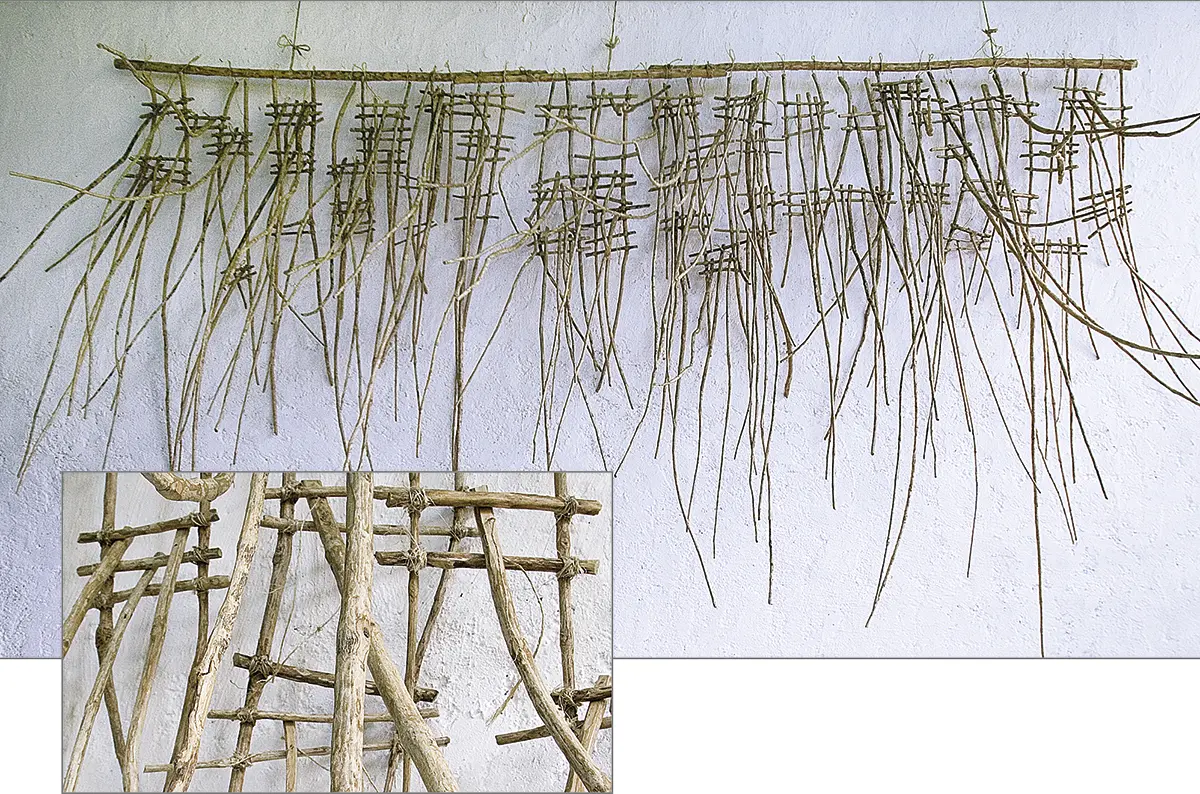
Contreras’s work is based on the constructive notion that the assembly of firewood and timber, with the intervention of other materials such as hemp and pieces of glass, textile, and paper, among others, constitutes the axis of his artistic approach. In highlighting the simple forms of this firewood and timber, bereft of all additional materiality, the artist place in evidence his vegetal essence and reveals that quiet vitality that survives after the pruning and cutting of trees and bushes. Each work evokes characteristics of other strokes of creation, such as the humble, rudimentary utilization of elements of arte povera (Poor Art), as well as the economy and purity of the forms illustrated in Minimalist Art. On the other hand, the organicity and monumentality of the installations are in counterpoint to the weightlessness and structuralism of the compositions; this lends itself to confrontational situations in which opposing factors come into play, such as order vs. chaos, natural vs. rational, fragile vs. resistant. The thematic unity of the exhibition transforms the scenario into a great installation that focuses on the one central idea guiding Contreras’s thought: this may be summed up as the relationship of human beings and nature, a duality that comes to be rigorously questioned at the middle of the 20th Century. From this perspective, Contreras’s proposal acquires a symbolic connotation in that it does not lose sight of the affective link that binds us to nature as the initial dwelling place of human beings; the artist’s work constructs a type of birthright architecture that seeks to dominate the environment, to add and create novel forms of the principles that reclaim Planet Earth. Works such as O Lluvia (Oh Rain) done in 1999, Cascada (Cascade) from the year 2005, and El viento (The Wind) in 2006 transmit a sensation of mobility in which a determined action—the plunge of a waterfall, the blowing of the wind, or the precipitation of the waters—would appear to be suspended in time and space. Nonetheless, other compositions, such as Espinazo (Backbone) from 2000, Retratos (Portraits) done in 2004, and La búsqueda (The Search) 2006, offer a more archaic interpretation in terms of ways of representing the figure.
Contreras’s studies in the field of Philosophy and Literature has taken him to delve into these searches in which the rescue of individual memory transcends their limits to become rooted in the environment of the universal. The theme the artist has developed throughout the years is connected precisely with these concerns with the ecological, oriented toward recovering the environment, and toward preserving nature in its true value as the final refuge and ambiance of humanity trapped in the swarming of science and technology, in which a utopia of unlimited progress has curtailed the bases of our very existence.
GLADYS YUNES YUNES