
Death is the most radical event for any human being. We are never prepared to face it. It is always experienced for the first time, in a unique way. It is unrepeatable, ineluctable, irreparable.
It appears from nothingness, from the darkness of non-being, devoid of past or future. Baring the superfluousness of our lives and their plotting on the time consumed and the vanity of any flow of the life to come.
Ser en el tiempo, German Arrubla’s show places the unadvised viewer in the situation of such an experience, always artificious, of death as threshold that cannot be crossed. It alludes to the impossibility of apprehending this event in Man’s historical time. It is an allusion to the “Being in time” we are when we face that event. We know nothing about it that could guide us in taking that step, which can take place at any moment. Despite this impossibility to relate to the experience based on past learnings, Man has insistently sought the way to correspond with the inaccessible side of that other, alien reality that accompanies us in the flows and ebbs of existence. This show by Arrubla offers a mirror to that inaccessible underworld.
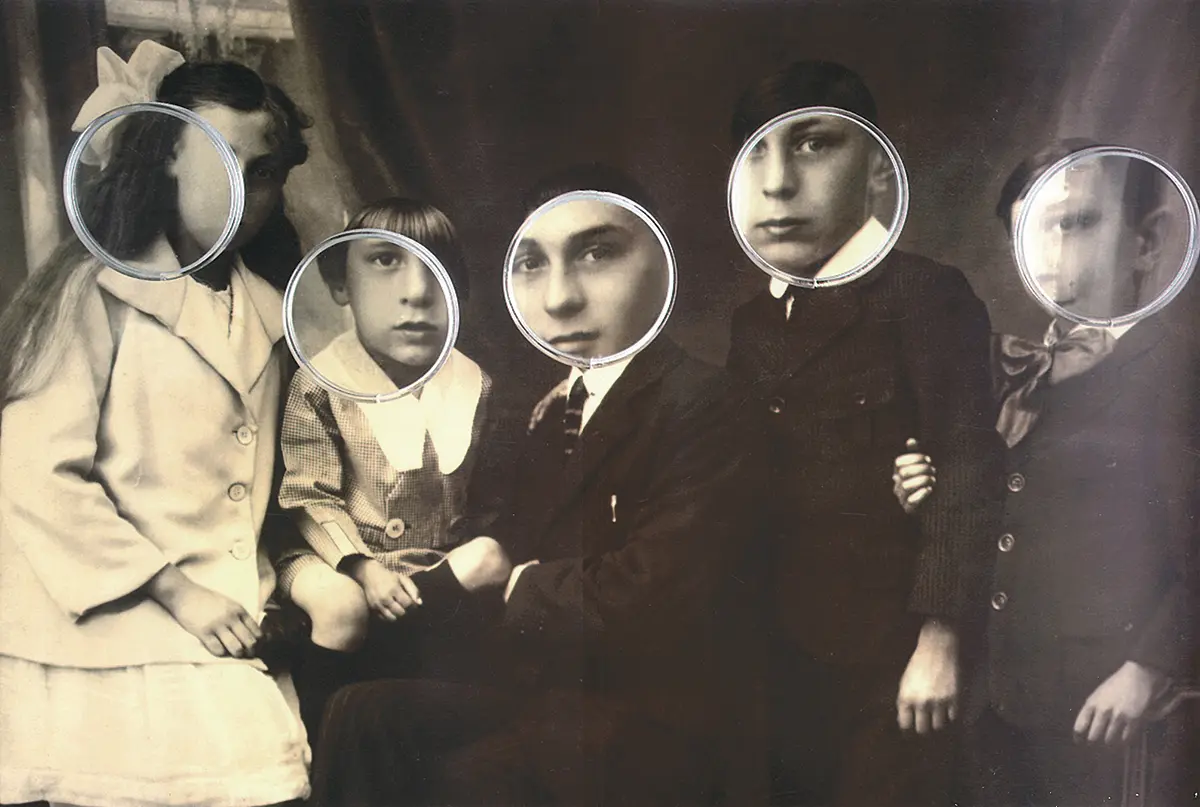
It achieves this by arranging in a thick weave, as in a museum installation of memory, a series of found and intervened photographs, lithographs, and cultural artifacts of people from, other times (the Nineteenth Century and the Deco period of the Twentieth; as well as objects from the Christian imagery of the Nineteenth Century.) These objects are encapsulated in boxes that superimpose transparent gauzes, magnifying glasses, resins, which confine them into a deathly, spectral allusion.
The portraits of these people from other times have been transformed into ghosts. What were family ties, filial connections and portraits of another life, are today Beings without time. Death itself.
Genuine objects from Christian religious culture, which in other times were part of incense-enveloped rituals, are mounted in a kind of mausoleum that capture the sensibility these solemn artifacts exude in their attempt to bring into our lives the spiritual transcendence of the other side of what exists. Arranged as sacred artifacts inside boxes made of layers of resin that result in a dream-like effect of optical distortions that force us to look for ways to focus our eyes and find the metaphorical sections of the body of Christ, of the Virgin, of the sacred ossuary.
No other destiny awaits us. We are Beings for death, and that human being’s entire life becomes an incessant debate to apprehend it. It will take us by surprise, in the midst of our worldly concerns. It will come, as usual, out of the blue. All we can do is to live the experience of death through others. Through the artifices of our culture and its fetishes.
MARÍA BELÉN SÁEZ DE IBARRA