
Four years ago, at the Eighth Havana Biennial held in the San Carlos de la Cabaña fort, viewers enjoyed a peculiar kinetic sculpture by Iván Capote. The title of that “machinery” (today in the collection of the University of Arizona Museum of Art) was Dislexia; the mechanism unveiled this sentence, which was hidden under a dark layer of industrial oil: “Life is a text we only learn how to read when it is too late.”
For Capote, who built ingenuous machines that focused on physical, psychological, and geographical limits, played with the plastic potency of natural materials like water, dirt, sweat, and oil, and were based on devices that accentuate certain visual metaphors, Dislexia meant a definitive enlargement of the conceptual sense of his artistic proposal, as it gave a special value to the word incorporated into the work and the tension thus created.
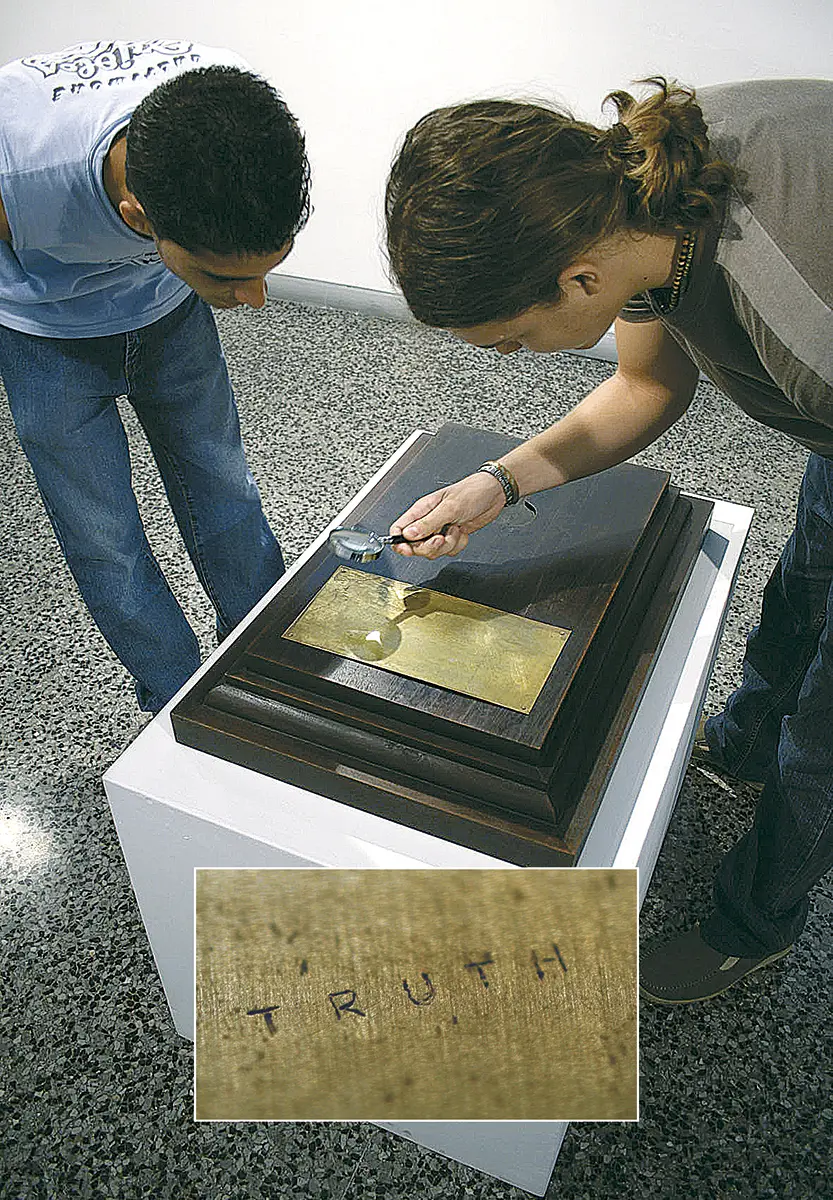
Aforismos, the exhibition Iván Capote presented at Galería Habana from December 6, 2006, through January 2007, continued this trend as the thirteen works displayed the leading role of the sculptural, with a focus on specific words chosen by the artist for his peculiar brand of reflection. His “objects” were extremely understated in form but, contrary to the frequent vacuity of minimalism, they were loaded with meanings that posited ideas on global issues.
In the recent exhibition, the same sentence conveyed in Dislexia was presented in oil on canvas; taking the form of a vision test intended to evaluate the “health” of the eyes, the sentence was difficult to read. One noticed this reformulation of Dislexia’s humanistic interrogation as shifting toward the role of money as the protagonist. In a painting titled Punto de vista, a mirror on the lower edge revealed the abstraction of the dollar sign arranged on the canvas. With the same title, a sculpture in steel seamlessly continued the argument; it could be seen from many points of view but appeared with complete clarity only from one, thanks to the technique of anamorphosis.
La llave de todas las cosas, with its oversized aluminum version of a key with ridges spelling (in English) half of the term “words,” was a tribute to the power of language. It was placed at the center of the gallery’s first section. Diagrama del pensamiento followed, a model of a white picket fence on which the term “words” had also been carved; its angular points suggested a possible schema for the ebbs and flows of ratiocination.
In La extensión de la palabra, the function of the Rolatape, an instrument used to measure distance, was altered. In order for viewers to read the sentence “Move your mind with each step,” they had to set the sculpture in motion and move it around the gallery. Here, Capote reflected on the need to evaluate actions that become irreversible when becoming concrete. Éxtasis; a line suspended in space, referred to intangible acts such as the actions of one’s mind and compared with the nature of wind, with English words are very subtly incorporated into the work.
Highly significant in this exhibition was the scale of the works presented. The works’ accessibility favored a more direct dialogue with the viewer, whose participation completed many of the works. This was demonstrated in Verso blanco; the viewer attempted to reach a sheet of blank paper with a pen chained to the wall, an act that became chimerical, frustrating the act of writing. Lost demanded a painstaking search: the sculpture included a magnifying glass, which allowed one to carefully scrutinize the metal piece on which the English word “truth” was engraved. As suggested by the artist, the search for this truth was a unique synthesis and translation of the meaning of our lives.
Aforismos was a veritably poetic composition of images. Each one of the metaphors, achieved by the artist with visual strength and conceptual roots, led the public to a profound reflection and demanded a display of intelligence, cunning, and lucidity in order to decipher each concretized maxim and the learning to which the human species is called.
CARIDAD BLANCO DE LA CRUZ