
URBANA brings together 12 projects—works of art for public spaces by the sculptor John Castles. The exhibition was organized with the intention of reviewing depth-in-hold aspects of the artist’s trajectory, these allowing the spectator to come near the processes of one of the Colombian sculptors who have approached public urban space in a rigorous manner. The exhibit is composed of drawings, photographs, and scale models of projects carried out in cities such as Bogotá, Medellín, and Washington, D.C., and of some not carried out due to administrative issues, such as the case of Gea, a project designed in 1991 for an impeccable contest in its formulation The Trisesquicentennial Anniversary of Bogotá (Trisequicentenario de Bogotá), organized by the Museo de Arte Moderno and the la Sociedad Colombiana de Arquitectos para Ciudad Salitre in Bogotá and sponsored by the Banco Central Hipotecario, this zone’s urbanizer, in which Castles was awarded the first prize.
All these exhibited projects were conceived of for a specific space, looking to the specific urban spaces of each place: visual axes; environment, and vehicular and pedestrian flows. After analyzing the place, working on the plans and carrying out a detailed study of these urbanistic determinants and of the use of passersby, Castles builds a scale model with which he generally determines the adequate scale for and the size of the proposed work in terms of its environment. He executes drawings referring to the work itself, to its development, to its vistas, elevations, floor plans, to later construct it within the space without the risk of mistaking its routing/directioning, volumes, lights, and shadows.
Castles belongs to the geometric abstractionist tradition. His artistic career began at the Third Biennial of Medellín (la Tercera Bienal de Medellín) in 1972, in which he presented a work comprising prefabricated tubes, which was cited by the critics as one of the works that gave rise to Minimalism in Colombia. In the XXV Salón Nacional de Artistas, Castles received first prize for Modulación vertical (Vertical Modulation), a symmetrical and illusory architectonic sculpture, rendered in metal and yellow color. The artist’s work in this decade and during the 1980s, in which he resorts to aluminum for his structures, which was characterized by a geometry inscribed within the axes of a hexagon, and the rhythmic repetition of a module; an example of this is the sculpture found in Bogotá’s center, in the triangular city square of the Banco de Crédito did in 1984, in which Castles worked in modules. On the side of the hypotenuse, the sculpture runs parallel to the avenue, presenting inside an arch that permits passersby to go by it, somewhat obliged to do so, to be able to enter the Bank or to come out of it onto the street.
Emphasis must be placed on the fact that the sites proposed for the artist’s sculptures in the public space are characterized by being urban sites that are in direct contact with the public and that possess a precise and clear function for city dwellers, as do plazas or city squares, as opposed to residual thoroughfares, where sculptures are often placed randomly and that passersby cannot even see.
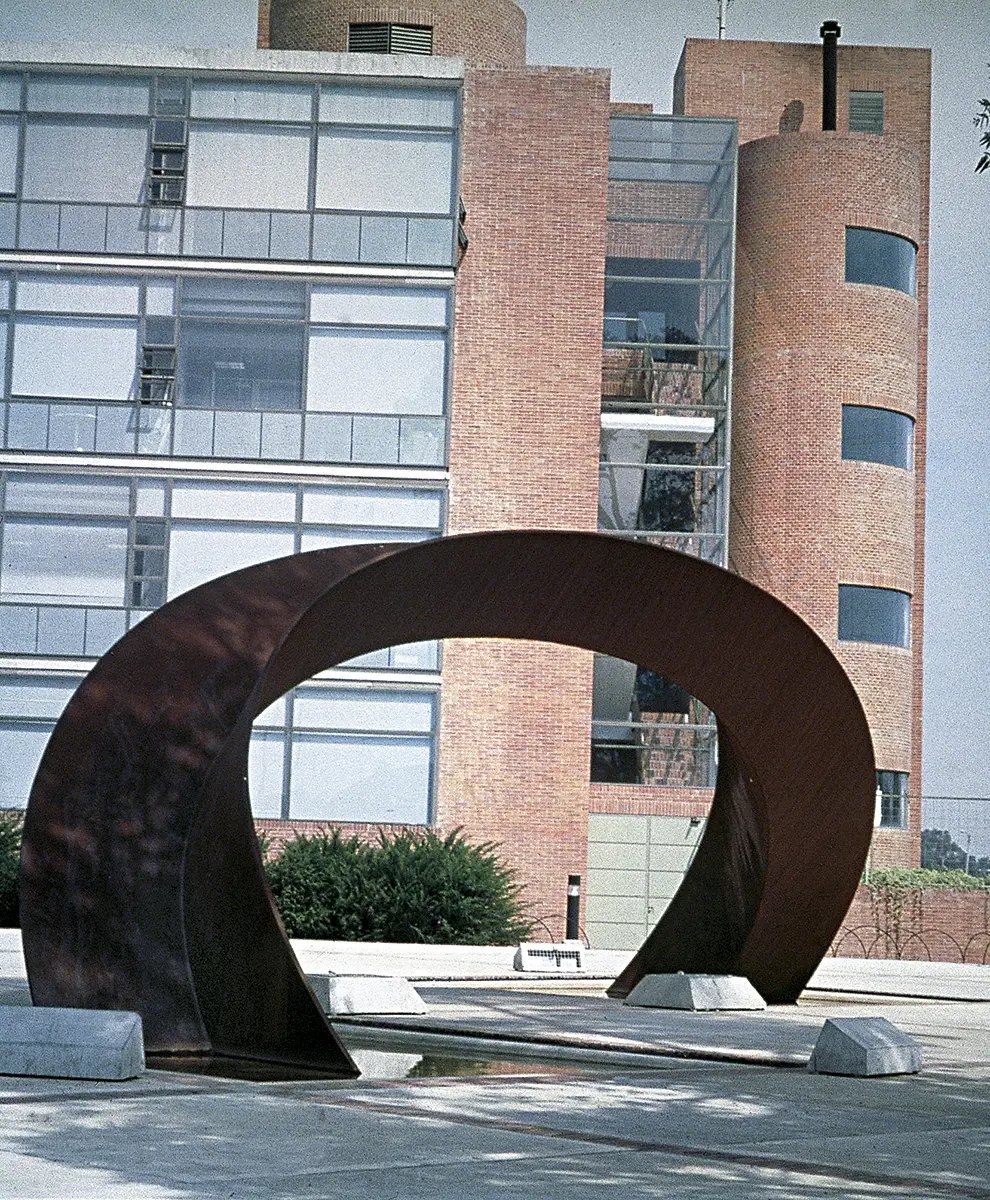
Actually, although Castles´ sculptures—well-named as Ondulantes (Undulating)— continue to be geometric, the spectator perceives them as if they were curved in on themselves as if the 3-mm thick steel did not offer any resistance to being bent. This allows the works to penetrate into the space in which they are inscribed, such as in the case of Américas (Américas), at the Compensation Fund (Compensar) in Bogotá, which affords passersby the opportunity to penetrate, walk by, or traverse its undulations by means of that double curve that plays with the place, the sculpture of rust and earth tones that gives rise to geographic forms that shape the wind. Similarly, there are sculptures rendered by a sole element, although they may possess several surfaces, depending on the sculpture’s size. From the constructive canons, Castles proceeds to what can be termed a sensitive geometry, ¨softer and more organic¨, which he achieves in his last works by means of plans that are geometrically modeled through inverted cylinders, generating the sensation of a total movement in anesthetic structure that resorts to the minimalist formulation of ¨less is more¨.
Castles, concerning formation in Architecture supervises the most minimal detail for the proposal of a work that is integrated into space. In his work, nothing is gratuitous; his works supply a spiritual bridge between the citizen of the city and the city itself; thus, one of his fundamental interests is the formal and geometric relationship with urban space. With this, he specifically refers to the spirituality of artistic expressions themselves, to the way of thinking that relates sculpture with human beings and their environment.
The exhibition conducted at the Fundación Gilberto Alzate Avendaño concludes with one of his most recent projects, this done in 2006 for the contest entitled City Hall Parks and Libraries of Medellín (Parques Bibliotecas de la alcaldía de Medellín), in which Castles obtained an honorable mention for Pendiente (Slope), a structure that brings together two levels of a terrace at the Biblioteca San Javier.
MARÍA ELVIRA ARDILA