
Under this suggestive title, Dominican artist Julio Valdez (born in 1969) gathers a group of his works done between 2005 and 2007 that are on exhibit at the Latin American Masters Gallery in Beverly Hills (California) from February 3 through March 10, 2007.
The color unity among these pieces allows us to read them as a single pictorial installation rather than as independent works, strengthening the show’s coherence. These are large-format paintings of predominantly blue and green tones; despite their evident mimesis with the sea, they do not approach this theme in a realistic fashion. On reclaiming the insular culture and the experience of exile (the artist has lived in New York since 1993), the sea becomes a discursive presence in his work, an allegory that at once unites and separates, that at once protects and threatens. In this recent phase, Valdez’s artistic approach not only displays an ability for renewing his esthetic language, but he is also able to extract from his earlier work the elements that confer change and depth on his present work. Thus it is that radical changes in artistic expression support continuity and the evolution of conceptual discourse.
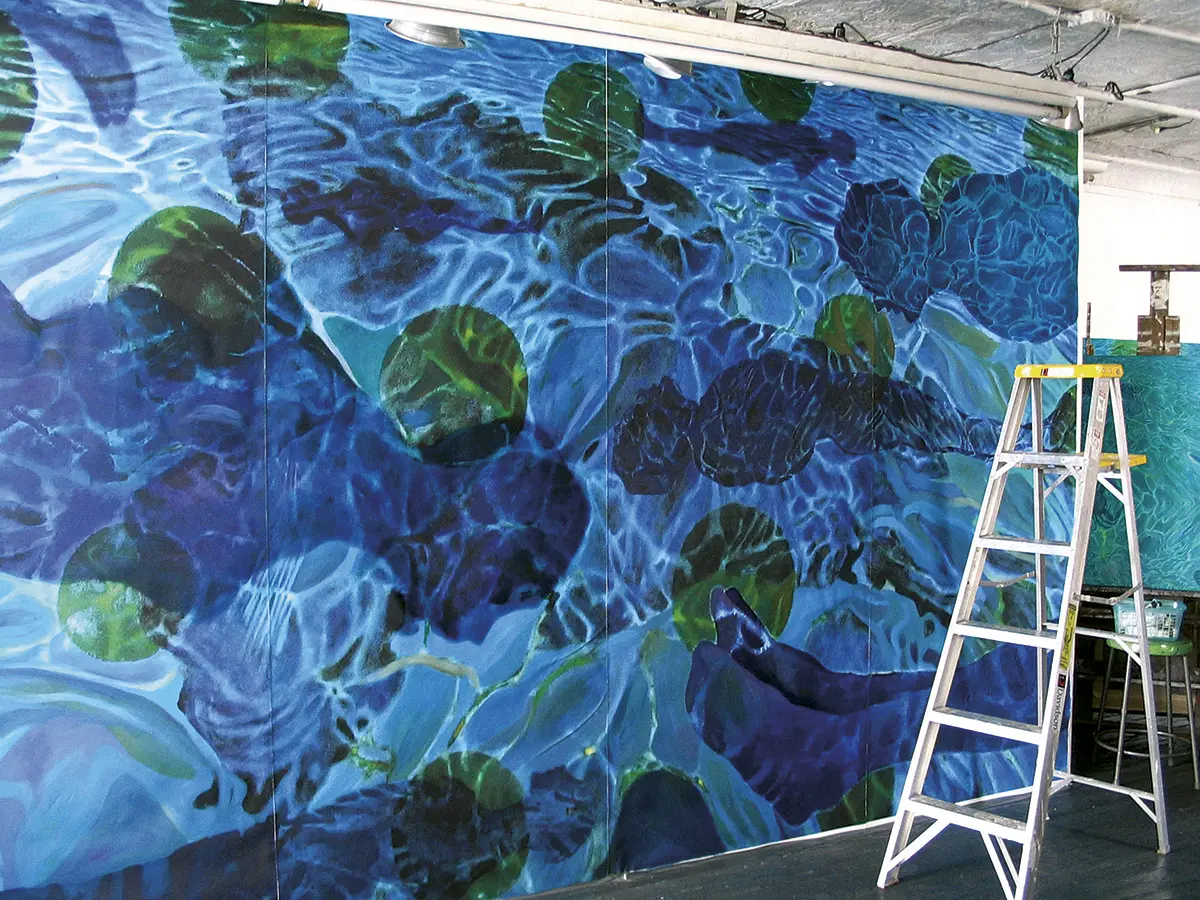
Great open surfaces, a silky appearance, fluidity, and the monochromatic produced by greens and blues at first glance suggest an ambiguity between representation and abstraction, between a desire to evoke the surface and the body of water with all of its lights, reflections, and movement, and a willingness to eliminate these figurative references in favor of the purely abstract effect of the all-enveloping “color-field”. Similarly, spaces blend into each other: One that could simply be showing us the sea as a landscape through the eyes of a swimmer eases into another that is free of external references, created in the painting itself, i.e., abstract (per the postulates of the abstract tradition) but nevertheless suggesting a external reference, such as a body of water as observed from the window of an aquarium.
A closer inspection, the nearly monochromatic surfaces, which are actually rich in tonal nuances and similar to spots of light reflected on water, unveil the presence of other more mysterious elements that inhabit them: Fish; crabs; butterflies; seaweed; underwater flowers, and human silhouettes. It would appear that figurative art has taken over, even by means of precise tracing, if not by the fish forming great ripples and ornamental curves as in Peces Curiosos (Curious Fish), butterfly wings becoming island silhouettes (Butterfly Islands), and aquatic vegetation, flat as if pressed down by a microscope’s glass slides, where marine light contrasts their darker areas as if backlighting them. There are no definitive forms; everything is ambiguous, intangible, like the eternal ebb and flow of the ocean. Human silhouettes adopt several forms and meanings: The self-portrait (a reoccurring theme in Valdez’s work) Aqueous Self-Portrait, a celebration of the sea as this artist’s natural medium, a symbol of his identity; or the one who prays—an archetypical representation—which connects the ocean with religious forces in Oficiante del Mar (Sea Celebrant), and in other examples such as lying bodies that appear to be drowned bodies floating, bringing to mind the most dramatic chapter in the history of the Caribbean: Slavery (a theme previously dealt with by the artist).
Valdez’s achievements with this new series are due in part to his mastery of technique, which allows him to manipulate tonality, veiling, translucence, and spatial blurring in such a way that we are shrouded in a sometimes welcoming and sometimes disquieting atmosphere. But his esthetic success is mainly due to his clear and solid conceptual proposition, his commitment to the Caribbean and universal language, and the equilibrium between what he brings forth from his earlier work and what he envisions as new and fertile pathways.
FEDERICA PALOMERO