
In Lezlie Milson’s creative universe, injured wood, tortuous rope, and dismembered bodies serve to communicate emotions and a particular worldview. Since the early 1990s, her work –which incorporates painting, sculpture, assemblage, and installation art—, has made reference to the environment and the human body, but also to psychic realities.1 To the artist, each of her pieces reflects personal feelings and experiences, as well as specific individuals or human groups that have made a mark on her life, which has unfolded in the U.S.A., where she was born in 1958; Israel, where she has spent long periods of time; and Panama, which has been her home since 1987. During the years of her multifarious development as an artist, Milson worked as a blacksmith’s apprentice, trained under a textile artist and learned to cast with a dentist, in addition to her formal studies in Sculpture, Design, and Semiotics in the U.S.A., both at Brown University and the Rhode Island School of Design.
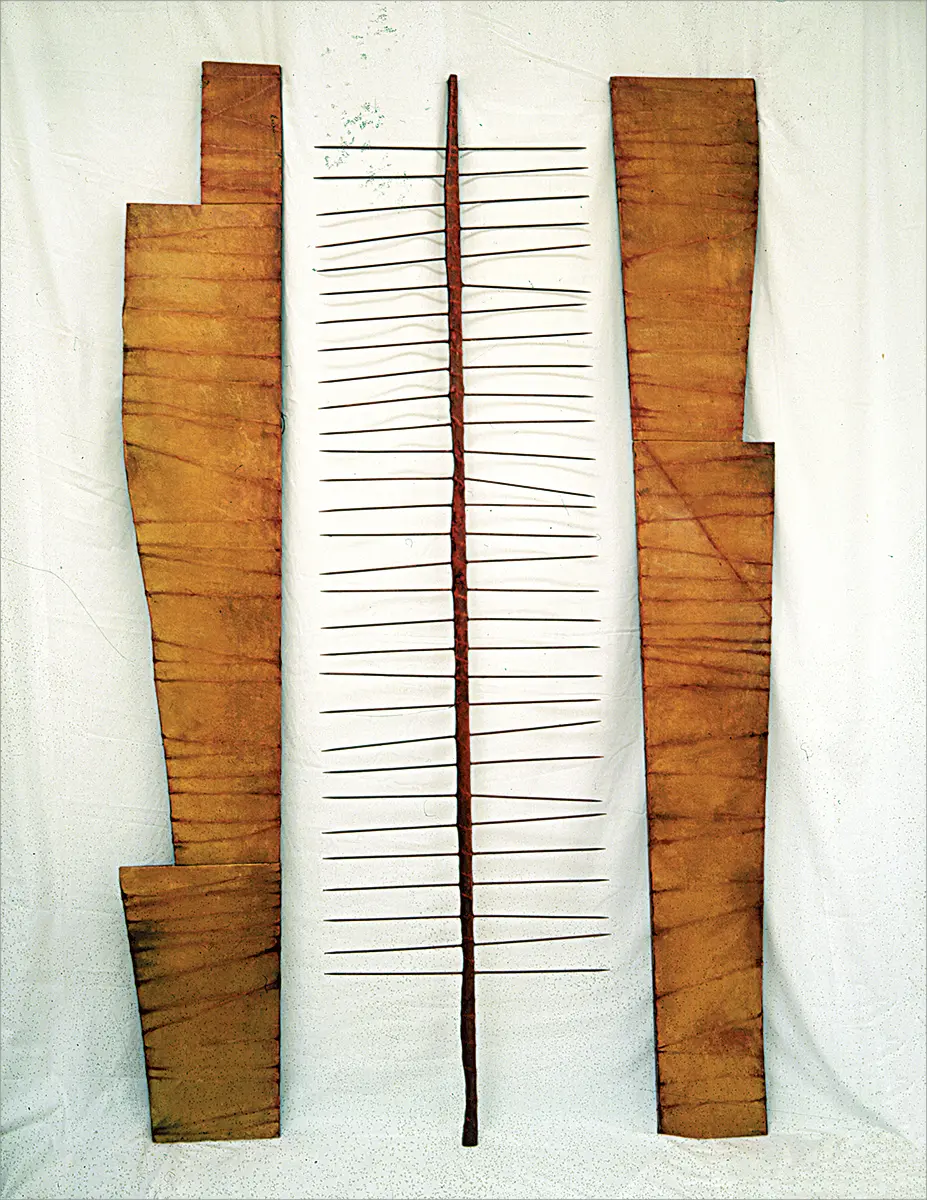
One of the first works Milson ever showed publicly in Panama was the triptych entitled The Enemy Within, a piece for which she was awarded an Honorable Mention at the 1994 Panama Art Biennial. Original both in style and content, the piece proclaimed the creative potential of this relatively unknown artist who had been producing paintings and sculptures in the solitude of her studio for years, while she worked professionally as a fashion and furniture designer. The triptych included a vertical shaft of wood with long thin spikes protruding to the left and right—as in the dry skeleton of a prehistoric fish—and on either side, like figures standing guard, two irregularly shaped canvases in shades of orange. Although the piece was mounted on the wall and described simply as “oil and canvas on wood,” it actually constituted an unusual mid-point between painting and sculpture.
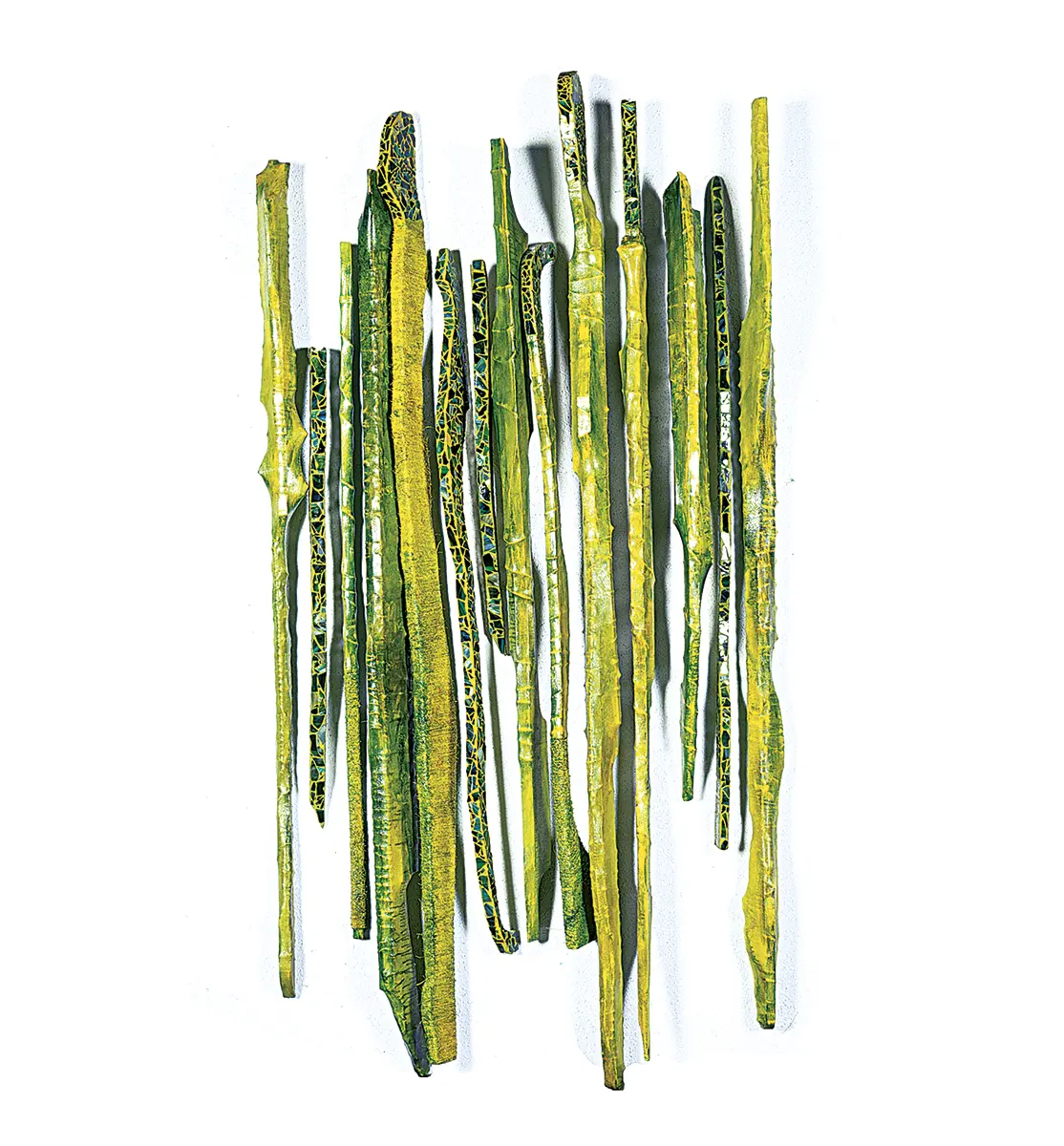
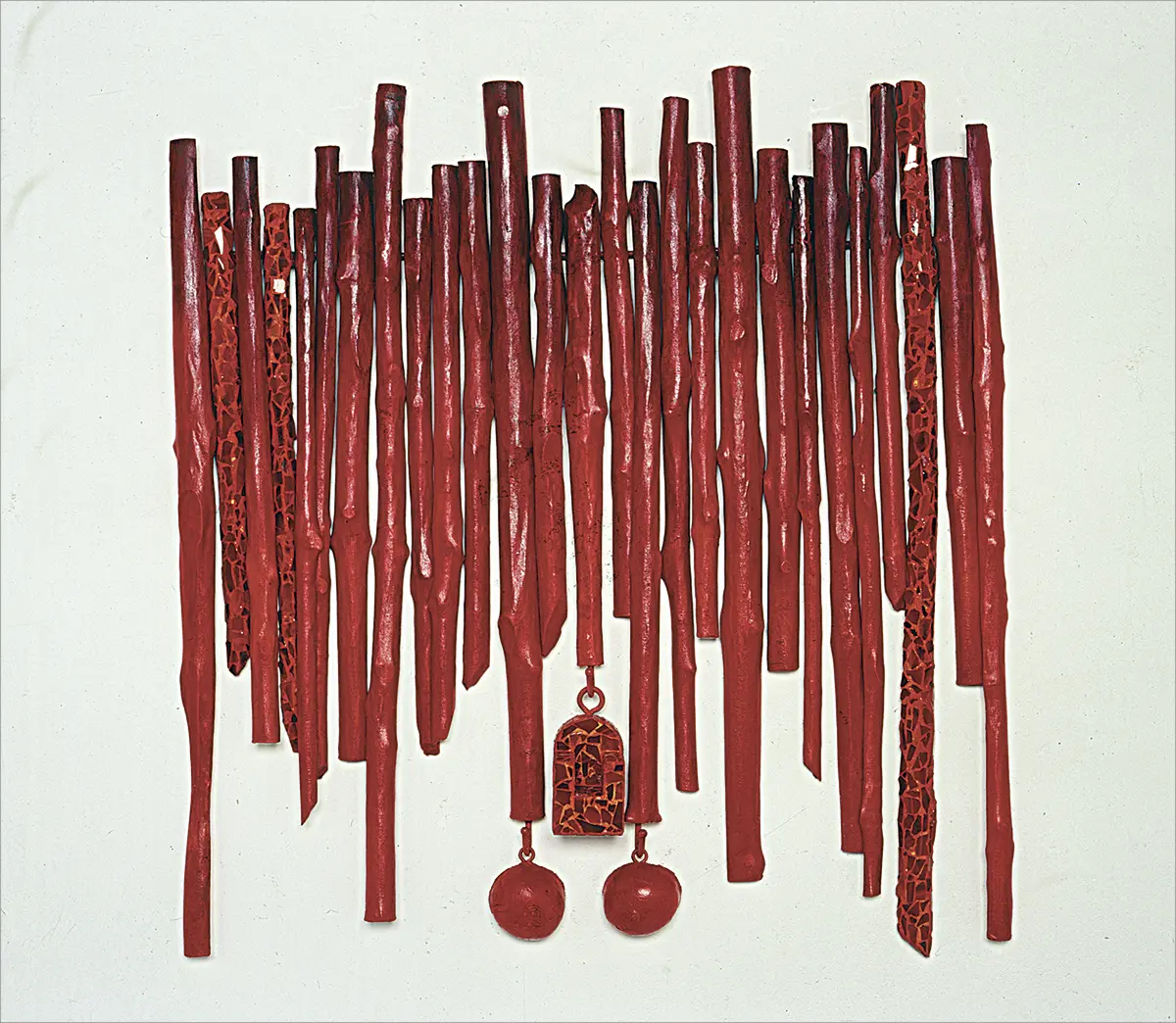
Over the following years, Milson would be drawn increasingly to working in the third dimension. She produced a great number of colorful polyptychs made up of canvas-covered vertical shafts, in large or small groups, through which she represented both herself and society at large. For Milson, these vertical poles are like human beings; schematic versions of men and women who sometimes live together in harmony and sometimes hurt each other. The pieces are all different, just as human beings are, for this artist who believes in diversity and reacts with anger to discrimination. The eleven vertical poles in Conversation among Hypocrites, for example, display silhouettes with a variety of stances, bumps, and peaks, but share a bright, intense red finish, whereas her Delinquents are all extremely thin and prickly. The colored paint and the varnished finish reveal things hidden under the surface: the ropes or sharp objects that lie just beneath the skin. According to the artist, her polyptychs interpret different aspects of her own personality and that of others, as well as sensations or wounds, which turn them –following an Arab metaphor—into what she describes as the “shadows of thoughts.”2
Milson’s assemblages make a strong first impression because of their solid, corporeal presence and the way she combines—through demanding physical effort—pieces of mahogany, mangrove, canvas, nails, staples, twisted ropes and wires, oil paints, mosaics, and fragmented glass. Some materials convey specific meanings, as in the case of tied ropes, which the artist relates to women: "One is tied to the family, to society; to work…Sometimes I tie the ropes on the outside because the bonds are external and obvious, but at other times the ties are internal and can be perceived only by their textures. They are like veins and, at the same time, like our self-imposed inner constraints."3 Other items, such as nails and broken mirrors, convey popular and even historical meanings, in addition to which they trigger different associations in each viewer.
The assorted parts in Milson’s multiform assemblages are made to harmonize through the application of colors, generally bright and warm tones like saffron yellows, bloody or coppery reds, organic purples, as well as earthy tones in pieces sometimes reminiscent of the roots thousand-year-old trees. Even traditionally “cold” colors, like blues or greens, turn warm in Milson’s hands as in the case of the rope-covered figure titled Green with Envy. The artist explores the symbolic value of colors and their connections to feelings—from passion to pride—in interpretations that emerge from a point of view that is both feminine and feminist. Over time, Milson, who has always been concerned with gender issues, began to include in her pieces anatomic shapes such as breasts, backsides, and bellies in a play on the manner in which the traditional “male gaze” dissects –and sexualizes—the female body.
With their ever more energetic proportions, it seemed inevitable that Milson’s assemblages would come away from the walls, becoming independent and fully three-dimensional works that blend painting, sculpture and installation art. This transition became obvious in the late 1990s when she produced groups such as Tongue-Tied Philosophers consisted of vertical beings leaning against the wall—as if in conversation—and later, Sleepwalkers at the Marching Hour where a dozen anthropomorphic poles hung from the ceiling in an open space. Like a “penetrable,” Sleepwalkers incited the viewer to touch, move, and even penetrate the harmonious forest of red staffs.
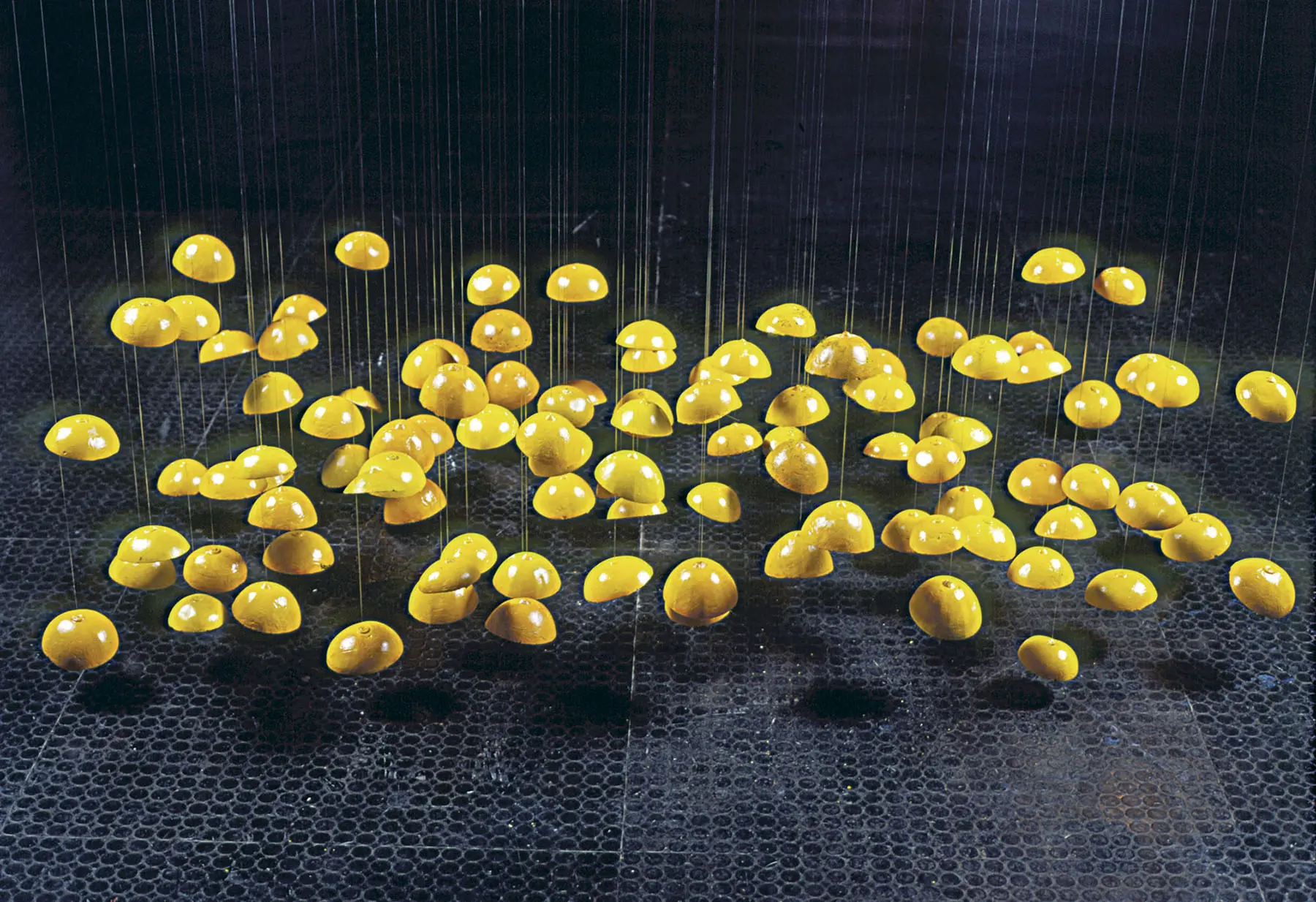
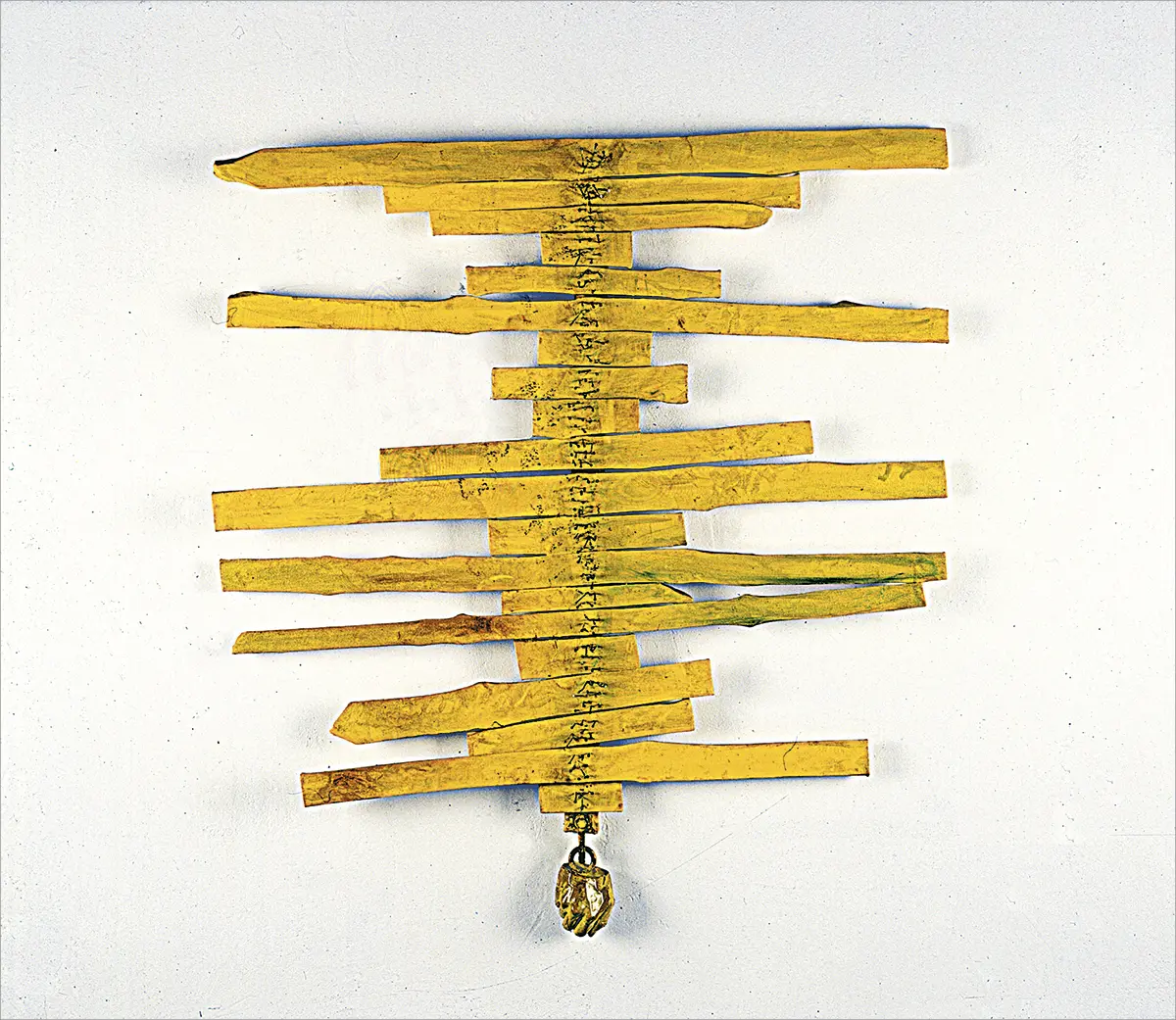
In 1999, Milson held a solo show at Panama’s Museo de Arte Contemporaneo, where she exhibited both wall pieces and innovative works in which body parts now appeared not only recontextualized but also completely independent from her traditional human-vertical forms. The dramatic installation titled Of Tits and Puppets included more than one hundred decorporalized breasts—life-size objects cast in plaster and painted an intense yellow—dangling from the ceiling by thin nylon threads. The breasts floated, hung by the nipples, looking like half-oranges, but also like toys or puppets in an ironic theater piece. Nearby, on the wall, was A Dream, in which several pairs of pale breasts hung from chains like sacrificial items from a medieval ritual. Partial Self-Portrait was a highly personal work consisting mainly of a single, long shaft painted bright yellow and full of dark nails that looked like protective thorns. At its lower end, suspended from the amber phallus by an iron chain, was a cast sculpture of an amputated hand, wide open and highly realistic.
For Milson, the desire to represent the human body, especially the female body, relates to her concern with the objectification of women, semiotics, and the social construction of femininity. Her works also reflect a certain zeitgeist in which creative artists make use of the body and its parts to represent our immediate reality, both private and sociopolitical. In recent decades, notable women artists— such as Louise Bourgeois, Eva Hesse, and Kiki Smith— have been significant players in the development of this “art of the body”, in which subjects previously considered private have become public, and esthetics are combined with cultural taboos.
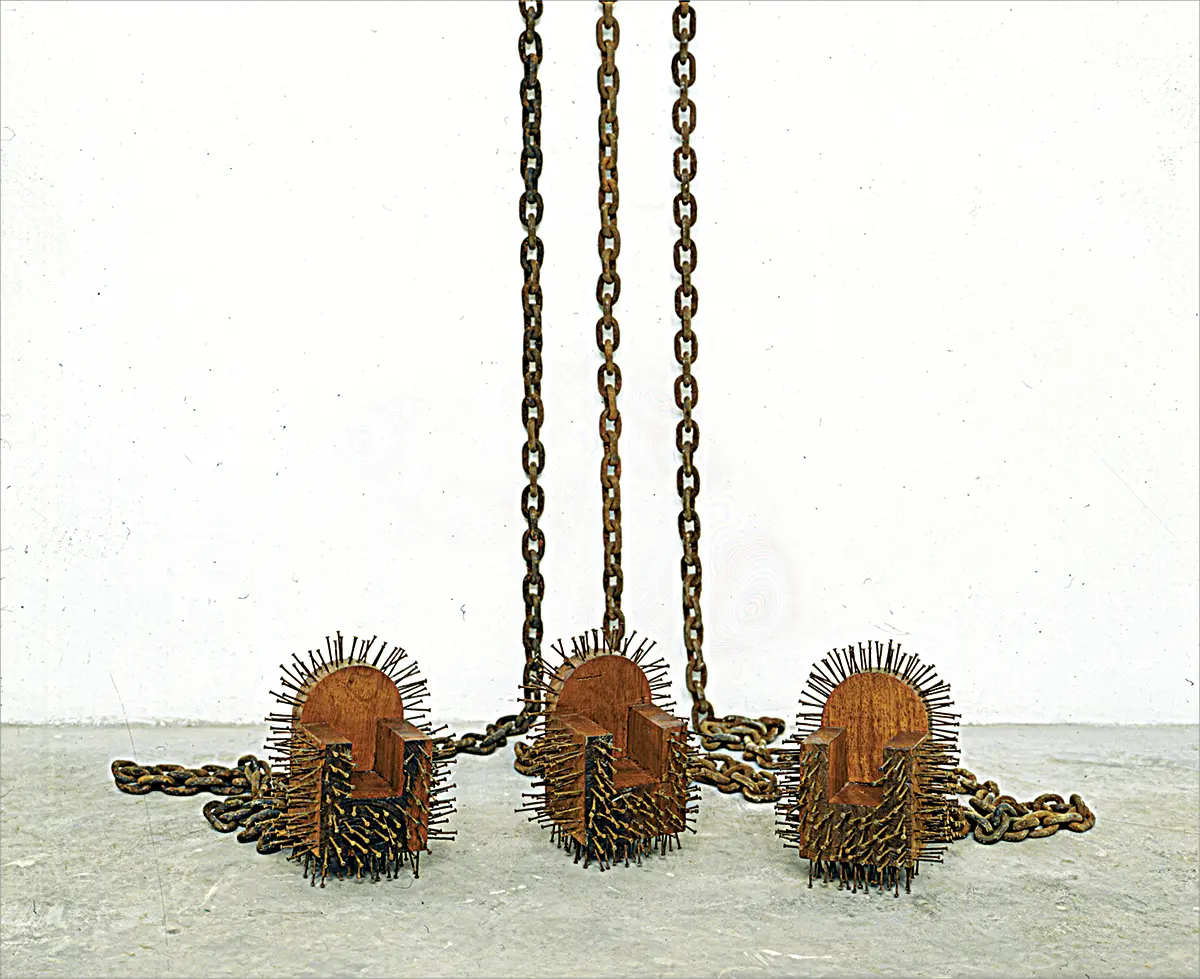
Milson has stated on more than one occasion that the ideas for her artworks come from her dreams, from subconscious information that she needs to express—or sublimate—through art. The relation between her work and psychoanalysis is open and intentional; she is an avid reader of the writings of Freud as well as other psychologists. Milson’s art often manifests personal experiences symbolically, as in the case of Maturing the Decision, a composition in which three tiny yet robust armchairs—surrounded by prickly nails and held in place by chains— make reference to major life choices such as the decision to have children. According to Milson, her self-expression stems from a “compulsive desire to say the unspeakable.”
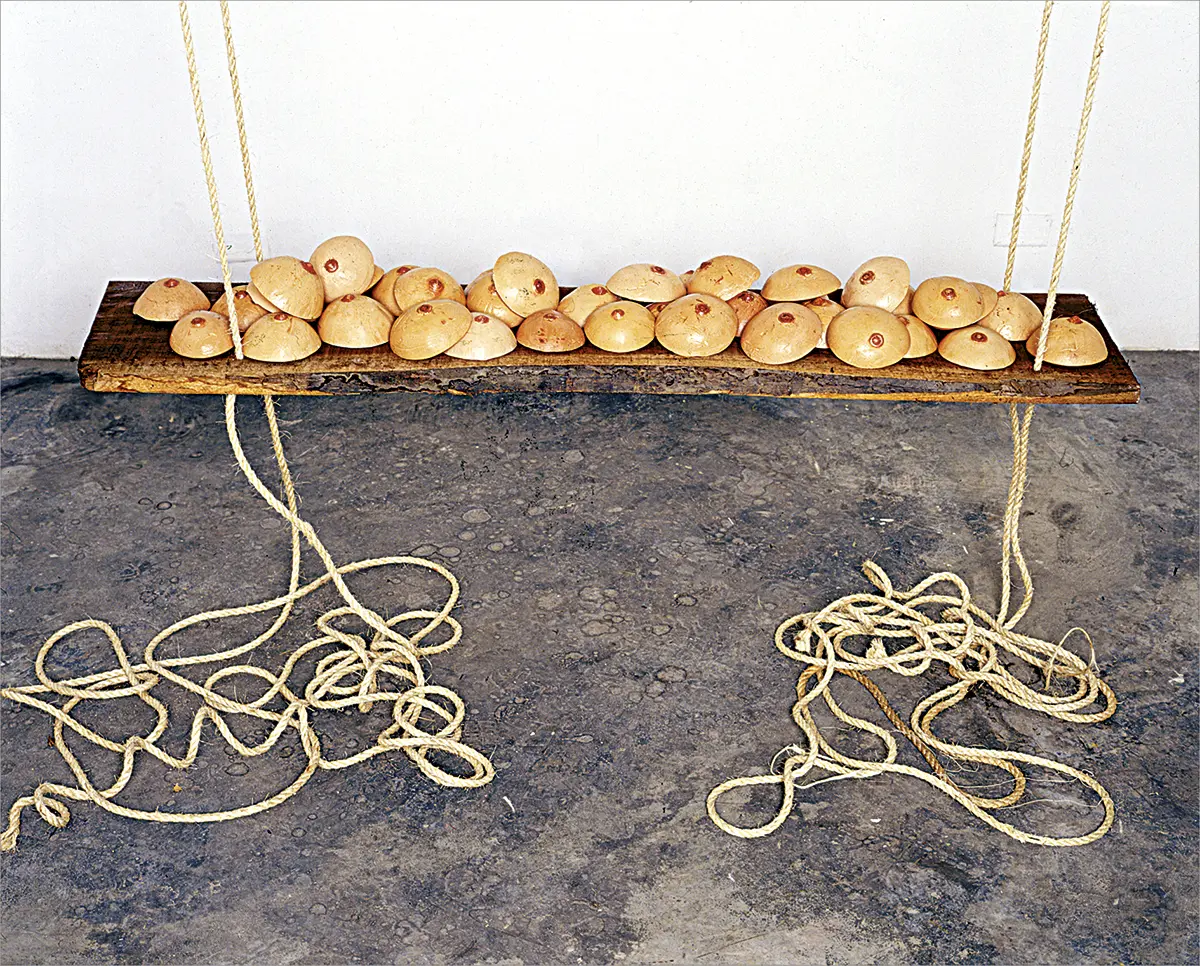
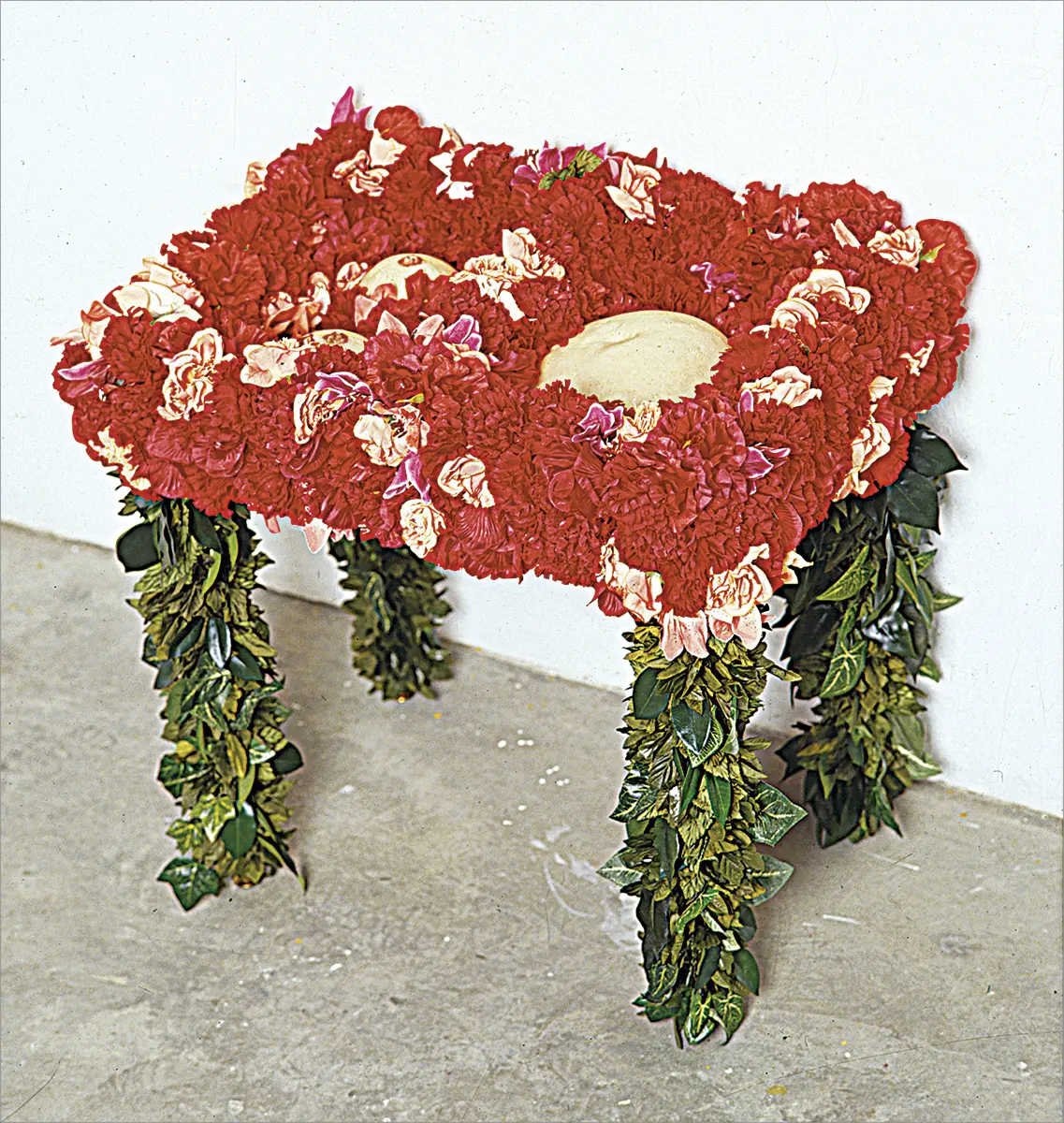
Themes related to gender also come to the fore in order to make tangible Milson’s way of interpreting the world from the perspective of the “other,” a position occupied to this day by women in many societies. She interprets and reacts to the precepts that have defined the role of women within the patriarchal hegemonic structure, a concern that was especially apparent in the works with which she represented Panama at the Cuenca Art Biennial held in Ecuador in 2001.4 Family Portrait, an assemblage of red vertical forms that includes a pair of breasts and a tiny armchair covered with glass shards makes reference to the role of women and that of the pater familias within the home. In Beyond the Pleasure Principle, a rustic, wooden swing held up by thick ropes serves as a support for a large number of natural-looking albeit severed breasts, hyper-realistic shapes that defy the viewer both by their appearance and their implications. Equally challenging is Body Box, a small table with four legs covered with faux ivy and red flowers, among which lie the life-size forms of a woman’s rounded belly and breasts, without limbs, and without a head. The work, with its references to nature, to women and to domestic life, triggers disquieting thoughts about life and death, one of the many dualities inherent to this artist’s oeuvre.
Over the next few years, Lezlie Milson’s work began to incorporate more or less obvious references to religion, ranging from the subtle message in the irregular planks and the closed fist of Acquired Faith to works like Pray for Me, where a broken mirror provides the background for a pair of breasts in a box surrounded by fake leaves and flowers, and crowned by five small figures of the Virgin Mary. Offensive to some viewers because of its attack on sexual, social, and religious stereotypes, the piece was typical of a new trend in Milson’s work in which she flirts with kitsch art while at the same time offering homage to the great Marcel Duchamp, an artist she admires deeply. The most unusual of the compositions from this period was probably The Gardening Club where she covered a bright red, beautifully carved bench with an abundance of crimson silk flowers that provide the setting for a large number of small plastic figures representing a variety of religions—both occidental and oriental—in a kind of mystical Disneyland.
In the first years of the new millennium, Milson continued to create her typical assemblages, from which she progressively eliminated the layers of rope, canvas, and mosaics, thereby exposing the natural wood. In her Tapestries of Wood and Iron from 2002, planks of different sizes and textures appear “nude” but nevertheless expressionistic through the intervention of hammers, chisels, and sandpaper. Beyond that, the compositions were enriched with drilled holes, a great number of hammered nails, and the incorporation of objets trouvées such as popular religious talismans and metal brushes of different shapes and sizes. This tendency peaked in 2004 with the exhibition titled Nocturnes, of a group of sculptures that conveyed intense feelings due to their somber character, the darkly sensuous finish of the wood, and the presence of mysterious objects cast in bronze, iron, and aluminum.
The pieces in Nocturnes showed transformations not only in their darkness but also in the way the wooden staffs had returned to a static position on the wall so that they could now be read horizontally. According to the artist, the absence of color in these somber new works reflects the world situation after September 11, a dark period characterized by terrorism and intolerance. The political message blends with female solidarity in pieces such as Woman Number 5261230, a figure that has a block of wood for a head, three pairs of eyes, lead tears, the number engraved on a metal plaque, and a pubis of nails. There are multiple metaphors here, but the number conveys a direct and historical message, especially in the context of Milson’s Jewish faith.
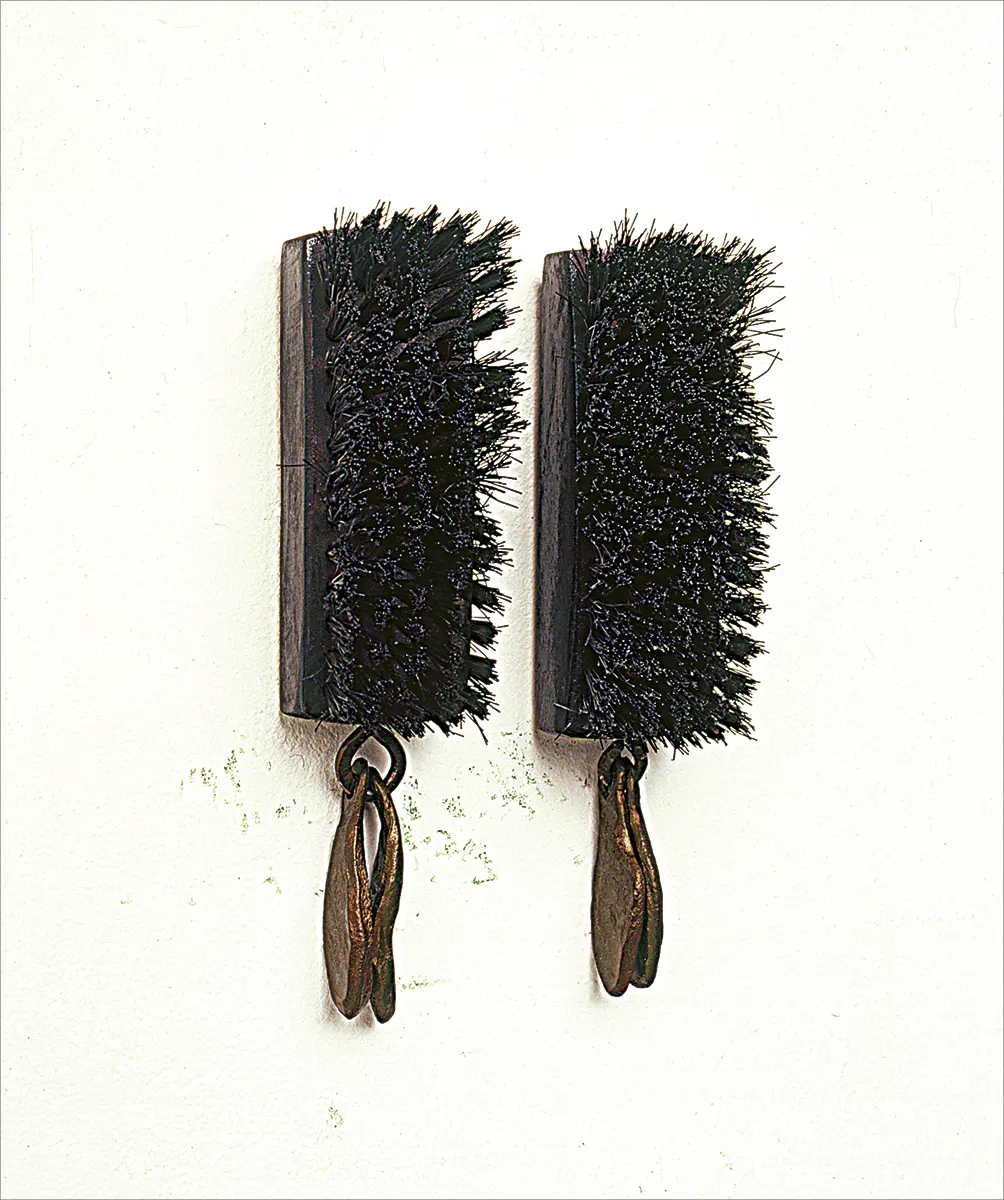
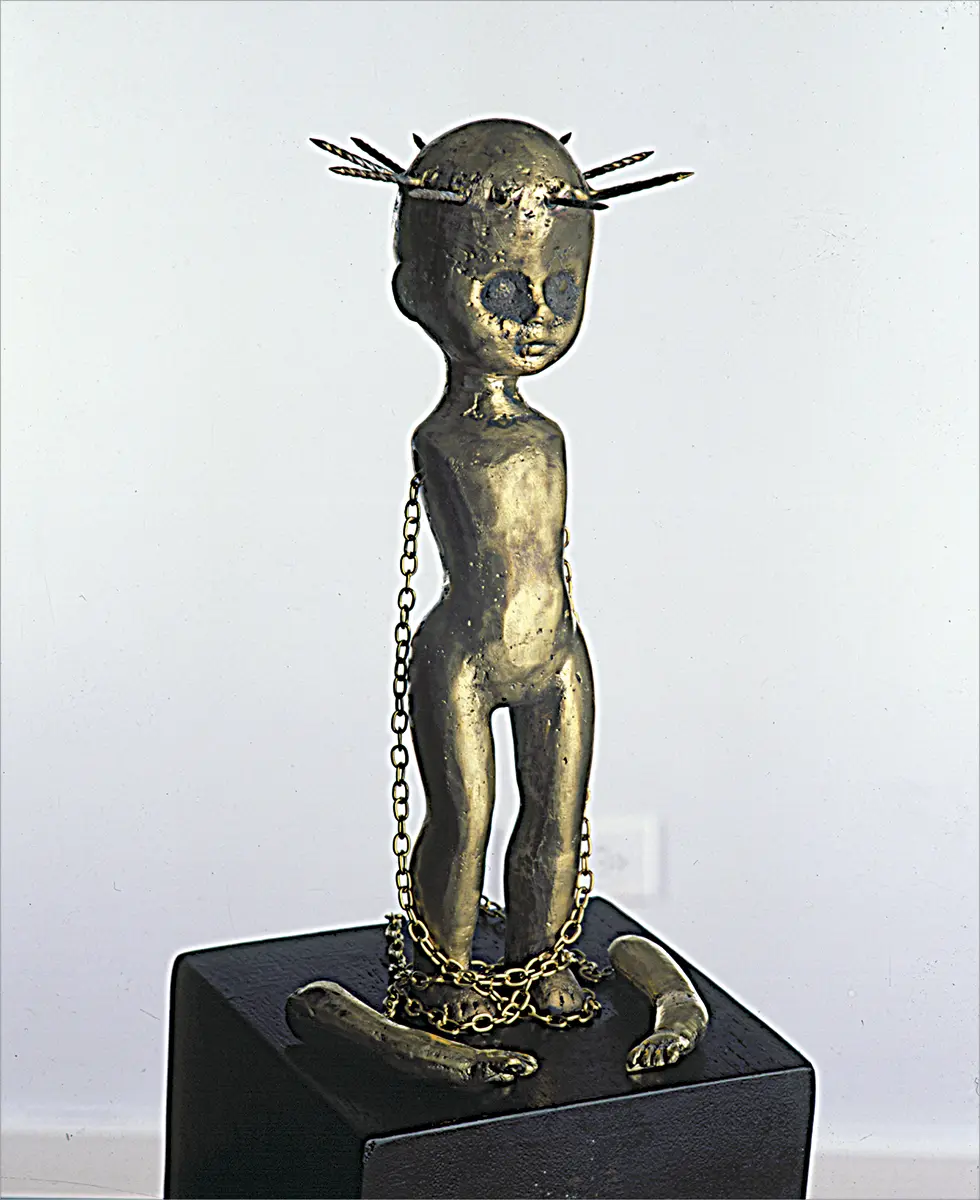
Women continue to be protagonists in Milson’s later oeuvre, which displays more cutting and explicit sexuality, depicted now not only by breasts but also by vaginas, as well as tears and tiny lead feet, mirrors, chains, belts, and nails. The piece entitled Twins is a good example with its two dark, thick-bristle brushes under which hang two hammered pieces of lead that resemble genital labia. The image of a woman is also the essence of a series of cast-metal sculptures in which Milson reproduced the body and the innocent face of a discarded doll. She presents this doll in pieces, in repetitive images, or as part of a delivery, as in the case of Birth where the infantile body can be seen while the imaginary head remains enclosed in a black cube. The artist created sculptures of the naked and broken-up body of the doll, like a toy, with or without arms or ahead, or in the stance of a small sacrificial saint with a halo of nails.
Lezlie Milson’s sculptures are remarkable for their poetic and existential charge, and for the way they incite the most varied interpretations, triggering exchanges in which the viewer is compelled to complete the meanings. With intense colors or without them, she continues to delve into deeper and more daring artistic explorations, where gender issues dominate and the technique is increasingly challenging. Milson creates sensual and dramatic works of art which, like the shadows of her thoughts, reflect a psychic reality as well as her convictions about the situation of mankind in our time.
NOTES
1. Kupfer, Monica. Lezlie Milson: las emociones al desnudo. Panama: Galería Arteconsult, 1996.
2. Aguilar, Amalia. “Lezlie Milson: Entre la pintura y la escultura”. Talingo (La Prensa), 19 May 1996.
3. Ibid.
4. Kupfer, Monica. De realidades y ausencias: tres artistas de Panamá. Bienal Internacional de Cuenca, Ecuador, 2001.
MONICA E. KUPFER
Doctor in Art History, art critic, and curator specialized in contemporary Latin American art. President of the Art & Culture Foundation, and Founding Director of the Panama Art Biennials.