
Contemporary culture is a great archive of images at the service of many. Some intervene on this legacy with a simple, cold, in a way, calculated appropriation; others, in turn, know how to explore its bottomless reserves through a cannibalistic operation that borrows in order to build allegorical narratives traversed by sophisticated ironies. Such is the case of the young Colombian artist Marco Mojica, who knows, and knows well, that visual borrowings can become the —pertinent and opportune— alibi for the articulation of rotund metaphors. His most recent exhibition at the Fernando Pradilla Gallery turned out to be an intelligent palimpsest in which infinite references and stylemes from the visual archive in use offered by the contemporary iconographic system copulated with pleasure and gusto. This being the case, and in his desire to revise this entire plotting of references, the realms of advertising, fashion magazines, and others, as well as the haphazard space of the Internet, film, video, and the watering holes of aesthetics itself, mix into a formula where a far-reaching conceptual and ideological depth take away from the seeming simplicity of the compositions and the presumed candid tone of what is represented.
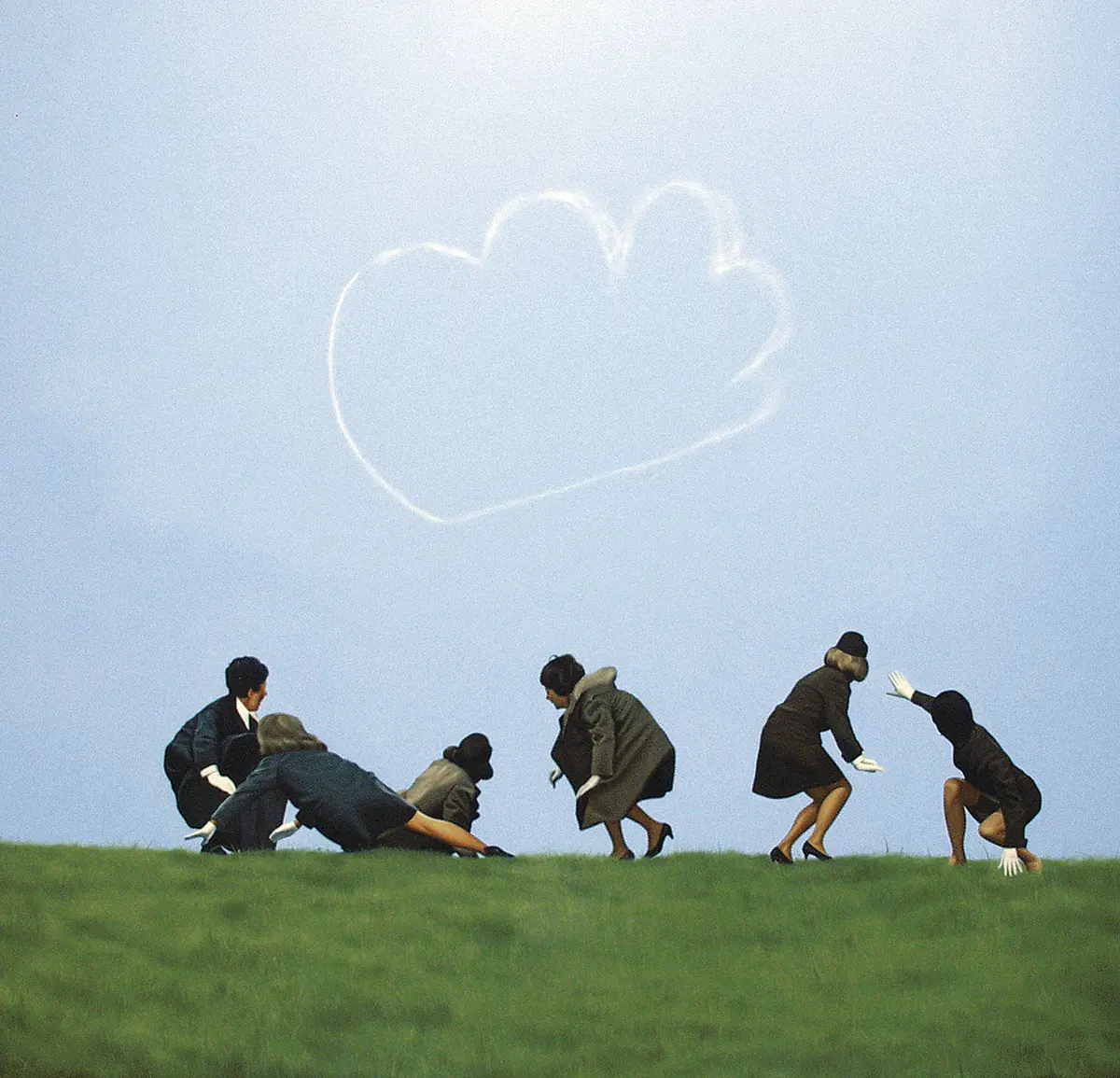
In these most recent works by Mojica, the device of appropriation is invested with infinite subtleties that imply a sharpened reflection on the systems of representation themselves, their hegemonic value, and the overwhelming centrality of certain iconography. As is the case with many of his Latin American contemporaries who produce works of art from the periphery of the artistic field and in unfavorable dialog with the aesthetic paradigms promoted by hegemonic circuits, Mojica doesn’t allow himself a gratuitous flirtation with the intervened sources. His proposal has a conceptual character and ideological background. This is why it becomes extremely evident in his works that these pictorial appropriations, developed by the artist on the basis of photographs and reproductions in books and catalogs for installations by various well-known artists are not reduced to the recursive procedure of quotation and re-signified recontextualization as a consequence of the new location; instead, he intervenes the sources from a critically-accented revisionist perspective, which guarantees an ideological deconstruction that is subject, in large part, to the manipulation of the images in play. In this way, each work introduces a commentary that is by turns sarcastic, ironic, or simply revisionistic. In all of them, we note a sophisticated sense of humor that brings to the fore a sharp way of thinking relationally. Marco Mojica enjoys activating the critical will of the aesthetic act, in the face of the amnesia and the many wild cards, offered up by new technologies.
Works like Autorretrato, El cubo, Paisaje, Perfect Lovers, for instance, show how the appropriationist game of the reinterpretation of contemporary art icons and languages, especially of installation in the context of painting, allows Mojica to establish a dialog that transcends the simple, unpolished juxtaposition of images on the same narrative plane. Mojica builds narratives of emancipation, de-sacralization, and revenge of the periphery. We must not lose sight of the fact that in the process of creating these new images, the conflictive relationship between center and periphery, a discursive axis activated by post-modern thought, is revealed. Most of the images intervened by Mojica come from other works of art, to which he only has access through their graphic representation. Traveling and gaining access to cultural capital are, in many cases, utopias for the Latin American artist. This is why, in part, this recourse to the appropriation of the original and its pouring into a new stage for meaning is so common a procedure among artists who articulate their aesthetic discourses in the margins, although it is also true that centrist discourses are traversed by and subjected to re-readings that want to turn down the aura and de-numb the axiological fields in which their cult value resides.
In the case of this show, we see that most of the images used by the artist belong to a distant cultural space. All have reached him through print references. This is, if you will, one of the great conflicts assumed by Art History programs in peripheral areas, where sensibility is cultivated and sharpened through reproductions. This ineluctable reality gives Mojica’s work a special interest because the “original” images are framed in a context that differs from the photography appropriated by the artist, which presupposes a triangulation between what is represented, the photography of what is represented, and the painting produced by the artist. This triangle generates a multi-directional conversation between the different elements that comprise it, generating questions like, What are the relationships between the images? How is each one of them understood individually in its own context? What is added to each image as it is filtered through a culture that is alien to it? And, moreover, what is the status acquired by a work of art created on the basis of the image of another work of art? Faced with these questions, Mojica sketches irony, and like a cannibal from the periphery, sits at the table. He takes for himself a legacy he thinks is his and warns us of a game that, while seeming naïve, ends up being openly perverse.
ANDRÉS ISSAC SANTANA