
In a socio-politically charged environment, in which issues of immigration challenge and question identity, it is refreshing to find an artist like Mario Ybarra Jr. who embraces and reenergizes his Mexican-American culture in joyful communion.
The key to understanding Ybarra’s work lies in his biography. Born in 1973 and raised in Wilmington near the Los Angeles harbor—where he still lives—he was exposed to the immigrant street culture and the politicized union dockworkers who, with their insignia, parades, and protests, influenced his subject matter and aesthetic sensibility. Ybarra is an artist who takes on life as an active participant, not as an onlooker. He examines his surroundings like an anthropologist and reinterprets in his installations how Latino communities appropriate elements of U.S. culture by altering them and making them their own.
Since graduating from the University of California, Irvine, in 2001, his politically-charged iconic installations and performances have been included in internationally renowned group shows and exhibitions including Uncertain States of America curated by Hans Ulrich Obrist in 2005, Alien Nation at the ICA in London in 2006, and California Biennial in 2006. He is also scheduled to participate in The World as a Stage curated by Jessica Morgan at the Tate Modern in London and in The Prague Biennial in 2007.
Ybarra’s first gallery show of his career at Anna Helwig Gallery in Los Angeles consisted of a minimalist, multi-media installation incorporating sculptures, drawings, painting, and video spanning the last nine years. Although more understated than his usual installations, this exhibition captured the artist’s vitality, creativity, and political stance.
Setting the exhibition’s tone and taking center stage was Ybarra’s conceptually witty Protest Flag (2006), composed of the Stars and Stripes hanging from a wall-mounted flagpole wrapped in black electrical tape. At first glance, the flag seemed to symbolize the artist’s official pledge of allegiance to his country of birth. But on closer examination, one discovered at the pole’s finial the national emblem of Mexico—a golden sculpture of an eagle perched on a cactus with a snake in its beak. Subtly, this powerfully manipulated icon raised the question “Who is protesting what?”
Strategically placed opposite the flag was MVP (2007), a painted clay self-portrait bust of the artist wearing his usual attire, a blue L.A. Dodgers baseball cap. Ybarra seemed to ironically place the image of himself in a position of pride opposite the American flag, like a hunter’s trophy; however, the miniature scale of the work seemed to diminish and question the artist’s intent.
The twenty brightly colored pencil drawings from the series The Ballad of Chalino Sanchez (1998) made up the artist’s homage to the popular singer’s tragic life. The musician born Rosalino Sanchez Felix began his career as an illegal Mexican immigrant and farmworker in California and became notorious in clubs for singing the norteño and corridos genres: music about drug trafficking, murders, and crooked police officials, as well as the struggles of working-class Mexicans. However, his life was cut short and his reputation rose to that of a folk hero when he received a death threat and was mysteriously murdered in northern Mexico. Ybarra’s beautiful series commemorated and outlined the heartbreaking life of this immigrant-turned-hero who celebrated the realities of his Chicano community in song. One drawing showed a pile of money and its diagrammed circulation among a house, cassette tapes and compact discs, a family, and a rifle. In another, three blonde girls dressed in Western attire dance on stage as Chalino performs.
In a more recent series of pencil drawings, Attack 1 and Attack 2 (2001), Ybarra offered a fresh perspective by fusing low and high culture images inspired by hip-hop, graffiti, and classic Chicano art. In these drawings, he staged “mythical” street fights and gave voice to hybrid identities were taken from urban street culture. In one, a middle-class house with a fancy sedan and a large satellite dish serves as the backdrop for a battle between a cowboy, demons, and possibly Ybarra, while a mighty eagle dives down with a rifle in its beak to save the day, swooping over the struggle and a group of protesters.
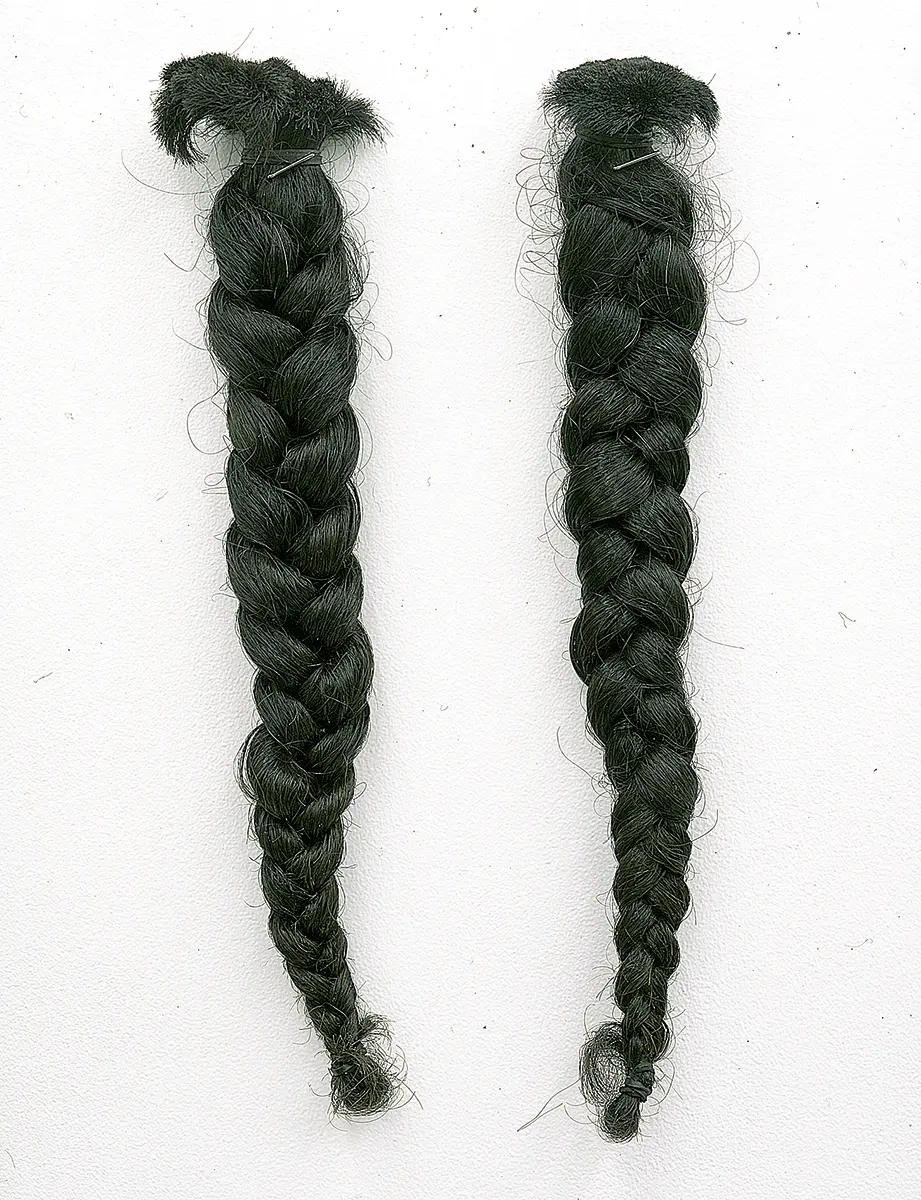
Clearly, Ybarra’s visual language stems from his experience as a Mexican American raised and living in Los Angeles, where a multitude of icons and images popularize and give voice to a myriad of varied cultures who share in the inevitable thread of integration. At thirty-three, Ybarra is making work that seems to celebrate the necessities and realities of assimilation. At the rear of the gallery was a mesmerizing clear Plexiglas box holding a pair of beautiful braids, pinned against a white background: Thanksgiving (2002), made with the artist’s hair, brought a smile.
MARIANGELA CAPUZZO