
Noemi Ruiz (who is in her '70s) and Julio Suarez and Jaime Romano (who are in their late 50’s), artists from two very different generations are probably the most authentic and consequent abstract painters in Puerto Rico today. It is not that Julio Rosado del Valle or Luis Hernandez Cruz are not extraordinary abstractionists who defined this field in the Island, but they have freely experimented with figuration during their very productive creative careers. On the other hand, the above-mentioned artists remain loyal to an aesthetic discourse that many believed would eventually fizzle but that instead has flourished and enriched itself through the years.
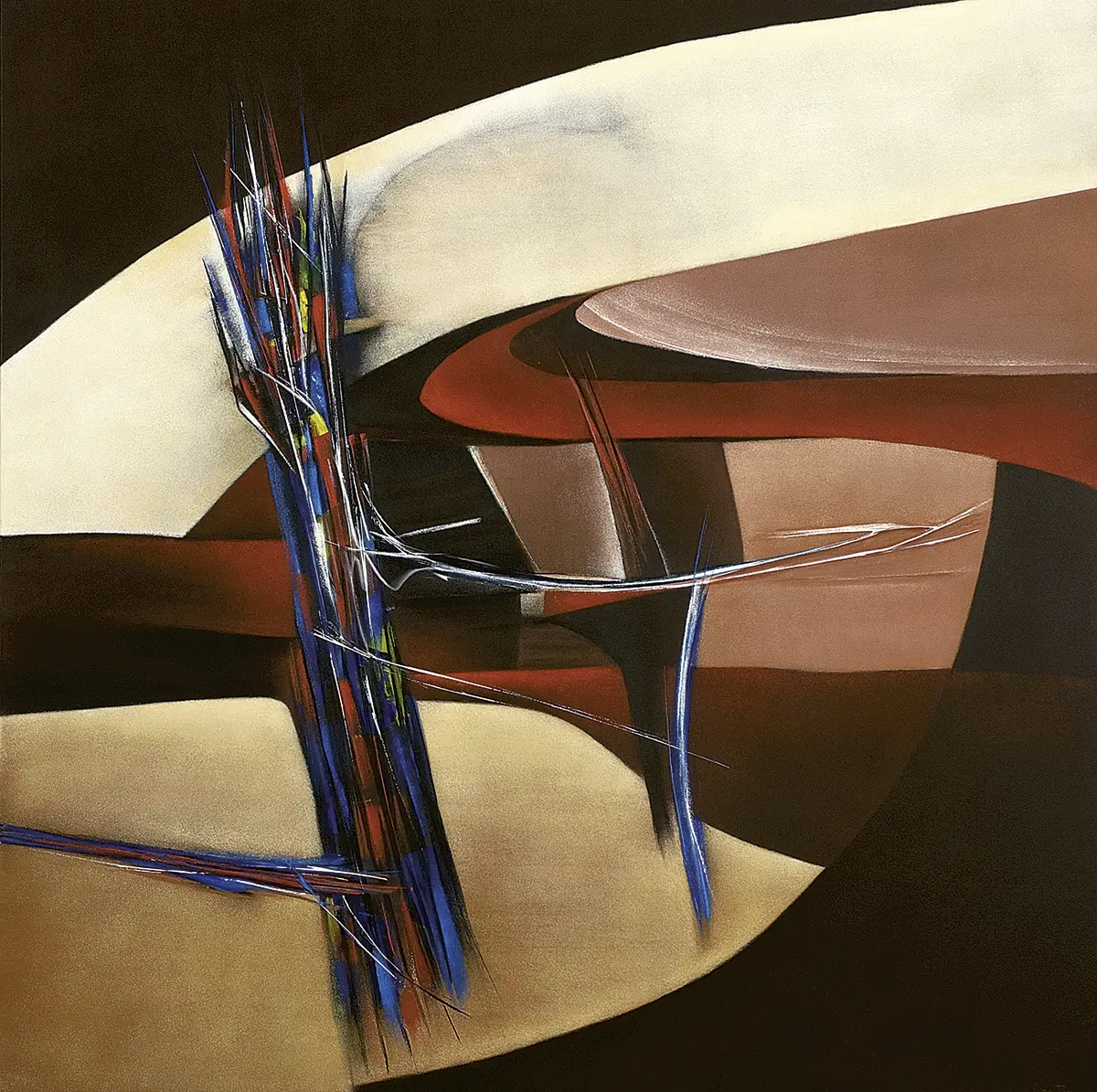
And Noemi Ruiz has remained loyal not only to abstractionism and her original and well-liked style during more than five decades but in the last l0 years she has reached a beautiful maturity that definitely puts her on the same label as the best abstract painters Latin America has produced. And it is her impeccable and successful career the reason for Noemí Ruiz y Su Espacio en el Tiempo, a superb retrospective exhibition at Museo de Arte Contemporáneo de Puerto Rico (which began in March of 2007).
As we know, abstractionism became an important aesthetic force since the beginning of the 20th century when artists like Mondrian Malevich, Kandinsky and later Brancusi presented a new way of expressing themselves after the Industrial Revolution and, especially, after the invention of the photographic camera which totally changed the cannons that had existed since the Renaissance. Of course, there are antecedents to 20th-century Abstractionism. It is now clear that sections of the enigmatic cave paintings of the Paleolithic period can be seen as abstract art, and that some of Turner’s most spectacular paintings contain powerful and passionate spaces that can only be defined as pure abstract painting. But the fact is that abstractionism, the persistent, enduring, tireless, and incredibly original aesthetic force we know today, in 2007, is not yet l00 years old, and that it is still full of possibilities and energies.
Although abstractionism arrived quite late to Puerto Rico (our first abstract artists such as Julio Rosado del Valle, Olga Albizu and Luis Hernández Cruz began experimenting within the freedoms of Abstractionism in the ’50s), in the ’60s the disagreements and political confrontations between the artists from Generacion del 50 (who believed that their mission as artists was mainly folkloric and patriotic, and who saw artists like Rosado del Valle as egotistical traitors to the Independence cause), had ended and Abstractionism had become a rich mainstream discourse in our Island (Marta Traba: How wrong you were!).
Soon the second generation of very talented abstract artists emerged: Marcos Irizarry, Roberto Bonilla Ryan, Julio Suárez, Jaime Suarez, Jaime Romano, Melquíades Rosario Sastre, Pablo Rubio, Lope Max Díaz, Carmen Ines Blondet (many of whom were influenced by Cuban Masters Rolando López Dirube and Zilia Sanchez, who had moved to San Juan in 1962). From the 60’s until today we have had extraordinary abstract creators among whom we find Eric Tabales, Rafael Rivera Rosa, Ramon Berrios, Carlos Guzman, Heriberto Nieves, Enrique Renta, Linda Pintor, Ricardo Avalo, Erick French, Javier Ramos, Boricua Rivera, Fabián Detres and Melvin Martínez, just to name a few.
Noemí Ruiz y Su Espacio en el Tiempo is not only an impressive retrospective exhibition (well-curated, effectively presented) that pays tribute to one of the most significant and refined painters Puerto Rico has produced during the second half of the 20th century but a true celebration of a life defined by poetry – real poetry (Noemí Ruiz writes poetry) and visual poetry. This tireless painter has been creating truly outstanding compositions (“landscapes”, “ritual dances”, “dreams”), since the early ’60s, and has taught every artist in her Island a great lesson: in art, you just can’t be a visionary or a poet, you have to be a real professional who works very hard to make those poems or visions of artistic reality.
From the beginning of her career, it was clear that Noemí Ruiz was not only a master in the field of color and composition but that she had been able to develop a unique type of lyricism in her paintings – a kind of “dance”, some sort of emotional “explosions”, where rhythms and tensions interact making each one of her paintings a distinctive aesthetic experience. There is indeed an indescribable dynamism in her compositions. Although her chromatic rhythms are the result of a well designed and rational process of painting, with a lucid final composition in mind, her work always reveals a distinctive kind of spontaneity where colors and lights recreate some amazing moments — that struggle between chaos and order that words could not capture completely in our Genesis.
Noemí Ruiz’s abstract discourse can be best defined as visual lyric poetry. There is an alluring ethereal quality in her work that sets her apart from other important abstract painters in the five generations of abstract creators that coexist right now in Puerto Rico. In this fine retrospective exhibition – one of the best in a long time in Puerto Rico – the public was able to see and enjoy a significant sample of the works of this impeccable artist. As it happens with Cuba’s Amelia Peláez, art lovers appreciated how a very personal and attractive style can change/evolve with time but maintain the essence that defines its uniqueness and beauty. Although throughout the years her work has become more intense she always succeeds in capturing in her paintings the flights that make us free.
In several conversations, I had with Noemí Ruiz before this exhibition, she confessed to me how draining the experience of organizing this retrospective had been; that the process of choosing the right paintings at times were even painful (but fulfilling) because she had had to re-live her past while looking at hundreds of her compositions from the ’50s to the present. More difficult was helping the curator in the process of selecting “the right pieces” in each of her major creative periods. And it was sad for her (and for me) to realize in this process that she had enough good paintings for another robust retrospective exhibition.
But no matter what Noemí Ruiz y Su Espacio en el Tiempo is a real tour d’ force that gave viewers an unforgettable experience: seeing almost 100 abstract compositions that teach us (or remind us) what a truly exceptional art professional and a great visual poet is about. We are talking about a passionate visionary who has been able to translate her delicious universes into the canvas. We are talking about a true lady who has spent all her life succeeding in making ours gentler, more beautiful.
MANUEL ÁLVAREZ LEZAMA