
Las Brujas de Tepoztlán (y otras óperas inéditas,) by Pablo Helguera, is presented by the Enrique Guerrero Gallery. As is customary in the case of this author, fiction and reality always rub against each other and the veracity of his work relative to the documents that supposedly back what he presents, gives his proposals a tone of corrosive humor that is in the end winning. Whoever is confronted with his work remains seemingly defenseless in the face of texts and interviewed actors that speak with sham seriousness and knowledge, even if every once in a while we discover that, as in the case of Samuel Sod, they are about to break into laughter, defeated by the “serious humor.”
Las Brujas de Tepoztlán (y otras óperas inéditas) is a project that includes an exhibition with polyvalent dioramas or stagings, collages in a fully Modernist vein, and the publication of a book written by Helguera which describes and studies the biographies of four opera composers who, according to him, “have been so deeply forgotten that they're very identity could be questioned: Enrico Camorelli (1868-1904,) creator of the opera Il Processo di Giordano Bruno; Mona Kassem, (1955-?,) creator of the minimalist political work Jahannam; Anselmo Jiménez de la Rueda (1593-1674.) author of Las Brujas de Tepoztlán; and Richard Pryce (1915-1078,) author of The Connecticut Story, an opera composed in the 1950s.”
Regarding Jiménez de Rueda supposed work, for example, Helguera affirms in the voice of one of his “interviewees” that it remained hidden inside an armoire (of course, where else can these things be hidden?) until 1654, which makes it perhaps the oldest such work in the Americas.
Another interviewee, Mona Kassem, gives a clear account of Helguera’s position with respect to contemporary art. From the sham conversation we extract phrases and positionings that had already appeared in Helguera’s work, in the same ironic tone, for instance in his Manual de Estilo de Arte Contemporáneo, first presented as part of Espejos/Mirrors in Washington D.C.
Perhaps one of the key moments in this purposefully unpolished video occurs when, on the basis of the description of a theater play, we are told how it has an unexpected ending that criticizes in the fourth act the previous three. Thus emerge characters that are extemporaneous (to the play) to critique the mise-en-scene and, interestingly, to debate the author. In sum, what according to Helguera gives the opera its fully contemporaneous character is its tightly concentrated self-referentiality.
Helguera himself tells us that “this project is the utterly failed result of an attempt to have the work of art speak for itself, without any need for criticism, historiography, or interpretation. Perhaps this is why it arouses in its viewers and/or readers the strange feeling that both in the exhibition and in the book the authors, interpreters, critics and characters fuse together or switch at different points their roles as if in a game of musical chairs but without chairs, and with a single player who is all of them at once.”
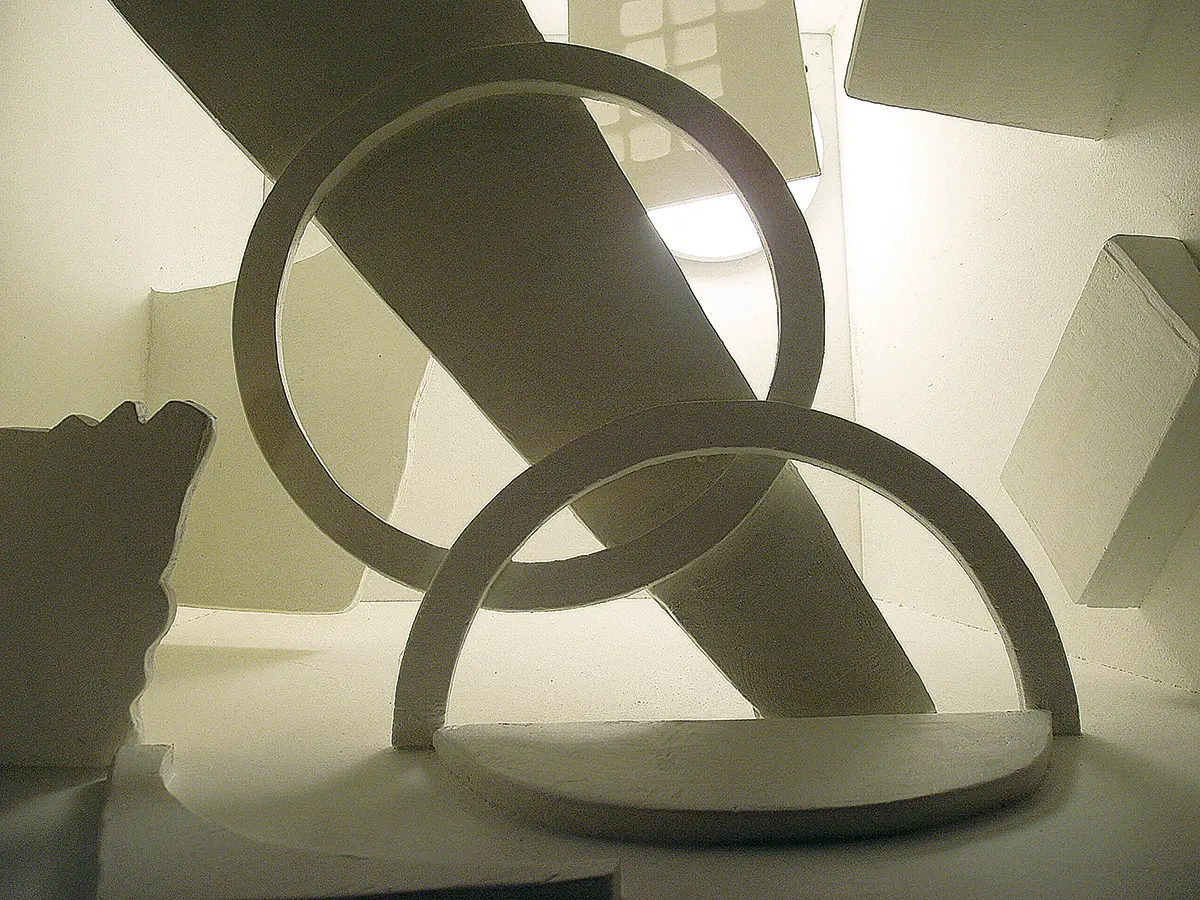
The show is accompanied by models representing stages with four sides made in the manner of cones in which the perspective of distance is located at the lowest and furthest point from the eye. Like surprise boxes, we can see in them silhouettes of characters who inhabit those spaces as well as chairs, pianos, and theatrical flies that relate harmoniously to one another, although at the same time contradicting each one of the scenarios exhibited.
A group of collages, fully Modernist in character, is also part of the show. They reveal a clear yearning, especially for the work of the European artist who made in this genre some of their more remarkable contributions. Las Brujas de Tepoztlán is a well-polished work, complemented by Helguera’s investigations/inventions and it must be read as another link in the artist’s already eventful career. At the same time, one must not lose sight of his comments to his own work: “Today, when we live in an academic context within art, dominated by comparative aesthetics, by self-referentiality, and when the fever of relational aesthetics is still common, it is difficult not to produce works that reflect on these issues, as is the case with this project, which, in it's modest way, is attempting a commentary on this territory.”
Well, not as modestly as he says, because once again Helguera points out, from the standpoint of the most recalcitrant contemporaneity, the onanism that reigns in many areas of the contemporary visual arts. We will always be thankful for the sense of humor, and even more for the sense of irony —this is his best insignia.
SANTIAGO ESPINOSA DE LOS MONTEROS