
Art critics and historians know that Soledad Salamé (born in 1954, Chile) has long been interested in the visualization and conceptualization of nature, and specifically water, in a humanistic context connected to the preservation of human life. For her, this topic is related to human beings and the majesty of the planet they inhabit; the issues that she confronts and explores in complex plastic terms are not simple. In the words of Edward Sullivan, writing in one of the four texts included in the catalog that accompanied Salamé’s recent exhibition, this oeuvre “is based on a deep understanding of the visual image’s aesthetics and its history.” Using a mixture of media, the topic of water—images of melting ice, precipitation, and running rivers—was expressed in the video, photography on aluminum, solar printing, drawing, and painting, as well as in a lenticular animation. In this work, Salamé arranged a panel with many lenses and two images; the result was a virtual movement of water currents that fell in a continuous sequence and which the viewer perceived while moving in front of the work. This exhibition, installed in three large galleries in the museum, was a unified multi-media installation. Aside from the presentation at Santiago’s Museo Nacional de Bellas Artes, the show traveled to the Museo Histórico y Arqueológico in La Serena, Chile, and the Pinacoteca de la Universidad de Concepción. Its tour ended in March 2007.
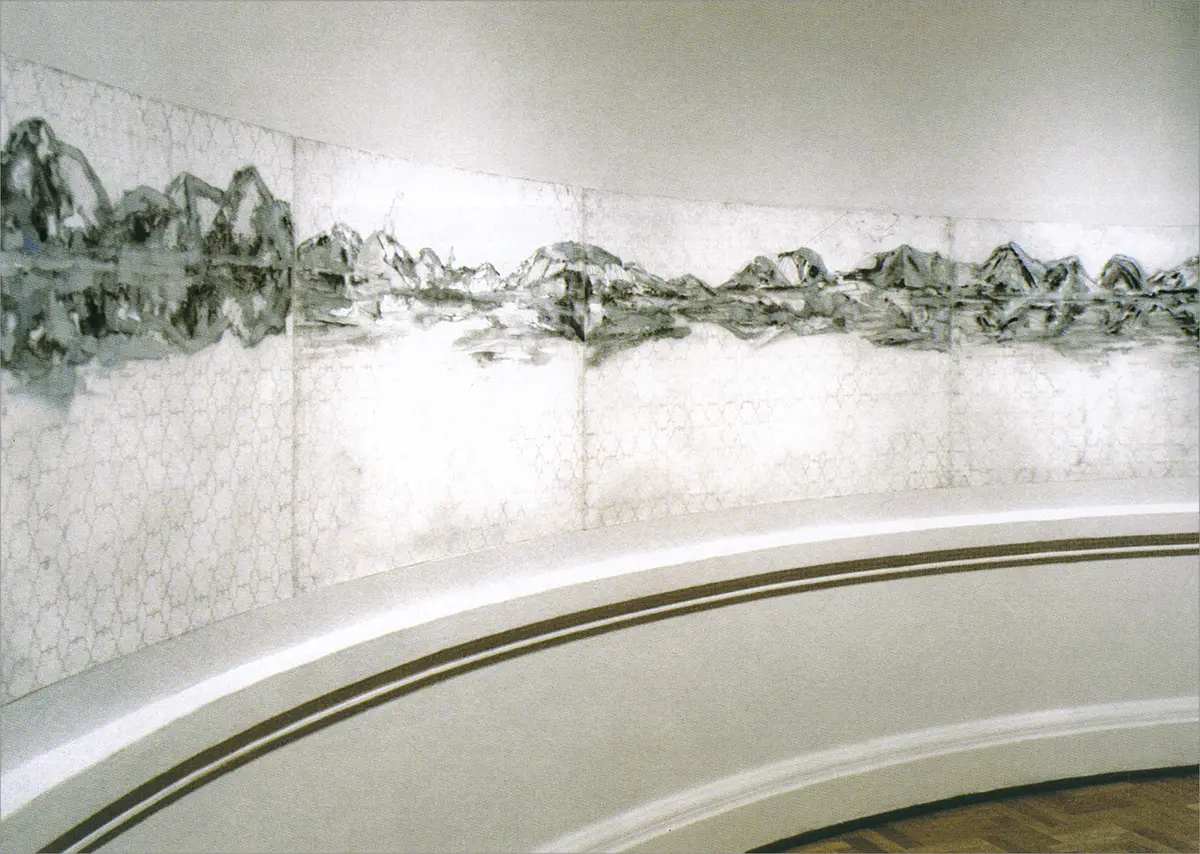
The artist’s “understanding of aesthetics” was supported on visual poetry of transparencies and subtle color strokes, especially white and various grays (never completely black), blues, greens, silvers, and purples. This gestural expression disorganized the support’s surface and violated the video images with a continued, shifting interaction of shapes, textures, and colors. Viewers reacted to the beauty of water as it moved in large waves, and they were immersed in an expressionistic spectacle with significant pictorial features and exquisite visual characteristics. A good example was Reflexiones antárticas, an unending drawing that, in a figurative way, showed the melting process in Antarctica. In the series of photographs on anodized aluminum titled Continentes de agua, Salamé displayed an image of water in movement, an image that expanded to create a kind of aerial geography that acquired volume, reducing abstract and figurative drawing to a mutating visual proposition, while the working tools transformed the exhibition into a multi-media visual performance. The titles of Salamé’s works were closely connected to the topic, a good example being Salto del Ángel, in reference to the Venezuelan waterfall commonly cited among the world’s great marvels. In the Rápidos series, the turbulent liquid became mysterious and hermetic. These last two works were of mixed techniques on canvas.
The mystery of water—its essence, its possible scarcity, and man’s fascination with it—has captured the imagination of many contemporary artists, who have approached the topic in various ways. But for Salamé, a Chilean artist who has lived for many years in Venezuela and currently lives in Baltimore, it has become a metaphor for life and art or, rather, a metaphor for art and life. She conveys the topic as planetary landscapes, cosmic landscapes in perpetual motion that come close to the viewer’s spirit and sensibility. She takes the most classical formal values and makes them contemporary via her exploration of technological media. Based on her own creative and artistic experiences, Salamé’s artistic/thematic proposition is very convincing. There is no doubt that this work, involving water and a concern for the damage inflicted by man upon nature, implies an important stage in the development of Salamé’s oeuvre. Her song is optimistic, a song of veneration for Nature that has given us so much.
BÉLGICA RODRÍGUEZ