
Each new exhibition of work by Alberto Passolini (born 1968, Buenos Aires) is a breath of fresh, playful air that sweeps away the solemnities of the art circuit, or at least the Argentinean one. Passolini does not follow fashionable trends and does not respond to demand. He does not waste time explaining his conceptual inclination in edifying statements, and his work is not (it must be pointed out) included in the collections it should be. Passolini does what he wants to do, and one cannot help but notice and enjoy it.
An excellent draftsman without an international presence, Passolini is one of Buenos Aires’s best-kept secrets. Entirely committed to those “features of the local” so dear to seekers of autochthonous talent, he nevertheless manages to retain his low profile, which is almost cult-like at this point. In his first exhibition of paintings for the Buenos Aires gallery Zavaleta Lab, Passolini carves out an area of interests—summarizing greatly, one can call it the “axis of evil”—and transforms it into a series of paintings exhibited alongside a self-portrait photographs. In the photos, he appears clad in black leather, accessorized with a red tail and small devil horns. The paintings present a variety of situations around error, accident, and paradox. The exhibition title refers to the twenty-year-old album by Michael Jackson, Bad.
Executed in acrylic on MDF, Passolini’s paintings only acquire meaning when one dives into what they narrate when one discovers the complicity between a work and its title, when one disassembles the subtle plot of references that are always humorously deployed. His use of figuration, clearly skewed toward the aesthetic of comics (“cartoonized” figures, as the catalog suggests), remove any sacred quality from the scenes, limits their traditional artiness, and adds references from comic books, illustration, and advertising. With their large, round eyes and their four-fingered hands, Passolini’s characters—those in this show and also many from before—are like pieces of comic strips that have fled the graphic art context and appear suddenly in the middle of fine art’s conventions and requirements.
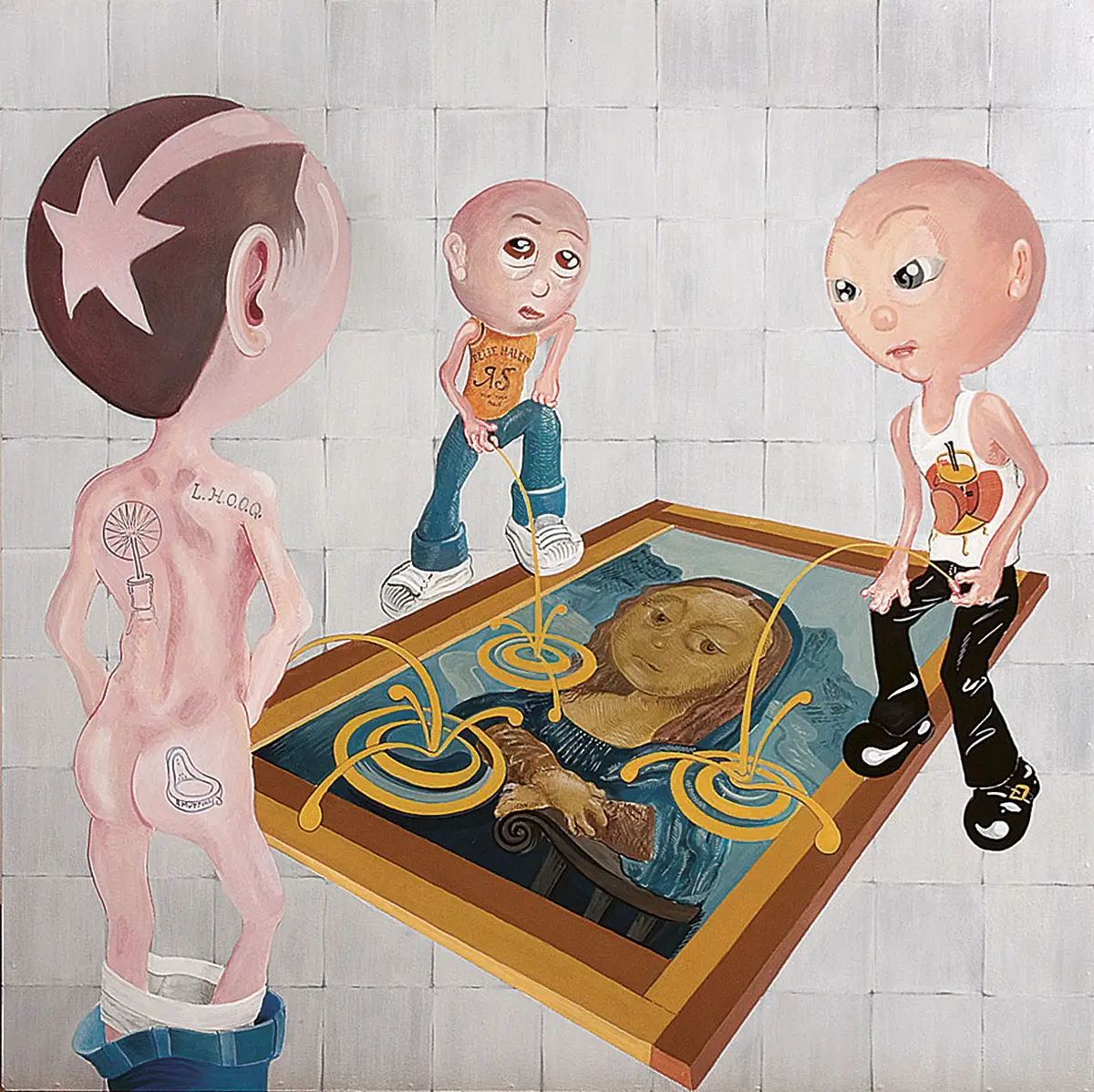
Perhaps this estrangement of characters is Passolini’s device for commenting on his own estrangement, turning over his questions, and above all laughing at some clichés. In one of his images, titled Pas de Duchamp! (fuente), three adolescents with shaved heads urinate on a fountain shaped as Leonardo’s La Gioconda. The figure in the foreground, with his back toward the viewer, presents three Duchampian tattoos: a urinal, a wheel, and the letters L.H.O.O.Q. (the title of the work in which Duchamp transformed La Gioconda with facial hair). Imagining a more extreme gesture toward the iconic figure, Passolini becomes even “badder” and more irreverent than Duchamp himself.
In another work, titled Dink (Double income, no kids), the protagonists are a gay couple that stares, on what could be a museum wall, at the photographs recording La familia obrera, a 1968 work by the Argentinean conceptual artist Oscar Bony, who (decades before Santiago Sierra) paid a family to be exhibited for hours atop a stage. Here also, art is a favorable medium for confrontation, in this case between archetypal families of the past and of today: a man, a woman, and a boy carrying a book versus a man, a man, and a small dog with a leash.
In a country where marginal citizens are commonly referred to as “blacks,” Passolini painted Negroni, in which a young window-washer has been hit by a car driven by a lady who sips from a cocktail, presumably a Negroni. In a city where a public-smoking ban has just been enacted, Passolini painted Excluidos inclusive, in which the new victims of the system appear condemned to isolation. In a world where Michael Jackson was synonymous with fame and fortune, Passolini hired two rock critics to write in his catalog of the fall of the King of Pop, of Bad, and to accompany him in his intention of pointing out other falls from grace, other decadences, and politically incorrect corrections.
EVA GRINSTEIN