
Venezuelan artist Amalia Caputo presented her most recent exhibition, titled Fe, cuerpo y artificio, at the Alejandro Otero Museum in Caracas from November 2006 through March 2007. The exhibition gathered a series of videos and color photographs printed with very high quality on vinyl, all referred to the issue of corporality. In Caputo’s work, the depiction of the nude body is the framework for images and objects that display thought and the aspirations we have for it. The body we inhabit appears as a façade for life and experience and as the victim of our obsessions. Present throughout the exhibition is the contemporary tension between the real body and the idealized one, between what is and what we desire.
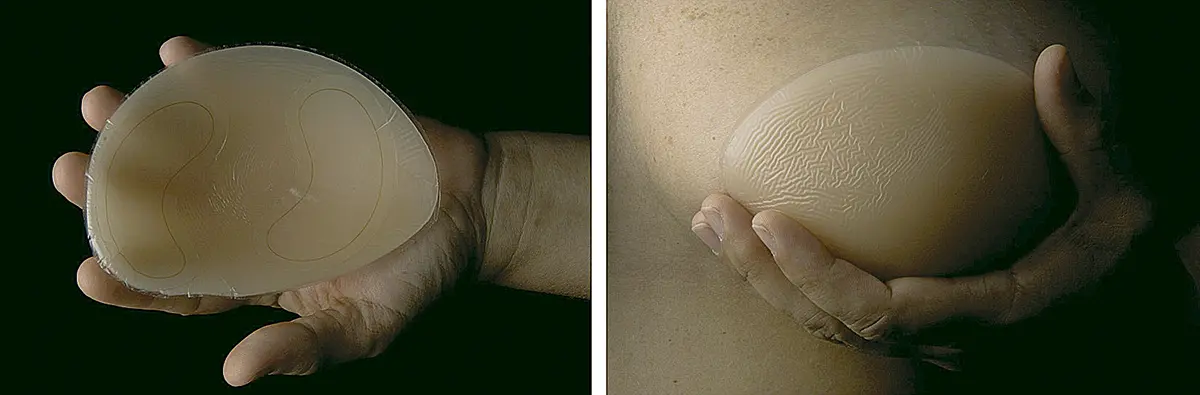
One group of works posits the possibility of aesthetic change through artifice. Using ingenuity and technology, the body can be transformed and brought closer to the ideal, which in turn is the result of a culture influenced by multiple factors, especially advertising. The symbol of these interventions is a silicon implant held by a hand, like a till life for our times, as seen in Untitled 1&II, 2006. In contrast, and distant from such concerns, there is also the freed body integrated into the nature of the video titled The Inner Tree, 2005.
Faith is another of the topics explored by the artist in clean large-format compositions in which the body is the carrier of small signs and talismans. A Chinese fortune cookie on the palm of one hand underscores the existence of a destiny written both in the little strip of paper inside the cookie and in the hand’s own lines; a colorful ribbon inside a neck displays the phrase “God keeps his promises” —to not forget—. Over the corporal and the concrete, the intangible is expressed. These works stand out as detailed approaches to parts of the body in a composition that is as solemn as its topic. In the diptych Fear-Faith, 2004, faith and its opposite, fear, appear through the figure of a boy with his face covered, isolated in his perceptions and with each feeling written in large letters, which is the only element differentiating the images.
The bodies exhibited are free of artifice, they are youthful and healthy and their nudity is not aggressive; they aren’t either beautiful or ugly, they are not manipulated to be glorious or grotesque, as often occurs in art and in advertising. Amalia Caputo’s vision is humanistic; she wonders about natural beings and cultural interventions. The first intervention is underwear, and thus her video Underwear, 2005-2006, where two monitors display a divided body: the upper monitor shows the breasts, and the lower one, the hips, both subjected to the obsessive action of putting on a brassiere in the first case and a pair of panties in the second, in a desperate attempt to find the right appearance and expressing great discomfort with the features actually possessed.
The exhibition deals with issues of appearance and belief, but also with trauma and healing as part of the history of the body. The Void-La casa pesa, 2004, a multiple works comprised of ten images, presents the body we inhabit as the subject of metaphors and allegories and also with elements like prostheses that refer to previous works by the artist. Amalia Caputo’s exhibition career has had the topic of the body as a constant, beginning with an exploration of her own body and later expanded to other bodies but always with an iconic element, a symbol of the passage of time and of cultural interventions, with specific investigations around gender attributes and prosthetic objects. The difference between genders appear under question in this show in Paradigm of love, 2004, four images of a young couple that display very few distinctions in terms of their physical characteristics.
Body and thought appear in Amalia Caputo’s images to question us about the contemporary world and its representation. Each image not only comments on each individual’s expectations but also points towards wider spheres and contextualizes the natural body as a representation of life and residence. There are many subtle ways of using the body for ends different from its primary intention. In this exhibition, after some reflection, what is natural triumphs over artifice.
SONIA CASANOVA