
Ángel Ramírez is one of the most notable voices of Cuba’s contemporary art scene. His versatility, continuous experimentation and solid artistic propositions are distinctive characteristics of his work, which borrows from our capacity to assimilate and restructure foreign codes as he redefines the function of medieval icons for constructing acid-like parables that highlight the prevalence of hic et nunc. Although the artist possesses an equally prolific artistic career as both painter and engraver, the exhibit hosted by the Centro Provincial de Artes Plásticas Eduardo Abela during the month of March 2007 focuses on Ramírez’s engravings.
From the very title of the exhibit, Ángelagrabado, and throughout the works themselves, we are entreated to appreciate and rethink Ángel Ramírez’s artistic trajectory through his engravings. The good fortune of this retrospective exhibit is observed in its bringing together important pieces belonging to different series, all exhaling an identifying trait of the poetics of this creator: The image-text juxtaposition emphasizes and/or expands the levels of meaning, while the title serves as paratext throughout, revealing the subtlety and sagacity in Ramírez’s work and comprising the parodic wink-of-an-eye midway between what it is said and what is suggested.
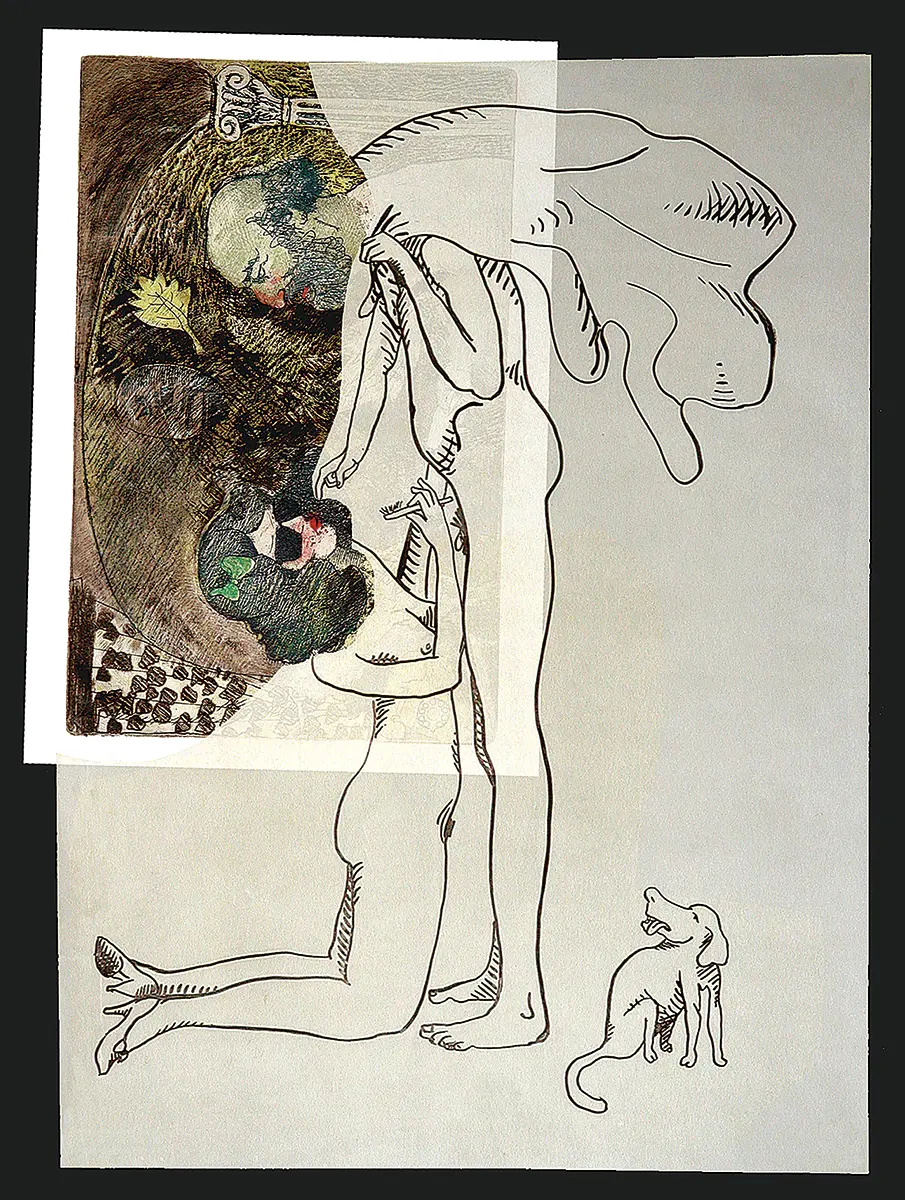
In many of the artist’s exhibited proposals, engravings are not only meant for personal expression and communication, but also, create a space for tautologic reflection. The printed image reveals to us its interest in grasping everyday life to interact with artistic tradition and cultural context. The image also desires to inform us of the importance it renders to its form, its expressive resourcefulness, its content, its technique, its reception, its support. The exhibit embodies the new dimension that engraving has achieved on our island since the last decade: It transgresses traditional methods, coexists with and receives nourishment from other manifestations, and seizes upon any support; new discursive strategies are sublimated into an “impression”, a “fingerprint” of multiple connotations.
On entering the gallery space, the visitor interacts with the Dando y dando (Give and Take) project in which Ángel Ramírez showcases both his capacity to make images and codes from Universal Art History and Cuban Art his own, as well as his deftness at transferring his personal symbology into the style of another creator for the sake of a common discourse. The group action presupposed by the duality of this work adds dimension to the brotherhood represented in the artistic profession, and especially in the exchange among Taller del Callejón del Chorro engravers.
Just three steps lead us to a zone where ideology, the struggle for power, and the hierarchy of the symbols king, peace, death, and good and evil converge, a place that establishes suggestive metaphors regarding our sociocultural surroundings. In works such as 2/1 and Vayamos por parte (Let’s Break It Down), we also are parties to a dialogue between the taco (shoe or dandy), considered here as work of art, and impressions from different fragments in the work, which deploy the recipient into a construction-deconstruction exercise for enjoying the game between the parts and the whole.
A similar intent can be appreciated in La Habana (fragment)—found in the third exhibit room—where the decoding-encoding of small, socioculturally meaningful places in Havana suggests to us the way in which Ángel perceives this city, a vision always renewed at every exhibit staging with adaptation on each occasion to the space housing installation of this graphic art. Likewise, works forming part of the gift wrapping paper-inspired series also combine medieval codes with symbols from our cultural and sociohistorical context. Cuentos de Ada sin censura (Uncensored Fairy Tales) addresses image manipulation: special paper (papel dibujo/papel alba) traces and modifies the engraving’s connotations; thus, a novel visual proposition is constructed. Sarcasm concerning the narrated story sounds this series’ most dissonant note.
Considered collectively, Ramírez’s pieces hyperbolize the manner in which art self-recycles itself into post-modernity. The artist’s dexterity is evident in his manipulation of medieval icons, emptying these of their original religious meaning, but maintaining their semantic weight, rich in polysemic folds that transfer their whipping metaphors into profane realities that are heavily infused with humor. This manifestation illustrates our assiduity for the Toma y daca (Give and Take), and our zeal to eschew the sacred, which early on has shaped our idiosyncrasies. The exhibit reveals a shrewd creator of the art of illustration, whose transforming take on the past allows for reflection on the present and utilizing Art History as an excuse for tautologic discourse. The art of Engraving emerges as an axle of meaning and as the thread for discerning Ángel Ramírez fingerprints.
IVONNETT ARCIA-ZAMORA