
Two great projections, installed one in front of the other, occupying the entire space, submerge us into a thunderous volume of violence of the river’s current. The water slowly drowns our consciousness. We stand before the Video Installation of the artist Clemencia Echeverri, titled Treno. Canto fúnebre (Train. Funeral Dirge).
The strength of the torrent whirls grows inside us and appears on the surface. Human voices echo in this denseness. These are calls, voices that travel through remote silences in the darkness of the waters’ deepness. The power of a subtle allegory is working on us, one that sends us to war, violence among human beings, and mourning. The power of this allegory consists precisely in carrying ourselves into this state of immersion in the current, which sets us in a reflective place, although unsought, nearly submitted to expectation, in which involuntary relationships flow in human disgrace with respect to violence. It touches the translucent bottom that exists behind thought, linking us intimately to these contradictory forces that comprise an unstoppable torrent: war.
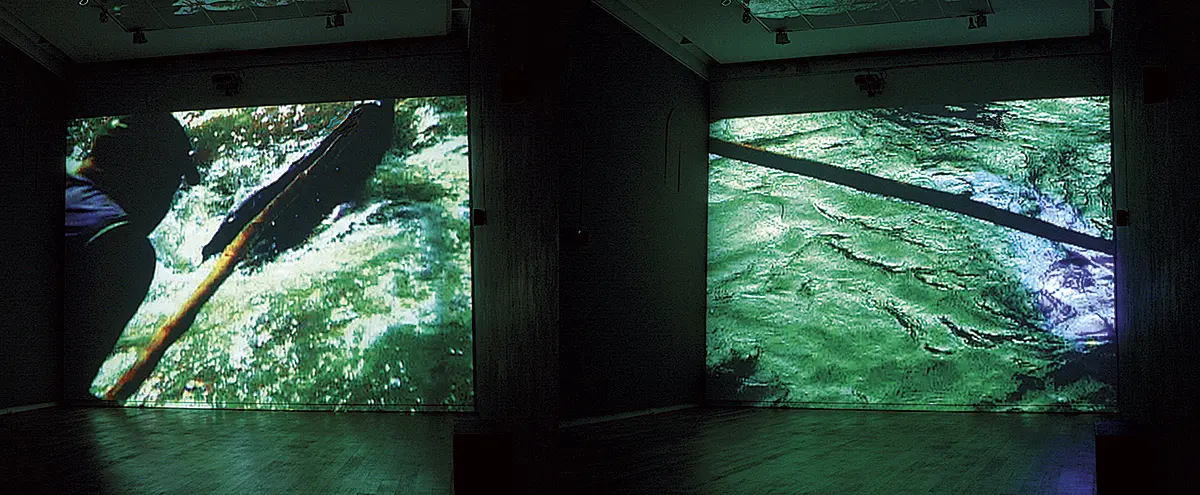
Clemencia tells me: ¨The installation has two shores, we cannot cross, we cannot cross to the other side”; “voices call from one side to the other”. The metaphor is clear: it alludes to the impotence, the impossibility of changing sides in the middle of the conflict, to the very experience of death. There is more. Placing ourselves in the center of this current situates us up, upriver, one more living force that adds itself to the river’s course. We are part of the conflict, “we are played”.
If art possesses any attribute, it might be this allegorical power of the sensory, which connects us with these processes that cradle the subconscious call and with something there that we do not know, but that we come to know in a distinct manner. Knowledge that determines us. The expression of the incommunicable... the symbolic.
This is the enormous responsibility implied in the artistic task. We have seen many works that allude to war and violence, above all from the 1990s on. There has been a veritable invasion of the violent image of pain in the global media world. The majority of these images contribute, without being aware of it, to feeding the contemporary myth of terror, that which comes to be the justification of the “just war”, of the “preventive war”, of the “state of exception” (permanent) in which everything is possible, even eschewing the attributes of what is human. This work, Treno, is distinct. It gets at the bottom of the social condition of war without falling into the spectacle, which annuls the genuinely communicative capacity of language.
In the panorama of contemporary artistic practice, this work is evidence of the possibility of entering into the scenario of violence and pain without damaging the dignity of suffering, and without converting violence and pain into symbolic merchandise.
MARÍA BELÉN SÁEZ DE IBARRA