
The Alejandra Von Hartz Gallery is very suitable for theatrical presentations of art. The arrangement of the walls, the wooden floors, and the lighting are all elements that in various ways complement the works on exhibit and act upon them. Viewers experience an instinctive desire to remain there for a long time, to explore what stories can be told through the woodwork, or to listen to the sounds—imaginary ones, perhaps—that filter through the roof tiles.
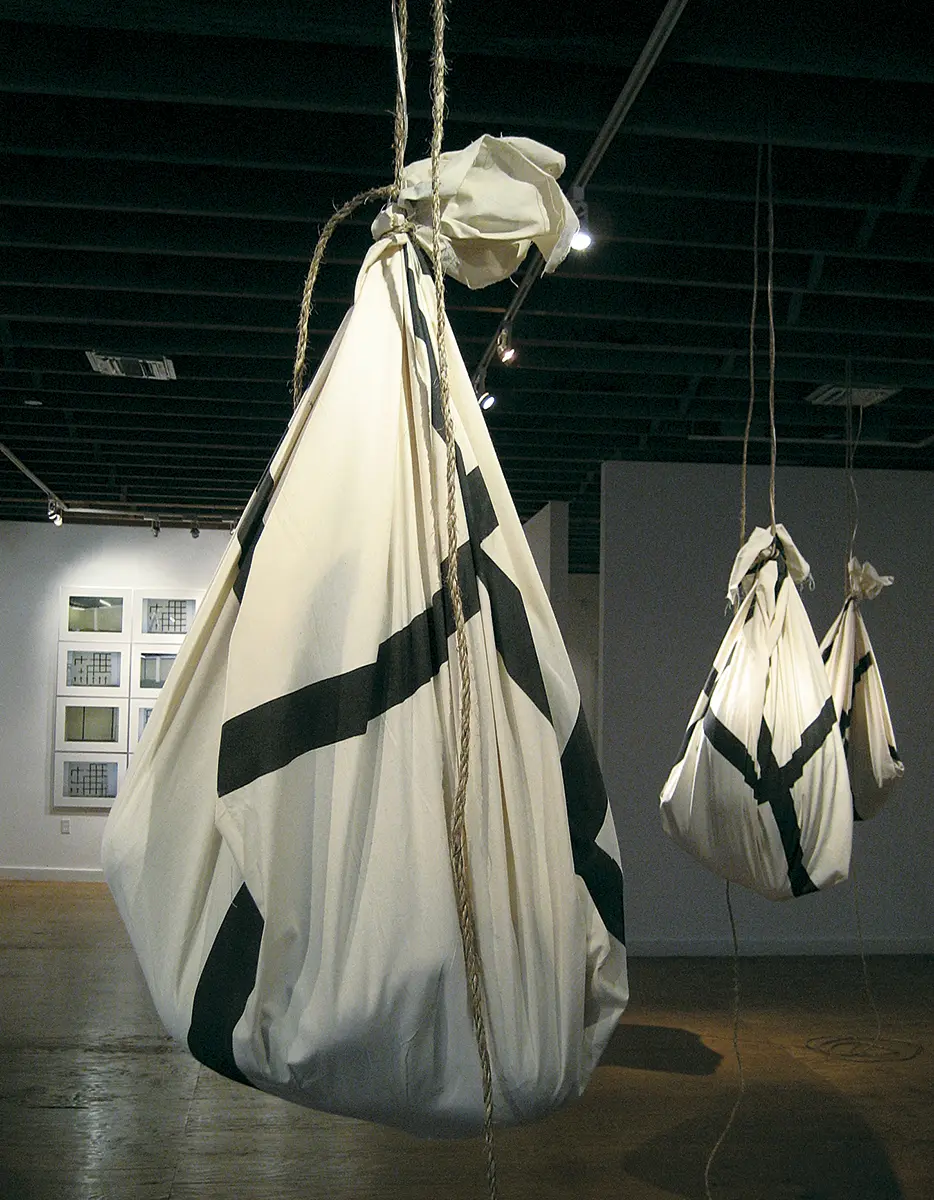
Eugenio Espinoza’s installation titled The Rite of Spring established a fluid dialogue with each (real or illusory) particle of the space. Three canvas bags with geometric motifs appeared suspended in the air. The viewer was unable to describe with full certainty the material contained inside the bags; one thought of a variety of three-dimensional objects. The music of the Russian composer Igor Stravinsky flooded the gallery, coming from the three hanging sacks. Was this a way of representing melodies without musical notation, an attempt to visualize or give form to the intangible? Instead of using a musical staff containing a score, the artist used the medium he knows to represent the cadences of the universal language of music. Any didactic readings, explanations, and indetermination were unnecessary, and a visitor decided to find an exit, a shortcut amidst the grids, and to divine the indecipherable.
The art of music, while considered a language that breaks down barriers between people, is in itself difficult to grasp, decipher, and conceive. Music is a form of abstraction formed by figures of different nature, many of which refer to geometry. As a common listener, one is able to apprehend and even demystify some of the basic musical elements such as melody, harmony, and rhythm. Others, gifted with a certain ability or natural sensibility, are able to discover easy chords as they play a given instrument. Yet, only those trained in the art (musicians or specialized students) are able to read, understand, and penetrate the accumulation of signs, drawings, and schemas that appear in a musical score. This is akin to what occurs with foreign languages, sciences, and the arts in a general sense.
To a degree, the creation of a new visualization of music is part of Eugenio Espinoza’s quest. Sustaining this pursuit since the 1970s, amidst the effervescence of geometric abstraction, his work has been recognized and admired in his native Venezuela and in Latin America. Espinoza’s work Impenetrable (1972) created a barrier similar to what emerges when two people attempt to communicate using two different languages. The installation, in grid-patterned cloth, blocked visitors from entering the exhibition area. It not only satirized the image many viewers have of the work of art (sacred, consecrated)—which is already “difficult” to access due to its multiplicity of meanings—but it also punctured the utopian possibility of dialoguing with abstraction. The Rite of Spring continued along the same path, now giving geometry a seemingly less rigid, less austere quality. The hanging sacks perhaps referred to the vulnerability of form, the work’s variable dimensions, and its context. Even so, one had difficulty in penetrating the essence of the objects, in unveiling what hid behind the grid-patterned cloth. The coming together of subject and object is like the relationship between a fruit’s skin and its pulp. It is a game of dangerous seduction, a game of (im)penetrability.
Eugenio Espinoza received the honor of the CIFO Commissions Program for 2007, and his work was also on display at the prestigious institution. Like the installation at Von Hartz, the works at CIFO also included grid-patterned cloths forming various structures as well as a vast array of drawings and photographs.
The Rite of Spring played with notions of tension and balance, and it stimulated one’s senses in ways that were similar to the Brazilian artist Ernesto Neto’s abstract, organic installations, which create perceptual spaces involving sight and smell. Stravinsky’s melodies, jealously guarded inside the bags, leaked through the cloth and invited one to become part of the story. Tension ebbed and flowed with the musical dramaturgy. The sacks became part of the stage décor in an imaginary dramatic piece that perhaps took place in the spring. When one saw the drawings of the work’s development and process, everything began to make sense: slowly, abstraction can mutate into a specific shape.
DINORAH PÉREZ-REMENTERÍA