
These two Venezuelan artists present their shows as Schuster&Zajac. With solid individual careers already behind them, since the mid-1990s they have shared the creative experience of painting without contradiction or stylistic conflict; the quality of their collaborative work was recognized at the Aragua National Art Salon in 2003, where they won first prize in the category of two-dimensional art. Deeply figurative, their theme can be understood as a celebration of the beauty of the body expressed through a formally rigorous draftsmanship, a chromatic richness, and spatial quality. The oeuvre is comprised of several parts that are differentiated and self-sufficient in their physical dimensions, linked into a whole by the invisible coordinates of a visual language developed from a series of themes based on a transcending historical memory, the sacred and the profane, to become an ultra-contemporary matter of two-dimensional formality presented to the viewer by way of installation.
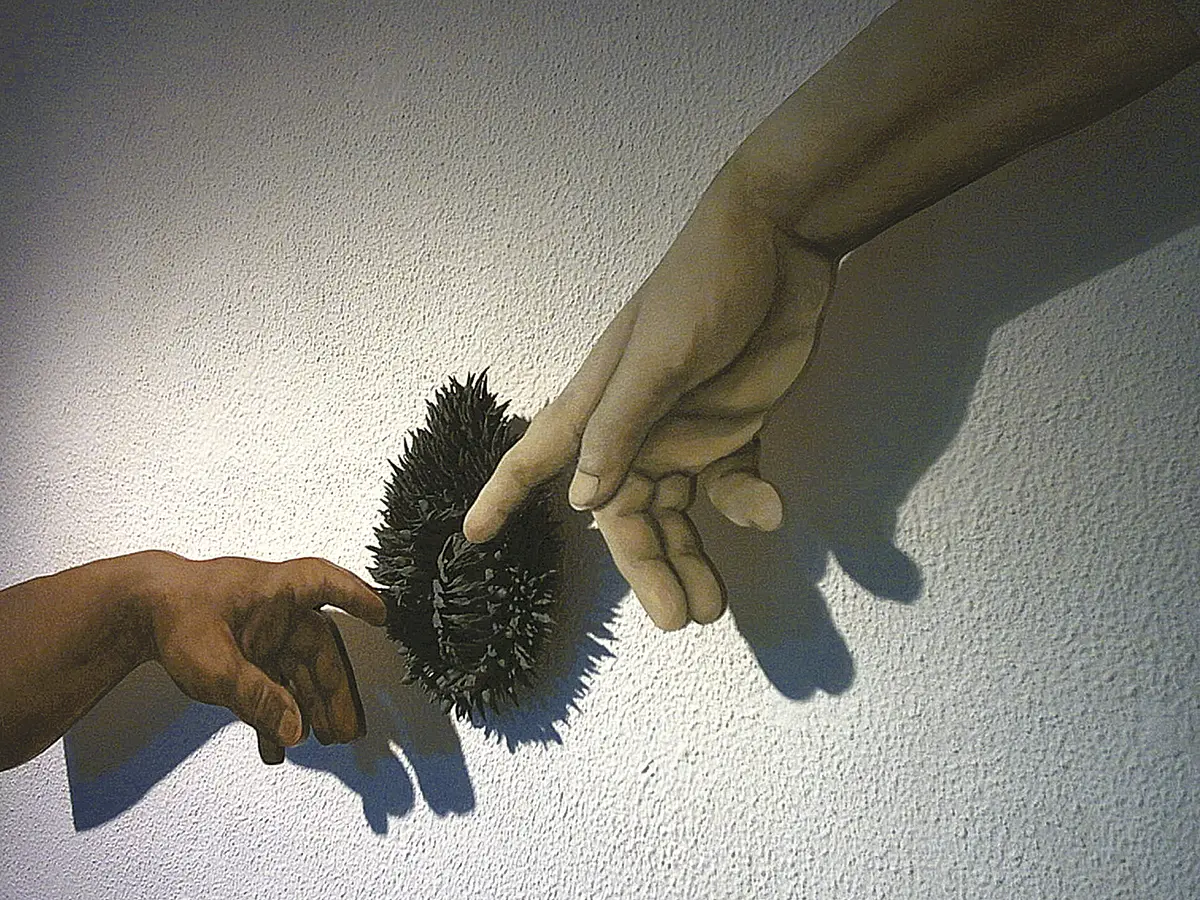
Traditional iconography results in a history of the present, part of a repertoire that includes references to myths, allegories, and realities (religious images taken from art history, the Americas’ baroque, the human body in spiritual and sexual positions,) where a certain humanistic ideology intersects a divine line of thought. Schuster (1956) works in oil, while Zajac (1954) works in graphite and acrylic, so that each becomes identified with his own technique but in the end the general spirit of the work imposes itself as the dramatic apotheosis of the classical image, which, like all images in the realm of representation, is at once descriptive and narrative; it falls on the viewer to complete both actions. The dissection of the body is another one of their iconic characteristics, in this case carrying a double reference. For example, the back of a male body, sensually disquieting, is visually engaged with the expression in the eyes of a Virgin suspended in a different section. No image is presented as complete, and none is resolved in its purest configuration. Much, on the contrary, it is discerned only as fragments of the topic’s significant reality. Might it be from there that the show’s title, Contra Ego, derives? Ego against Ego is the clash of opposites and equals.
The work of these artists is combinatory of decentered images on which the gaze doesn’t come to rest on a fixed point; thus its unity is located in the transgression of spatial limits. Here the pictorial “event” results from a play of analogies of images taken from differentiated universes. We could perhaps describe it as a figurative abstraction, since their discourse is situated in a non-functional perpetual-motion space that revitalizes the discourse of postmodernity and implies the avant-garde of the painting tradition. Schuster and Zajac base their work on a dramatic conceptualization of religious themes, similar to battles of images and the equally dramatic character of contemporary Man’s violence; paradoxically, what provokes the unsettling sensuality permeating these pictorial atmospheres that oscillate between the sacred and the profane, is this violence, with its hardened, sharply expressionistic features.
Schuster and Zajac navigate the culture of non-culture, where notions of iconoclastic images impose themselves in order to define an artistic position that is almost metaphysical: purist symbolism of topics that belong to a history of their time.
BÉLGICA RODRÍGUEZ