
The University of Miami’s Lowe Art Museum organized a retrospective Humberto Calzada: In Dreams Awake. A Thirty-Year Retrospective. Comprising more than 50 works and an excellent catalog with texts by Museum Director Brian Durusun, distinguished Cuban intellectual Carlos Alberto Montaner, and critics Carol Damian and Jesús Rosado, the sow is a well-deserved tribute to the Cuban artist settled in Miami since 1960. The show’s curatorship, by the Museum’s team in collaboration with Jesús Rosado, guides the viewer from the beginnings of Calzada’s career, with small ink drawings on paper made in 1960. These early works, representing colonial haciendas and typical 1950s and 60s architecture were close to architectural sketches but already announced the paths to be followed by the artist’s oeuvre and his interest in architectural themes. The show’s trajectory continued with the successive presence of works from different periods, which allowed the public to gain a clear awareness of the artist’s consolidation and maturation.
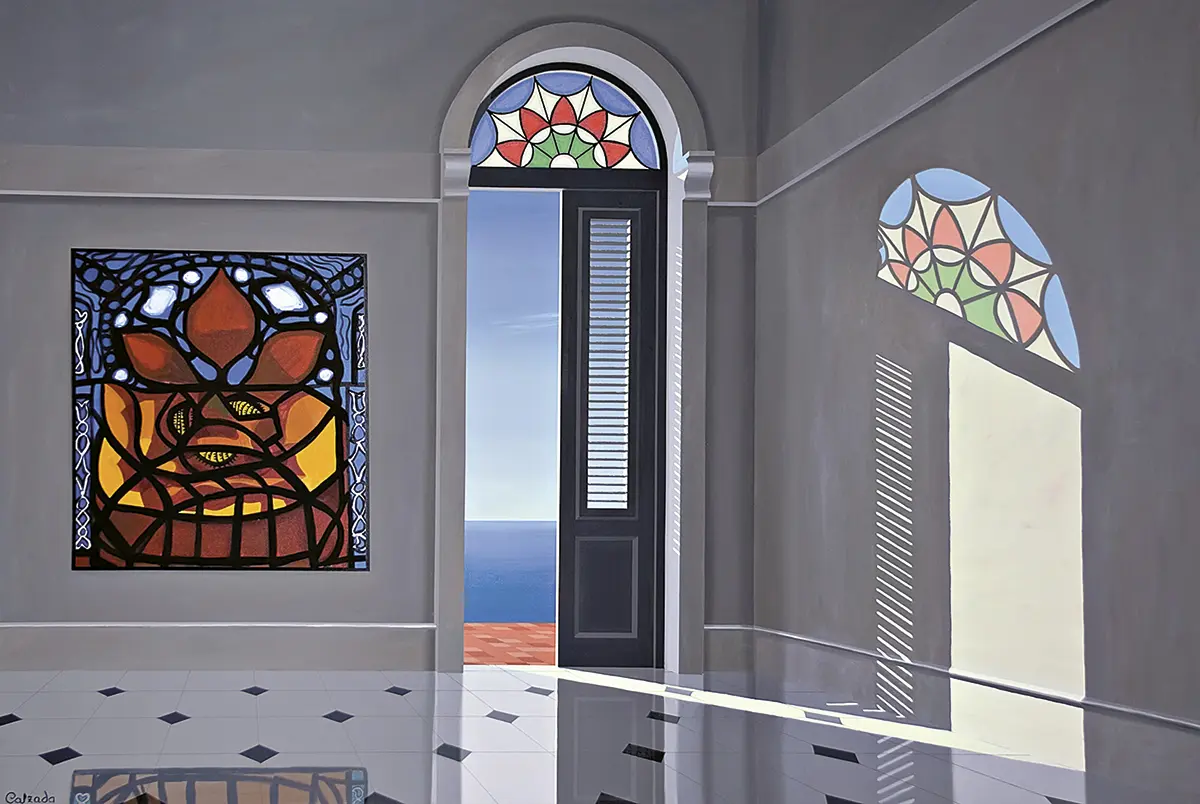
Humberto Calzada’s education as an industrial engineer and his deep engagement with Cuban themes are already visible in his earliest works. Calzada emerged to the Miami art scene towards 1975, alongside a group of Cuban artists like César Trasobares, Mario Bencomo, Miguel Falero and María Brito, who became known as the Miami Generation and started to shape a movement of Cuban art in exile. Calzada’s works from those years represent sections of architecture that immediately refer to Havana buildings, where the mid-point and the famous “Havana blue” are among the protagonists.
By 1980, his works had begun to include somewhat surrealistic atmospheres, where staircases and walls lead nowhere. In those years, the sea and water become a strong presence, which was to remain current throughout his entire oeuvre, as in Otra vez el mar, 2002. Towards the end of the decade, we see a consolidated oeuvre, already incorporating most of the elements that were to remain as constants, and already positing its conceptual motivation. Calzada is involved with and committed to the Fatherland he left behind, and it is through his art that he brings out those sentiments and longings. Architecture, an important element in Cuban culture, serves him as a valuable resource to keep the memory alive. His conservation and promotion of these memories are one of his greatest contributions to Cuban art, and it links him to different generations of artists who conceive their work to reflect and accentuate the presence of symbols and values from national Cuban culture.
One of the most important points of reference in the artist’s oeuvre is the presence of some of the interiors he represents from the work of other paragons of Cuban painting, such as Wilfredo Lam and Amelia Peláez. In La tarde y Amelia, from 1994, the quote from Amelia Peláez’s work is particularly interesting, as is comes from an artist whose works helped value and reinforce importantly elements of Cuban architecture, such as the mid-point and the stained-glass window.
Humberto Calzada’s commitment to his origins is not only evident in the presence and recreation of Cuban architecture, but also in his attention to the course of Cuban reality, through the knowledge of what occurs in Cuba. This interests drove him to produce works like Ensayo para un paladar, which alludes directly to life in the island, reflecting one of the sites that became symbols of survival in the 19990s, the famous home-based restaurants known as paladares.
Besides his representation of important symbols of Cuban architecture such as the mid-point, stained-glass windows, panoramic windows, roof, and floor tiles, Humberto Calzada has handled light and color masterfully in his paintings, elements that qualify his representation of urban and rural environments.
Humberto Calzada: In Dreams Awake, A thirty-Year Retrospective is a show that, beyond its character as a tribute and the way in which it allows viewers to develop a just idea of the artist’s trajectory keeps a door open to memory and takes us to places whose pristine execution surpasses the reality they reflect.
MARISOL MARTELL