
In 1993, Luis Lares impressed the visiting public at the Museo de Bellas Artes in Caracas, Venezuela, where he exhibited the series Hombres de Carbón (Men of Coal). The images displayed there were not only impacting for their portrayal of the reality of the underground mining world and the stupor under which the Guayanan miners are forced to work, but also for their highly poetic connotations and beauty, set against the dense subject on the crude reality of mining. These photographs are still fascinating because of the humanity emanating from each of the faces portrayed amid not only a miserable and hostile, but also an exhausting and feverish context, metaphorically speaking. We have recently again seen a section from these series and a review of what Luis Lares’ photographic production has been between 1975 and 1998, during the anthological exhibit at the Sala TAC (Trasnocho Arte Contacto). There, we were able to appreciate, in addition to the series already mentioned, a selection of images from earlier photographic essays such as At the Edge of the Road (1975), Far Away in a Place That Doesn’t Exist (1979–1983), Men and Contemporary Architecture (1984), Permeables (1984), and Matanzas, Industrial Zone (1984–1989), an important series that arose from photographs grouped in the series The Guayanan Industry, The Sensuality of the Industry, and finally, Machine Man, from 1998.
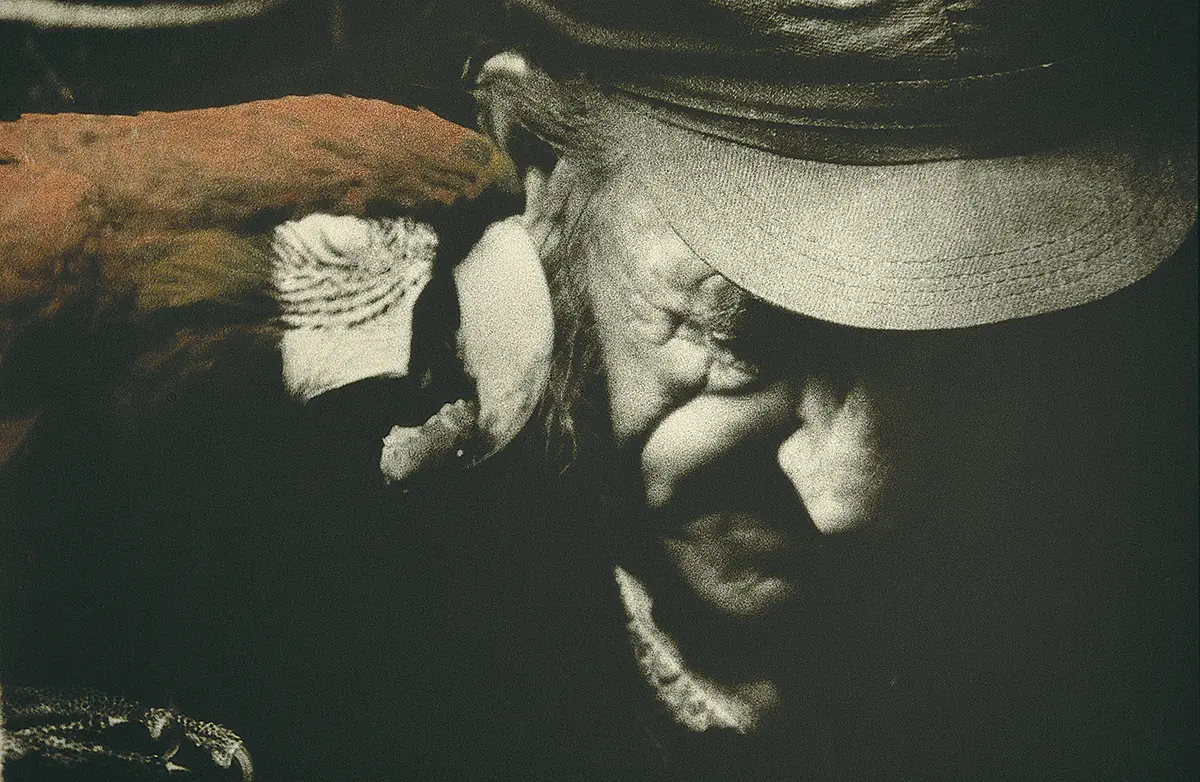
It can be said that Lares’ work subscribes to three important schematic axes: The city (its architecture), where this photographer experiments in conveying atmospheric attractiveness to the images, in some instances by allowing the use of paint to add color; men framed by their context and circumstances, a subject Luis works on in both London and Guayana, separately searching for the humanity specific to each place, and finally, the portrait. The common unifying denominator in these three elements is the photographer’s critical gaze. It reveals the real situation of the men that are portrayed are experiencing: whether it’s about a contemporary urban context “on a different scale”, as the show’s curator, Tomás Rodríguez, points out; whether it’s about being immersed in an ocean of pipes inside the “metallic city” of industry, or whether it’s about men and their prematurely waning lives because of the terrible working conditions underground, where they inhale “the impurities from the liquid steel”, their skins wasting away due to the intense heat.
Each of these thematic axes function independently of each other: There are photos of architecture, of industrial environments with their machines, and of poor working persons of in their everyday roles. Somehow, though, these axes converge when the men appear juxtaposed to these other elements. In each of these photographic essays, Lares elaborates an unquestionably critical and inquisitive discourse that is not free from a fascination with these settings: The cold metallic materials used in contemporary architecture; the metallic pipes at the industrial sites, and the vapors they generate, everything playing out inside a world full of expressivity and fascinating forms. Notwithstanding this, the images are revealing because they transmit the inhuman conditions men suffer is monstrous urban settings, or by means of the cruel mining environments, where other men are exploited and sacrificed while the mine owners shamefully never meet the miners face to face.
In the interview by Teresa Casique published in the exhibit’s catalog, Lares noted that that chance and improvisation are part of his approach to work. Without a tripod or a flash, using solely the light that is available, the artist’s images are characterized by a particular luminosity, an effect he achieves in the darkroom. He wants the film grain to be a large grain and uses this to create his delicate atmospheres with the aid of highly contrasted images. This does not hold back each image from maintaining a richness of shades, a very important aspect in Lares’ work because it somehow defines his personal style. The shades are a central aspect of his photographs, to which his many several series attest.
The photography he created in Europe, on the other hand, is more experimental in nature: There, he sometimes painted touches of color on photographs or explored other mediums, such as the installations and audiovisuals he created at his first solo show in 1984, Permeables, which took place at the Sala de Arte Sidor in Guayana. This was an exhibit that exalted color, dynamism, and sensorial perception. Later, during the photographic essays in Guayana, Lares chose direct and natural imagery, created under conditions of low light, just that light that was available inside the mines, a restriction he takes full advantage of when he is able to extract nuances that only the night or darkness can provide. This direct and frontal vision is impressive, especially in his portraits. Lares admits: “I was interested in the eyes […] I always believed that the face would better show that wasting away, that suffering. I feel that in those portraits they are telling me their truth […] I believe the eyes in these images speak of that truth”.
Luis Lares’ photography is undoubtedly human, profoundly human.
SUSANA BENKO