
The present proposal of Pedro Vizcaíno can be synthesized by antithesis, an existential antithesis that flirts at all times with the ontologic human condition and that ranges from the naiveté of the child to the patheticism of the adult, from the joke to the sociopolitical enunciation, from the microcosm to the macrocosm. The Galería Ardex, situated in Coral Gables, Miami, Florida, has the pleasure this time of delighting us with the proposal. Alien DNA (ADN Alien) is the suggestive title that enlivens the show.
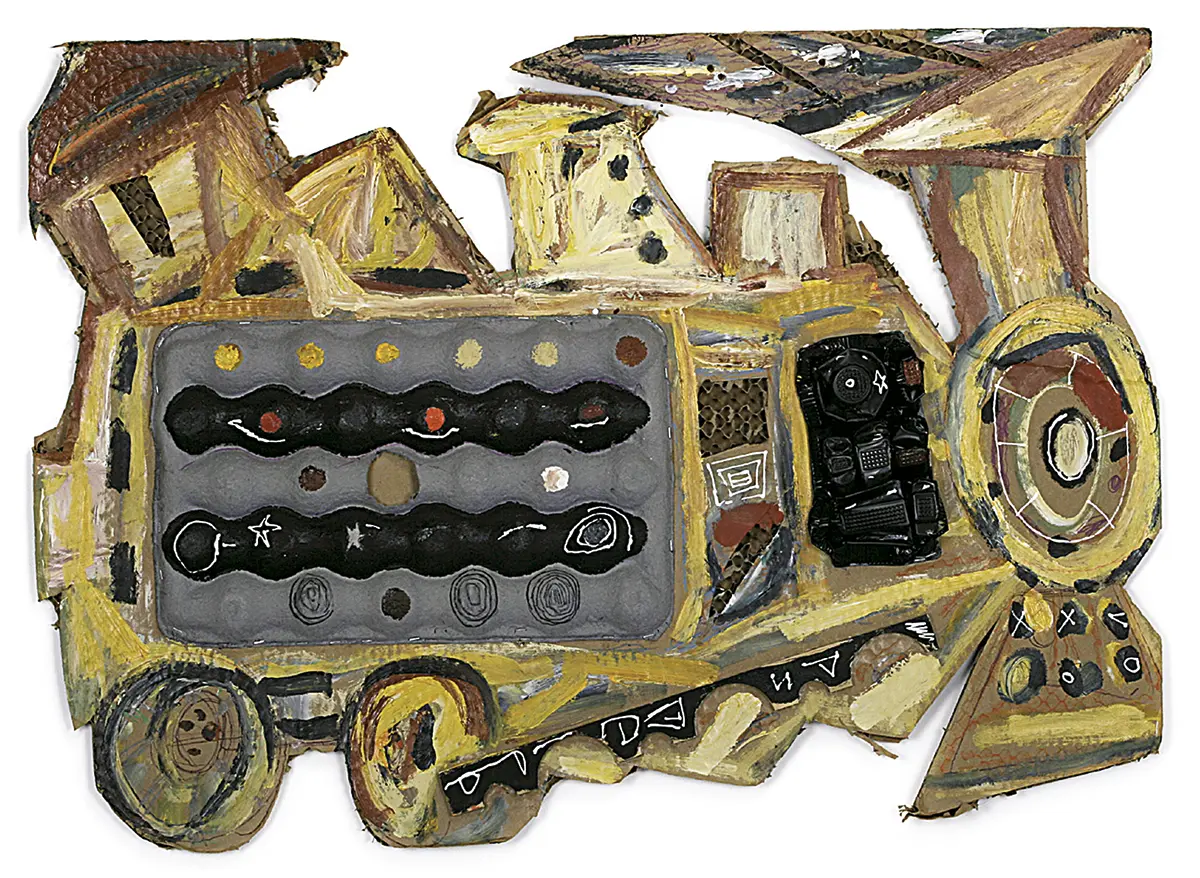
Faithful to bad painting and to pop art, Vizcaíno plunges into the whirlwind of daily and suburban culture to construct parody from his immaculate trash heap. The artist utilizes impeccable discarded products, preserved in a state of integrity that disconcerts us, thus allowing the first antithesis to blossom. This modeling clay with which the creator works sheds light on the absent subject, the suggested subject. The human being appears only through the slaughterhouse, the trail that is always pressured by the means of transport that contains it once and that swallows it. Anthropomorphized ships, cannibals with open mouths, sharp teeth, wounding silhouettes, rot that defies time and space. Humans becoming carcasses. Like one of those insects with a hard shell in the patio that we as children poked with a stick, attempting to see whether something alive would emerge from its interior, or at least, whether the obstinate creature with rigid armor would decided to move a leg as a final act of complacency in the face of our harassing presence.
These capricious creatures are part of the repertoire in the exhibition obtaining from two fundamental enclaves: the city and the battlefield. The limits between one and the other are not clear and, for moments at a time, are superimposed. The city ambiance is grasped through the taxi, the yellow cab, the transitoriness of contemporary society, in which stability is relativized, yielding to speed. The vector constituted by space smashes into pieces, and in its place, there arises a novel and unveiled axis of Homo sapiens: velocity. Consequently, the transitory, the ephemeral, the here- and-now, dominate this enclave. And this is because contemporary society appears to define itself, in counterpoint to traditional society, by an axis of velocity. Traditional society, guided by the idea of a spatial enclave and sedentariness vs. contemporary society dictated by the vertigo of speed, the loss of gravity, of the center, of belonging. A species of centrifugal force that propels us, atomized, here or there. This sensation of atomization is reinforced by the isolation of each of the specimens of this enclave. One of these is recruited into a glass case, like a rare museum specimen.
Another ambiance that is recreated is that of war. The artist takes on this enclave by means of a playful installation that unfolds along the entirety of one of the gallery’s walls. The monsters now are associated, to invade us like the plague. The heaviness of the theme here is aroused with the ingenious stroke, appeasing, the taste for the colored pencil and the distinctive childish signs of war drawings: the zigzagging flame, the lights in rays that irradiate, the puffs and bangs, This is the levity of the scribble, like revisiting the battlefield of toy soldiers. What a toxic childhood! And then, we discover another important antiethical factor woven into the present series of Vizcaíno: the scale. From the modular idea, from the genetic to the macro cosmos, the galactic scale. Bellicose artifacts at times begin to appear as insects, other as colossal threatening ships: rudimentary, torpid, and lethal. At this point, one senses the presence of H.G. Wells and his implacable sentence of a man too centered on himself as being able to rebound. Blind to his need.
This installation of Vizcaíno, supported by other pieces that the exhibition presents, achieves a mental zoom that evokes old science-fiction films; via macro estrangements, we traveled from one scale to another—from the defenseless insect, passing through the stage of the curious child, to the city plane, and on until reaching the sliver UFO, from which we barely observed a shadow or a shimmer, all this prefigured in our ancestral fears. The fearful alien that hides his interior, of whom we know nothing, but above all, from whom we can expect nothing good. The fear of the “other”, the unknown. And this is it; this is the War of the Worlds. The alien invasion! Oops! Did someone say undocumented?
Almost a joke, bad painting, politically incorrect, paradoxical. These kissing-fighting-machines are eroticized in a final supplication, somewhat démodé for our time, and from the appeasing childish scribbling they appear to implore: Make peace, not war.
A strange pastiche between the literary movement of science fiction of the end of the XIX Century, during which our most twisted fears paraded, our monsters, and the desire for reconciliation of the 1960s Peace and Love Movement, which procured the restoration of the perpetual and human desire for love, and behind the pace or the obstinate presence of war. Terrorism?!
JANET BATET