
We have come to expect baroque puzzles from Rigoberto Quintana, whether in big paintings overstuffed with precisely rendered quotations from art history, underground comics, weird science, and family life, or arrangements of actual student desks on which he has inscribed, like so much classroom graffiti, equally dense and amusing exercises in referentiality.
Quintana is a master of chaos that he brings on himself, or perhaps he would say that he is simply mapping the unendingly quirky vectors of human consciousness: visual puns, hallucinations, free associations, anomalies, and freak accidents that swirl about each other like the babble of a thousand encyclopedia salesmen pitching at once. In the painting that he showed in Puerto Rico’s La Muestra Nacional last winter, Había una vez..., it was possible to discover one of the eighteenth-century Puerto Rican painter José Campeche’s aristocratic ladies holding the leash of a collared alligator amidst vapor-exuding pineapples and smoking Bosch-like eyeballs. What saved this work from a cheap neo-surrealist formula was its overall cohesion and flow: a sense that Quintana, like a sun-burnished California surfer, is riding a wave of basically compositional concerns, in the grip of his highly disciplined training and a pretty funny idea of what art should be about.
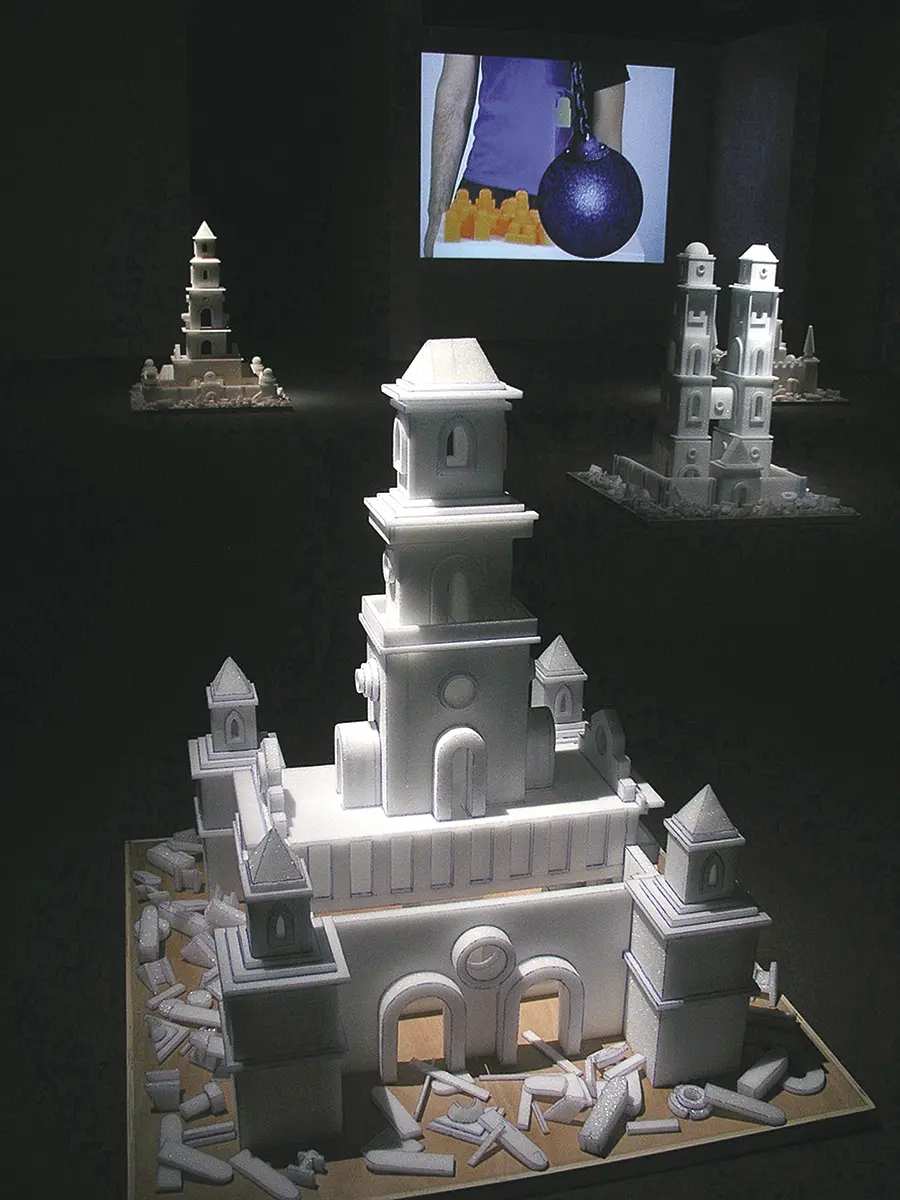
In March of this year, Quintana mounted a video-and-sculpture installation in La Sala de las Artes at Universidad del Sagrado Corazon in San Juan, Puerto Rico. Sin título consisted of five carved Styrofoam castle-fortresses, each about three feet tall, mounted on wooden platforms and theatrically spot-lit from above in an otherwise darkened room. If these elements were alone in the space, Sin título would have been as meditative as a saint’s grotto in a gothic cathedral.
But Quintana was not in a contemplative mood. From an alcove on one side of the room, a loudly chattering video portrayed busy young hands trying to build structures out of colorful Legos, before a cartoon wrecking-ball swung into view and the next pair of hands took over the apparently insurmountable task.
The Styrofoam buildings—or more properly said, maquettes for buildings—were precisely symmetrical and distinguished by a determined facelessness. One had two towers, the left topped by a dome, the right by a pyramid. The sparkling white Styrofoam was outlined in one of two primary colors, blue or red; and with their arched entrances, cylindrical columns, turrets, cupolas, and parapet walls, the sculptures resembled absurdly generic permutations of Disneyland castles. Each was different from the others, yet none of them showed anything resembling a unique character. Around their outer walls floated random wheels, orbs, blocks, and wafers of Styrofoam, like moats of miscellaneous leftover parts.
Quintana has said that he is mimicking a degenerate, profligate architectural—and, by extension, consumerist—style, which he alternately calls inconcluso and refrito, characterized by ostentatious aims and pedestrian execution. It is an impulse to make things, discard them, and make more of the same upon the refuse, which he attributes to Puerto Rico and Latin America generally, although he insists that this dynamic has a global application. The video provided a colorful, animated counterpoint—coincidentally showing off the latest in t-shirt designs, fashion accouterments like jump-drives, and tattooing—to the vacuity and compulsiveness implied by the maquettes. The hurried builders were usually able to put something together in a limited time, but their structures were invariably an off-kilter mess, a repeated mistake the designers—and, more to the point, we—have to live with.
There was a great deal of Quintana’s usual raffishness in Sin título, both in terms of art and social commentary. Its play of scale, the addition of the most elementary kind of drawing to a stringently regular sculpture, the way that the different colors gave a different cast to the works—a sickly warmth to the red-outlined maquettes, a frosty clarity to the blue—the sparkle of Styrofoam pretending to be, perhaps, marble: these were all standard-issue artist’s jests. However constricted in form—with paired arches and doorways, quartets of turrets, and the wedding-cake progression of levels—the buildings attained a fascist grandiosity on a small scale, which seemed to be Quintana’s point, and it was as well-realized here as in the infinitely more colorful and elaborate play of his paintings.
He might have left well enough alone with the maquettes by themselves. His response to this suggestion is that the video was what made Sin título something more than an architectural project, by which he must mean the video gave Sin título a useless, artistic dimension. But if that is the case, he underestimates the power of his handiwork. The video satisfied the rage for motion and noise that our clamorous moment demands. It was well made and, with its youthful groping, was modestly entertaining at the characters’ expense. But it also only overstated what the maquettes so glibly proposed: that we are obsessively, dangerously indulgent, that we dwell in the ruins not just of our cities but also of our imaginations.
JOEL WEINSTEIN