
The Tamayo exhibition, which opened at the Sta. Barbara Museum on February 17, is the biggest and most comprehensive retrospective exhibition of the artist’s work in this country in almost thirty years. It is an extensive retrospective of Tamayo’s work that encompasses one hundred works. The exhibition is scheduled to travel from the Sta. Barbara Museum to the Miami Art Museum and to end its course at the Tamayo Museum in Mexico City.
However, only at the Sta. Barbara venue, will the visitor have the unique opportunity to see Tamayo’s work in the company of a magnificent fresco by Siqueiros, who was both Tamayo’s contemporary and artistic rival. His Portrait of Mexico Today, from 1932, is the only surviving fresco in intact condition by the artist in this country, and an excellent example of the Mexican Muralist movement that is beautifully displayed at the museum’s entrance in a special installation. It very nicely presents us with the artistic framework of Tamayo’s Mexico before we get to see his paintings. The visitor will then more easily comprehend how Tamayo must have really challenged the Mexican artistic establishment when comparing the fresco to his output, which from the very start was pointing in a different direction.1
Tamayo’s role has been a controversial one in Mexican culture. His debut as an artist came at a time that the Mexican Muralist school was in full bloom under “Los Tres Grandes” Rivera, Orozco and Siqueiros, all of whom had instituted social realism as the official art in Mexico. Tamayo’s very individualist interpretation of mexicanidad put him at odds with the famed trio, which considered him a bourgeois painter catering to foreign tastes.
Tamayo, as it turned out, was one of Mexico’s most innovative artists. He stayed current on the trends of art through his long and frequent visits to New York and Paris to the extent that he actually did spend most of his career outside of Mexico, but there is no question that his cultural roots are an integral part of all the different stages in his work, and that he was a pivotal factor in updating the great Mexican artistic tradition within the framework of 20th Century innovations. As it is so eloquently stated in the exhibition catalog, “Equally important to Tamayo was the example of the French School. Like Cezanne, Matisse, and Picasso, he looked to the Western classical tradition of figure painting for inspiration but reinvented it for a new era”.2
The exhibition at Sta. Barbara emphasizes the works from the ’40s and ’50s, which is Tamayo’s golden age of inventiveness. Curator Diana Dupont’s selection of works is outstanding, but even more impressive is her extensive and well-documented essay on the artist, which is particularly detailed in its very appropriate comparisons to other works of art and artists of the period, and offers doubtlessly one of the most insightful interpretations of the artist within the international framework of his time.
There is a phase of his work in the ’30s that addressed social issues. His figures, whether workers in strike as portrayed in Movimiento Fabril, 1935, circus people in El circo from 1938 or the beautiful Mujeres from Tehuantepec from the same year, are all grounded in the Modernist language and are an updated rendering of ancient archetypes of his old land.
Later we see Picasso's influence in the composition of Retrato de Maria Izquierdo, a picture from 1932 that depicts Tamayo’s first companion, Maria Izquierdo sitting in a throne-like chair in a hieratic pose, where her mask-like expression is reminiscent of Picasso’s celebrated portrait of Gertrude Stein. Picasso made Ms. Stein’s face like an African mask and Tamayo has portrayed Maria donning a Pre-Columbian one, both artists are renewing the energy of their art by their observation of what was then considered primitive.
In Naturaleza Muerta con Pie from 1931 we see the influence of de Chirico3 p. 352 and the Surrealist landscape, this time saw through a window, like the first plane of the picture is taken over by an also Surreal still life arrangement that includes the model for a foot, scissors, and playing cards while another picture, The Girls is a color-saturated painting from 1929, inspired by German Expressionism, very much recalling similar depictions of the subject matter by Erich Heckel and Max Beckmann. Through Tamayo’s development, we see the history of European and international tendencies that he was absorbing and re-shaping with his unique vision and most importantly, his Mexican colors.
Pink, in particular, is one of his most successful renderings. We think of Tamayo’s rose tones as his unique way of rendering the color as an expression of joy, a great example of which is particularly poignant in one of his masterpieces, Danza de la Alegria a pivotal picture in his career that also recalls the exuberance of Matisse’s famous Le Bonheur de Vivre.4
This exhibition was particularly good at bringing out paintings that had been stored in Museum reserves for decades, as is definitely the case with Guggenheim’s Mujer en gris from 1959, one of the maestros’ best attempts at abstract figuration5 which has not been seen hanging at the New York Guggenheim for over twenty years.
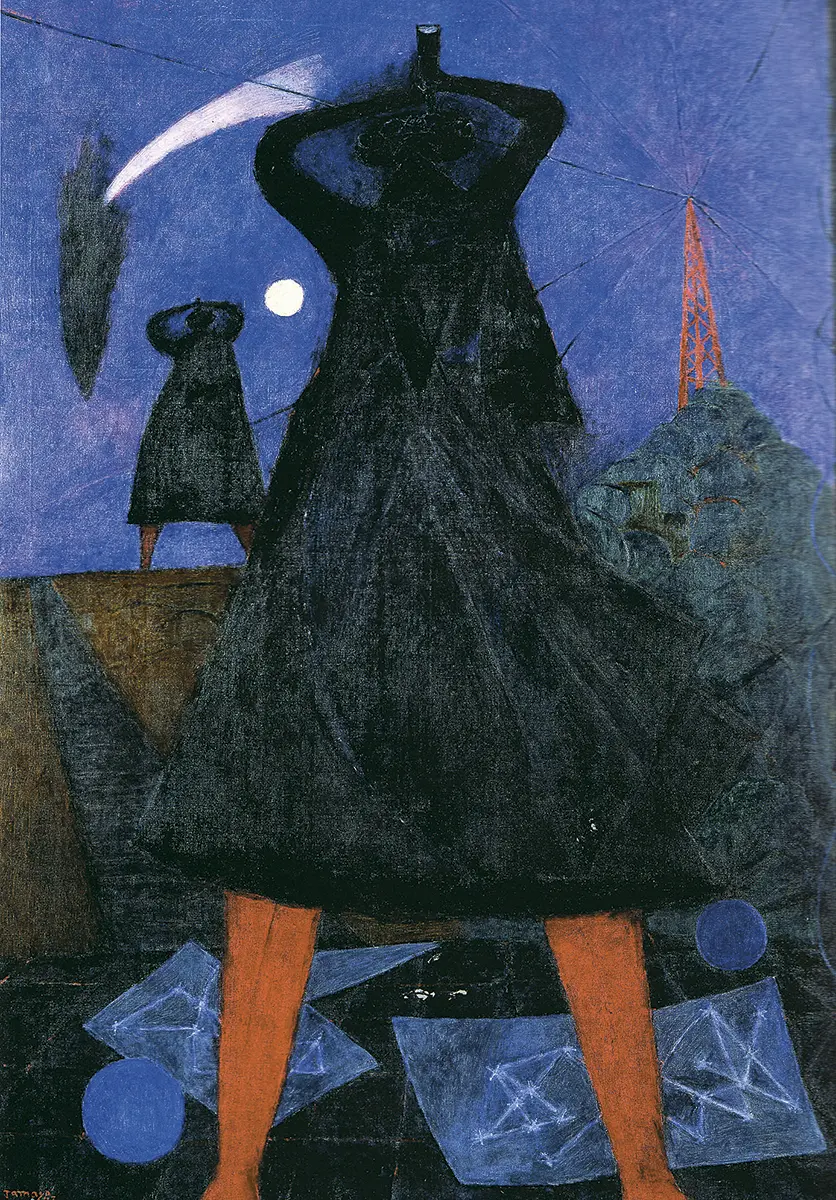
It is perhaps in the depiction of the human figure juxtaposed against the chaos and emptiness of the universe that Tamayo achieved some of his most relevant pictures6. It is also an important cultural element with roots in Ancient Mexico, where the stargazer-priests of Mesoamerica as well as the religious calendar that they oversaw had paramount importance in Mexico’s ancient society. A work that represents the mystery of man and cosmos and is one of his iconic works, Los Astrólogos de la Vida, was a highlight of the exhibition and was featured in a separate wall at the entrance of the gallery that marks the beginning of Tamayo’s mature style. It is an accomplished masterpiece in blue tones, one of Tamayo’s most vibrant and complex colors, which is deeply explored in many of the other paintings that he did with the theme of the cosmos that he continued to elaborate through the 50s and 60s and all the way to the very end of his very long artistic life.
The last two large rooms showed a selection of his late works. Tamayo was one of those rare artists that like Titian, kept excellence of execution to the very end of his life. The texture of the pictures started to change in the ’60s when Tamayo introduces sand as part of his surfaces. A good example to see the effects of this heavier texturizing is Tres Figuras from 1966, where the viewer can appreciate the complexity of Tamayo’s coloring. Here the exhibition showed a very impressive Hombre in Blanco, a monumental work from 1973, which shows Tamayo has not lost any of his strength in depicting a man standing alone with his destiny, yet his style has evolved and he has managed to establish an abstracted human figure, that is now a very comfortable and (to the viewer) familiar part of his vocabulary, with great subtlety in the color graduations, and the painting’s surface has also evolved into more complex and textured material. We leave these two rooms feeling that we have witnessed something important, these paintings from his last period has a way of making us believe that any color combination could be harmonious, and that very quality alone is enough to make us realize what a great painter Tamayo turned out to be.
*The Rufino Tamayo exhibition will also be presented at the Miami Art Museum starting in June.
NOTES
1. Adriana Zaval, “Tamayo’s Women Figures of an Alternative Modernism” in Tamayo: A Modern Icon Reinterpreted Sta. Barbara Museum and Editorial Turner, SA, February 2007. p. 219
2. Diana Dupont, “Realistic, Never Descriptive: Tamayo and the Art of Abstract Figuration", Ibid, p.39
3. Anna Indych-López, “None of those Little Donkeys for me: Tamayo, Cultural prestige, and perceptions of Modern Mexican Art in the United States", Ibid, p. 352
4. Dupont, Ibid, p.74
5. Dupont, Ibid, p. 92
6. Dupont, Ibid p. 67
ALBERTO BARRAL