
From November 29, 2006, through January 13, 2007, the Peruvian artist Sandra Gamarra Heshiki presented a solo show titled Brazilian Acquisitions at Leme Gallery.
Gamarra’s hyperrealist paintings possess, along with their fine spirit of appropriation and citation, a certain anachronistic discipline; confronted with her images, one is always located in a space-time without cause or consequence. Her works are perfect simulacra that stop the viewer at the point of expectation, of desire—the desire to incorporate them into one’s own small, imaginary museum, from a position similar to that of anachronism, also known as “cultured painting” or “memory painting,” in which the remembrance of the immediate past is “compiled” based on the concept of the museum as an illusion.
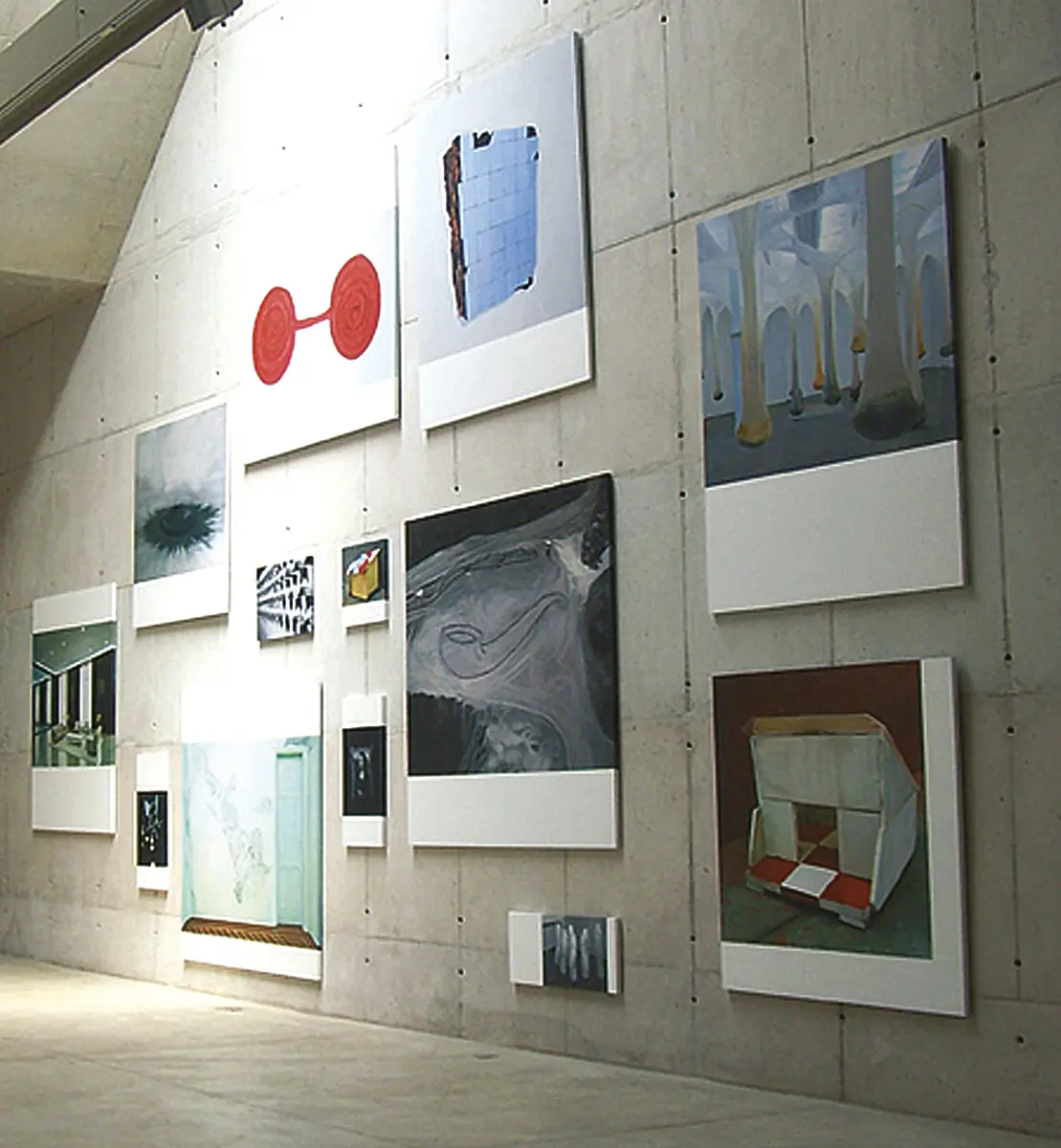
In this new show, Gamarra—who lives in Madrid—presented a group of “tributes” to the work of such prestigious Brazilian artists as Ernesto Neto, Adriana Varejão, Sandra Cinto, Vik Muniz, and others. At the forefront of formal and iconographic motifs was the conscious recovery of the craft of a painter who locates herself in front of the canvas in order to bring to life a large group of “views.”
Gamarra’s strategy emphasizes a return to painting—“museum-able painting”— with the incorporation of a variety of stylistic and literary sources. “Museum-able” painting, which manipulates various discourses and poetics through the cult of technical media, is also privileged by the other anachronistic artists. “Adquisiciones Brasileñas” becomes a unique case, a paradox, a contrary path relative to contemporary art. Gamarra’s work is a singular instance within the anachronistic aesthetic because it continues to sway between truth and fiction, with significant borrowings of pictorial intertextuality. It embraces the imitation of the sculptor and object-maker Ernesto Neto’s terse, velvet-like, pliable, and subtle textures or the visceral bluntness of Ana Varejão’s installations.
Gamarra’s art reverberates like a double mirror and highlights present chimeras in the search of a space of pure aesthetic respite and delectation, filled with erudite concepts and an undeniable, dilettante savoir-faire. This is a re-invention of the art of the immediate past or of the most heated contemporariness, in which the historical and/or post-historical “model” implies a return to the order of form.
For several years, Sandra Gamarra has found the highest manifestation of mythical imagination in Western painting and sculpture of the past centuries—especially Classicism, in all its variants and national schools. Indeed, the artist uses a repertoire of cultural citations that promote an intense dialogue between memory and the present. The tradition and the academy rejected by Gamarra are, at any rate, those derived from the discourse and the orthodoxy of avant-garde radicalism.
The works on exhibit formed a compact body of “tests for the naive eye,” in an ironic and witty turn of phrase. It is interesting to point out the ambiguous character of these works; they appeared unaffected by the patina of time. The time of execution of the series and the time arranged in each work put the viewer’s gaze to constant examination; they maliciously created “images from nothing” in that which was represented. In truth, these were hyper-simulacra, with such a perfectionist degree of realism that the public was provoked upon first seeing this installation into a welcoming reaction more often felt for photography than for painting. This “imposter realism,” or better yet hyperrealism of illustration, belongs to the present, albeit as a concession or a kind of tribute. Perhaps this is Gamarra’s proposal, that realism has an infinite number of styles and manners, which removes the question about which of them is the true one. In any case, the operatic group possessed the structure and the density of a single visual text, read in the plural as indicated by the exhibition’s title. The “consecrated” works reproduced by the artist were illustrations that provoked endless speculation about their degree of truth or falseness. The important idea is that there are no longer naïve eyes when it comes to painting and that the criterion of retinal identification is no longer sufficient to define a contemporary work of art as such. The paintings on exhibit were a meditation about current painting, resemblance, verisimilitude, the power of art systems, the revisited meaning of contemporary art icons, the complex nature of the rules of visual representation, and the diffuse differences between untemporality and historicity. All of this is part of Gamarra’s current quest and is embodied in her works.
To that end, Adquisiciones Brasileñas re-proposed the pictorial discourse in its slowest and most stratified processes, the most morose and almost interminable, precisely where the avant-garde had collapsed painting’s time into the immediacy of gestures.
CLAUDIA LAUDANNO