
Claudia Laudanno: In a formal/conceptual sense, you have been investigating color in large paintings, in “out of phase” contemporary printmaking, and in large sculptures. How do you first approach chromaticism?
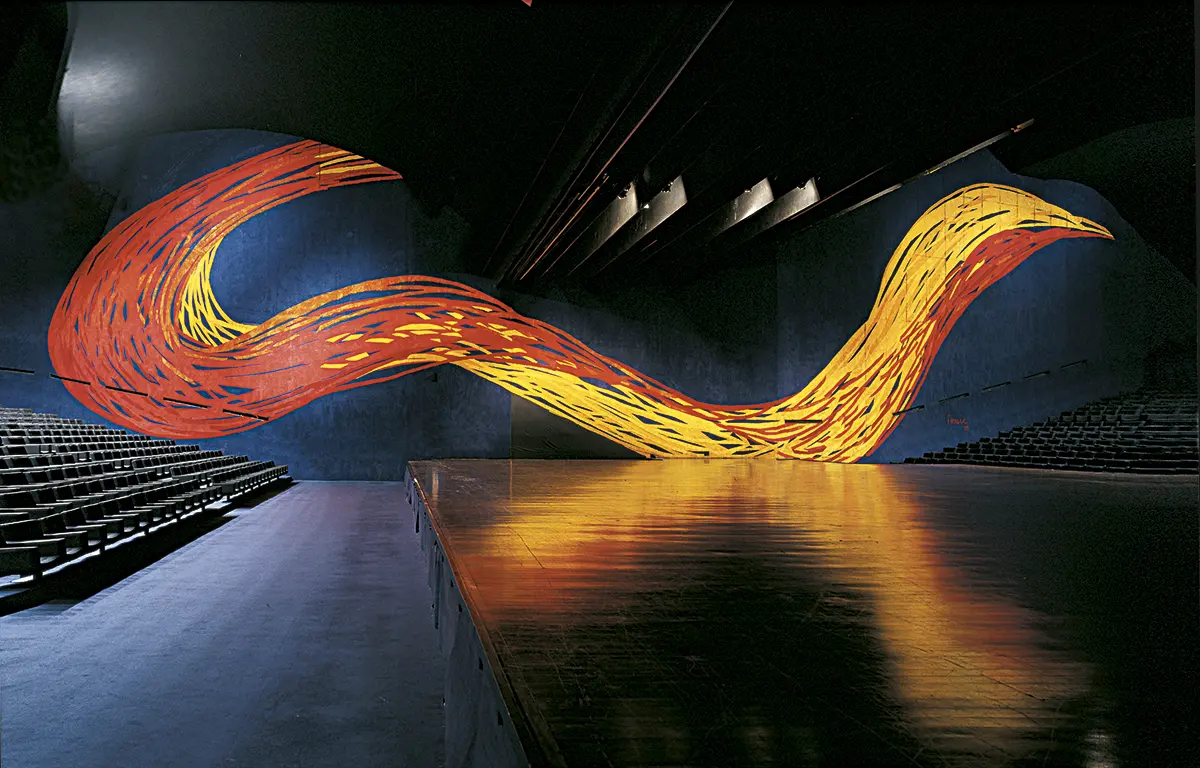
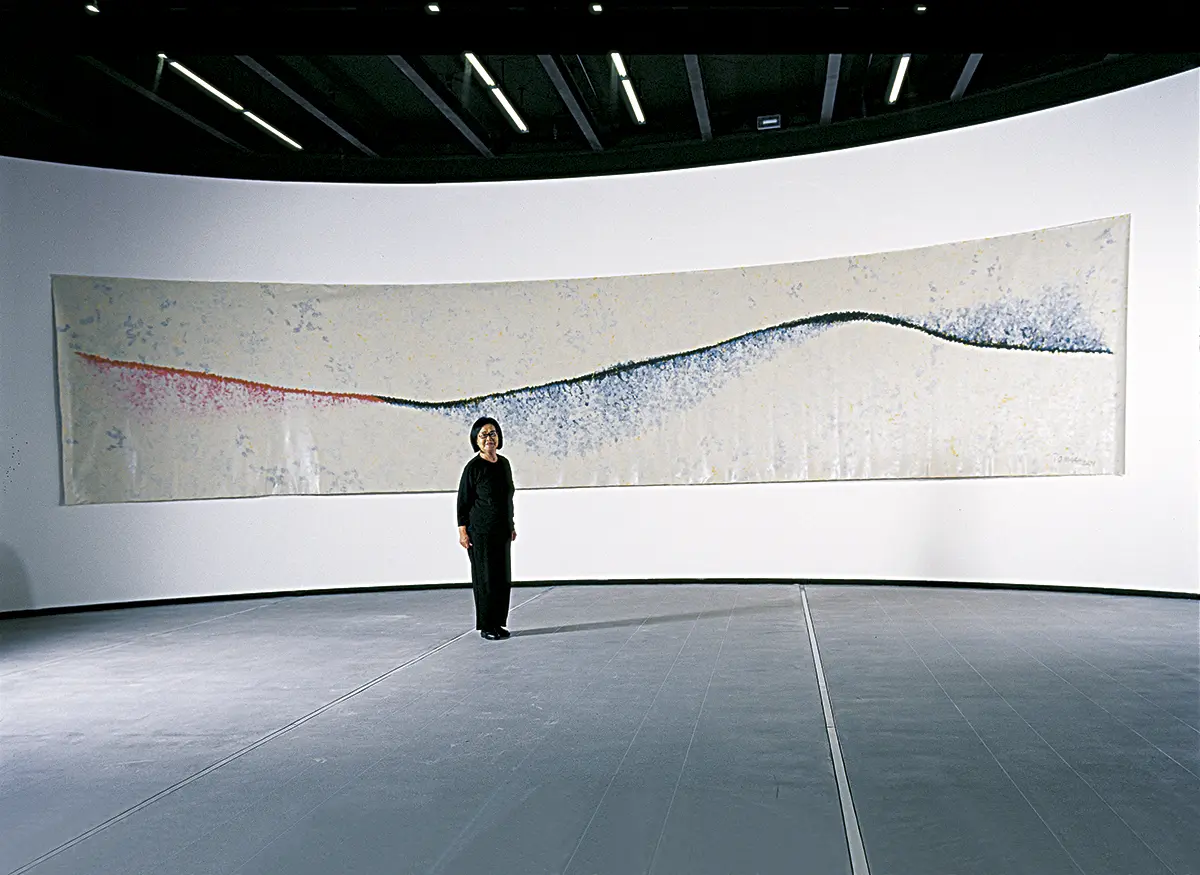
Tomie Ohtake: My way of working with color is highly intuitive. I don’t start with a precious selection of color. Let’s say it is less a priori. In my case, the issue is not to seek a “use” for color on the basis of rational criteria. However, starting with that search, I put in other colors, other hues, even of the same ink, calibrating the intensities in the space in my canvases. So, I operate starting from different series of brushstrokes that vary with each superimposed layer, opting between transparency and opacity, but both are drawn. But the depth and the application of flat color are necessary to me. Also important is the matter of how a plane meets another plane through polychromy. At times, it is softer; at other times, it consists of ruptures, breaks, and fragments.
CL: Do you have a system or structural theory of proper color?
TO: If there is a theory or system of color in my works, I have not articulated it rationally. It’d be rather interesting for a scholar to decipher it.
CL: I would like you to expand on your artistic and interdisciplinary relationship with the poet Haroldo de Campos. This question centers on the idea of the plural work, “woven” in two voices, where each of your authorial traces is mimicked in a symbiotic exchange.
TO: Haroldo de Campos was very interested in my work in the last fifteen years of his life, and he visited me every so often, but not too frequently. We did talk on the phone, however. At one meeting, the documentary director Cacá Vicalvi was at my house and Haroldo arrived. The film crew took advantage of that circumstance to record us talking about our collaborative work.
Together we did Y-Gen: Haroldo wrote poems about Japan, and I created some cycles of prints that included those poems. I greatly enjoyed this work because Haroldo’s original manuscript retained its format, in which he had written about each of the prints I created especially for the occasion, so my graphic works received the texts on them. I also selected the ranges of colors for the writing of each poem. This interdisciplinary work was later exhibited in a show at the Nara Roesler Gallery.
From the beginning, I enjoyed absolute freedom to construct the images in order to achieve a good dialogue with the poems. The technique used was etching on metal, in collaboration with Claudio Vasquez, who worked with great initiative and care in all aspects.
CL: You have made works in sculpture and painting in an expanded field, site-specific installations in public and private spaces, and performances and interactions with the audience with your large works, such as the series of the Arcos. How do you conceive the notion of space, and how do you appropriate and occupy these “sites”? These giant, fluctuating, moving sculptures display the role of color as a protagonist, don’t they?
TO: The work of art that remains situated in the public space must, by necessity, converse with the terrain that hosts it and with the viewer. This is essential for a panel, a relief, a sculpture, a printed object, or any kind of three-dimensional work. You ask me how I conceive of space. In the first place, I see and study the specific place or site. Then, I wonder about how the public will interact with the work: what are the perspectives, what is in front, behind, to the sides; at what distance will people be able to see and how far does that point of approach reach; in sum, through where does the gaze pass or circulate? This determines the shape, color, and material. I am able to answer these kinds of questions on the basis of what I did before because if I had nothing to say before doing the work, I would achieve nothing since I don’t have all the paths previously thought out. I find that it is intuition that tells me where to go. So, color appears along with the rest of the work, at the moment of its execution, with the understanding that when I execute the final work, I have already gone through several project stages, which take me to the end canvas. What I was talking about before was the definition of the project.
CL: In what way have your works previously had and continue to have a dialogue with the oeuvre of your Brazilian artist contemporaries, such as Cildo Meireles, Amilcar de Castro, and Lygia Clark? What kinds of elective affinities—if any—do you find with those artists?
TO: I have always greatly admired Lygia Clark’s bichos and the sculptures of Amilcar de Castro, who is such a dear friend—I have a work of his in my home, which I exchanged for one of my paintings.
My knowledge of these two artists and my relationships with them and with others of the Neo-Concrete movement came about through Mario Pedrosa and Willys de Castro, who visited me frequently for several years, mainly during the period when I did those monochromatic works in 1960. However, I was never part of any group or association of artists, be it Neo-Concrete, abstract, Japanese, gestural, informalist, etc. So, I don’t believe I had any relationship with artists or groups of artists. My path in art has always been independent and autonomous, but I can say that we are all artists of the same period, in the same way, that happens with contemporary artists.
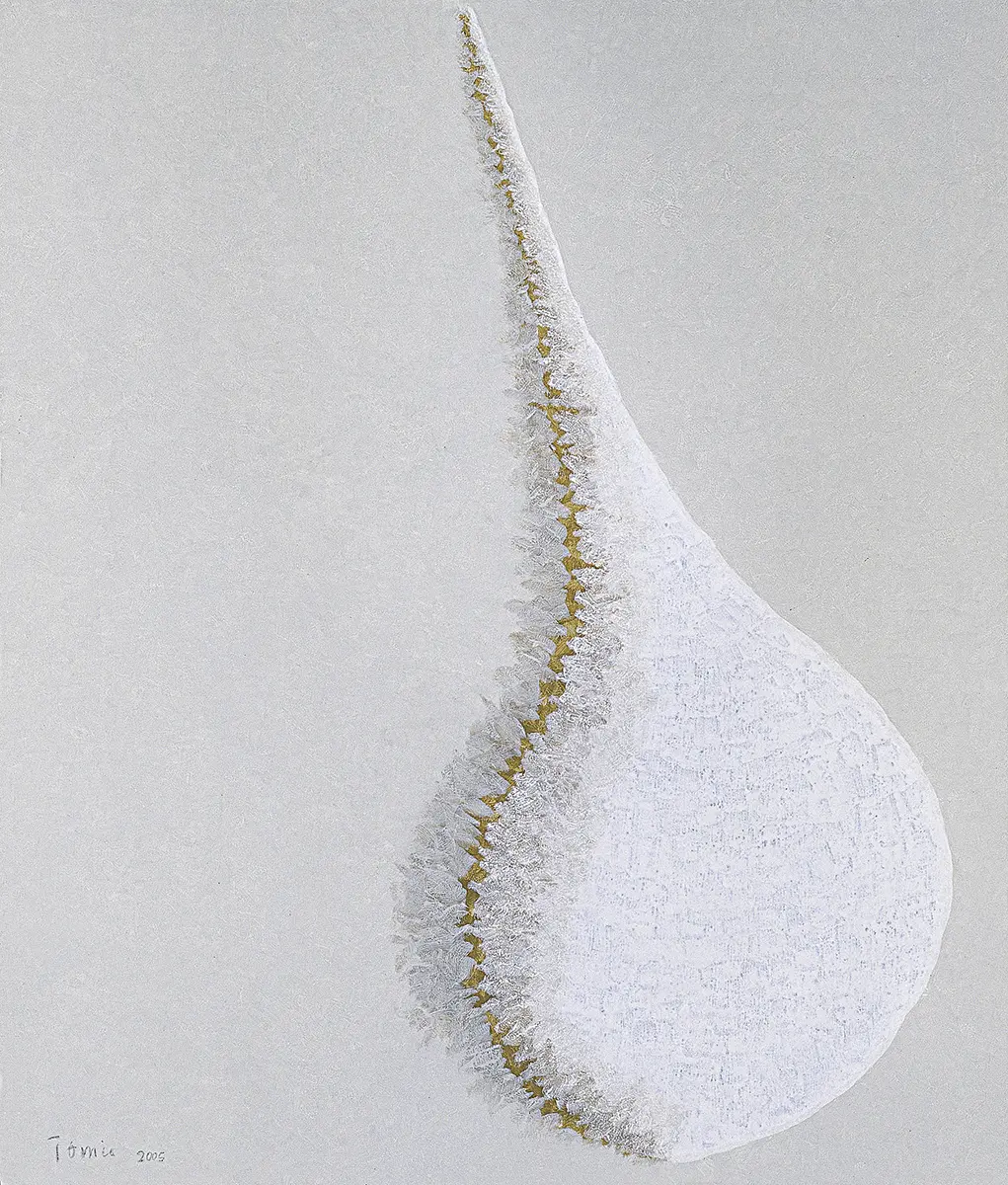
CL: The forms of the ring, the egg, the ellipse, the spiral, and the awning are all frequent in your recent work. What connotations do you find in them, if there are any, beyond the purely formal? Is there any kind of allegorical strategy?
TO: These shapes have no relationship with any meaning that could be attributed to them. They can very easily have similarities, like the ones Miguel Chaia mentions in his texts referring to nebulae, but they are not intentional. But it is important to underscore that both my paintings and the photographs of intergalactic nebulae belong to the same period.
CL: What were your beginnings in art, once you settled permanently in São Paulo? What do you retain, for yourself and for your art, of the long visual and spatial tradition of your ancestral Japan?
TO: I started painting when I was almost forty years old and had been living in Brazil for more than fifteen years. I always liked painting very much, and I did it frequently in Japan. When I arrived in Brazil, I started painting systematically. My Brazilian and Western spirit was clear then, and I was, in a way, far from my Eastern origins, but I must acknowledge that to this day the influence of my motherland—the place where I was born and raised, the imperial city of Kyoto—continues to be present in my work.
CL: Do you define yourself as a multi-disciplinary artist? How do you see the course of contemporary art inside and outside Brazil?
TO: These days, I work a lot in printmaking and sculpture, but my everyday labor is, without a doubt, painting. The languages of sculpture and painting are extremely important for me at this time because they give me information for painting. This means that I start from great liberty to create various series of sculptures and prints, which are different from my paintings. The latter follows a daily evolution. More than twenty years ago, Olivio Tavares de Araújo said that printmaking opened the path to my current paintings. Today, like any fully active artist, I have my own crises, when at times I feel that my work does not go forward. I can spend weeks without developing anything relevant. There, then, the practice of a little printmaking or sculpture helps me clarify my formal investigations.
CL: How did the Monument to Eighty Years of Japanese Immigration—which was your first large-scale sculpture project, situated in the inner garden of 23 de Mayo Avenue—alter the urban landscape of the São Paulo megalopolis? Did you take into account spatial premises and concepts in its execution? How do the four “waves” in reinforced concrete relate and connect to each other?
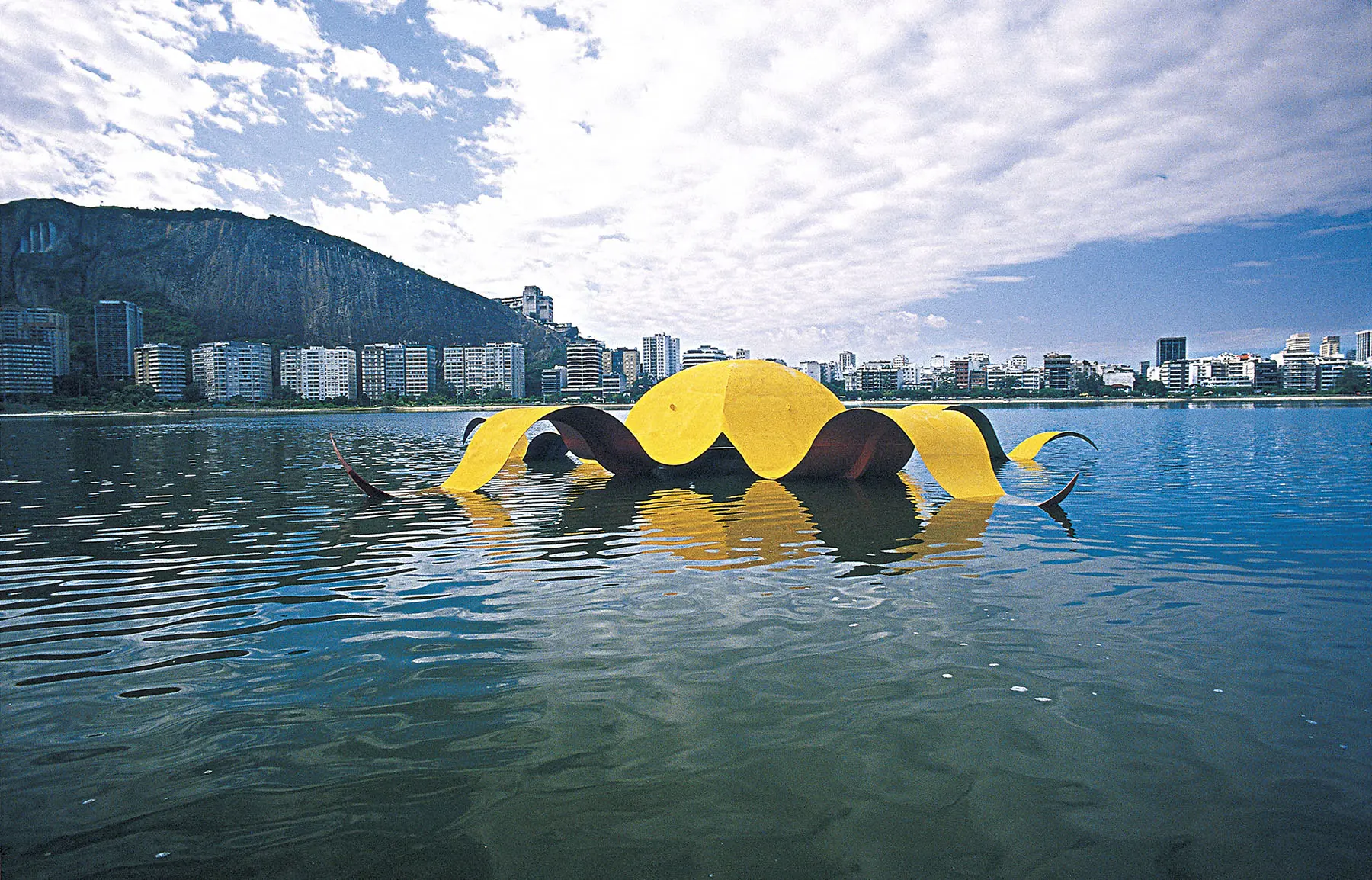
TO: Before this monumental work, I had only made Estrella de mar, which was erected in 1985. It was an undulating expansive structure over the Rodrigo de Freitas lagoon in Rio de Janeiro and built of iron that was painted yellow, measuring twenty meters in diameter and weighing seventeen tons. It stayed there for a long time.
The sculpture group on 23 de Mayo Avenue, created in 1988, took that elongated spatial configuration because it was located on one of the streets with the heaviest traffic in São Paulo. The four sinuous shapes, expressing a subtle movement of displacement and advance, coexist well with the automobiles that circulate at full speed, acquiring—I would say—a double dynamic.
In São Paulo, people say that each “wave” represents a new generation of Japanese immigrants to Brazil, and since the press generally seeks an explanation of this kind, I prefer to leave the work free to multiple interpretations. I prefer for it to suggest much more than its simple literal or commemorative reference.
CL: The application of the color yellow on the inside of those veritable Mobius strips that are the four three-dimensional “waves” is also a meaningful detail. Does the selection of this color have a particular connotation?
TO: Inside, the colors underwent several successive modifications: irregular bands or stripes and curves in various colors. Later, the primacy of yellow became apparent. Now they are going to be painted, with a dominance of blue shades, taking into account the internal movement suggested by the configurations.
CL: You were specially invited to show at the 23rd São Paulo Biennial in 1996 by the curator, Nelson Aguilar. On that occasion, you exhibited an installation of site-specific, three-dimensional, very light works that were almost weightless, which were floating, aerial, playful, and broke down orthodox sculpture languages. How did the passage from the undulating curve to the pendular white line take place? What relationship do those works have with the architectural space designed by Oscar Niemeyer, and how do they influence the empty space around them?
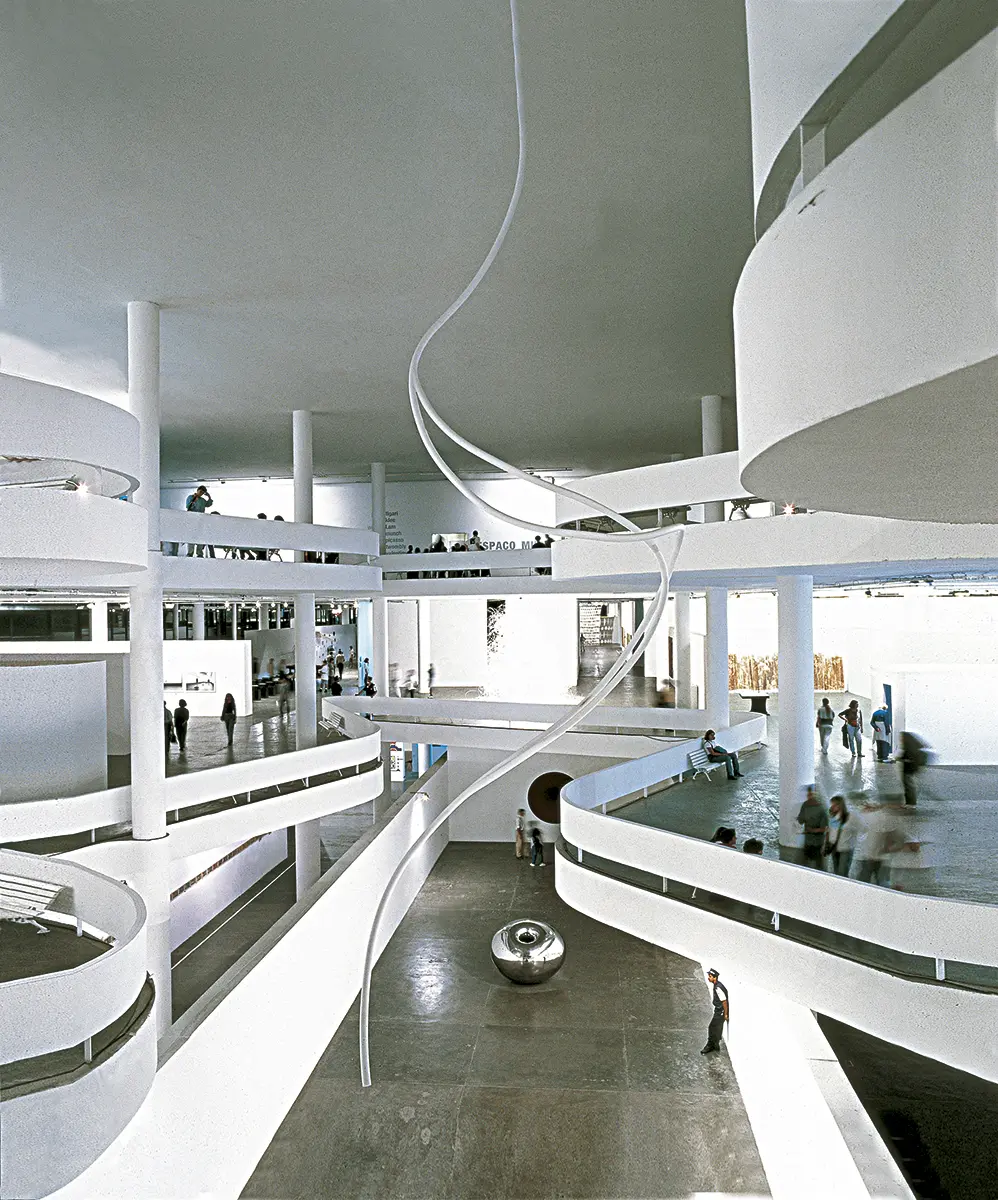
TO: Let me clarify that only one of those sculptures, made in tubular white metal, was specially conceived for the central window on the Biennial grounds. It was suspended over the access ramps and the dividing area, between the lower level and the first floor. This site-specific work was situated in that context of amplitude and white space where you could see Oscar Niemeyer’s beautiful architectural “sculpture,” composed of an enveloping interplay of ascending ramps and the cut marked by the dividing line between one floor and the other. On that occasion, I made a piece of hollow, white, iron tube, a little over ten meters tall, that attempted to dialogue closely with the exuberance of Niemeyer’s architecture.
However, my sculpture acquired all its spatial and visual potency during that biennial in that particular context; in that same unoccupied space, without the presence of any work, my sculpture would have been somewhat isolated. I was very happy and satisfied with the results because the work was not detrimental to the architecture that hosted it but it was nonetheless a small signal, a sign, in that free space.
CL: Why did you affirm in 2000 your interest in the concepts of instability and imbalance, be it in painting, printmaking, or sculpture? Today, what does the option for de-centering and discontinuity contribute to you? Do these guidelines continue to be indicators of change?
TO: I had a period when instability and imbalance were important in my works, just like I had a period in which transparency and depth were substantial resources in my work. These matters are lodged in my subconscious, and right now I don’t know if I have precise intentions of using them in some work. The analysis of these notions takes place in the making of each work.
*All images illustrating this article are courtesy of Galeria Nara Roesler and Instituto Tomie Ohtake, São Paulo, Brazil.
CLAUDIA LAUDANNO
Received a doctorate in History and Art Theory from the University of Buenos Aires (UBA) and is an independent art critic and curator.