
From his arrival in Bogotá, Colombia during the mid-1960s, Umberto Giangrandi has been an active artist in the Colombian artistic environment. As a professor at the Escuelas de Bellas Artes of the Universidad Nacional and the Universidad los Andes, Giangrandi reactivated the practice of the graphic arts and has had an important influence among professors and students. He was a founder, together with Nirma Zárate y Diego Arango, of Workshop 4 Red (Taller 4 Rojo); later, in his workshop located on Highway 12, he edited the best portfolios circulating during the 1970s and 1980s. Many artists studied the art of engraving under Giangrandi at this time. It is well to recall that in Colombia and Latin America in general, graphic work possessed great importance in the ’60s and ’70s; this was the era of the Biennials of Latin-American Graphic Arts (Bienales de Gráfica Latinoamericana) at the Museo de La Tertulia in Cali, which brought together the most important artists committed to the promotion of their work through multiple art forms.
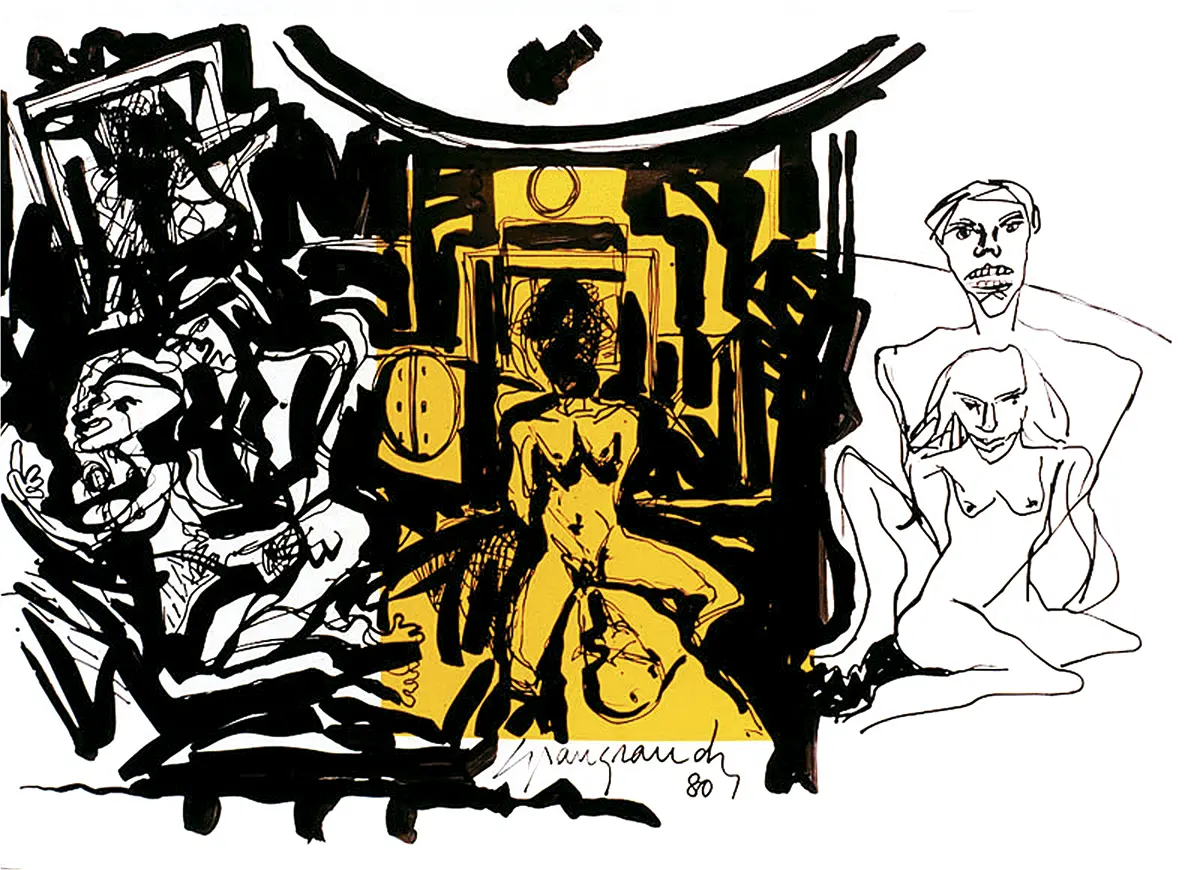
Umberto Giangrandi’s retrospective exhibit, which occupied three gallery rooms at the Museo de la Universidad Nacional, was surprising for those of us who know him and was surely a revelation for more recent generations. The work of an artist does not always resist that retrospective glance, which in this case implies confronting the artist’s production with a present that possesses other frames of reference. Additionally, in one exhibit it is even more difficult to sustain in a totality of works as complex as that shown, which included approximately 150 works ranging from graphics, sketches, pictures, and photographs. Careful curating by Raúl Cristancho allowed for an appreciation of a conductor thread based on two aspects: on the one hand, we find Giangrandi’s acute social sensitivity toward the marginalized characters who inhabit the city, particularly women. This sensibility led the artist to participate in the foundation of Workshop 4 Red, where he developed political action in addition to his artistic work. On the other hand, he demonstrated a constant exploration of traditional means and procedures, these akin to the work carried out at his workshop and as an art school faculty member.
Those of us who were close to Giangrandi remember many of his works: for example, his engravings entitled Neighboring Spaces (Espacios vecinos) (1968), in which he demonstrated the ways of life of the inhabitants of central Bogotá, and the series Latin America (América Latina) (1970–1971), in which the artist works with very strong iconography in which the feminine body and the landscape is the recipient of violence. We also recall the serigraphs entitled Carrera 12 (1979), in which Giangrandi presents intimate spaces in the lives of marginalized personages such as the prostitutes and transvestites who also inhabit the central Bogotá urban zone. In addition, we remember the artist as a painter through his participation in distinct Colombian events and in his last exhibition in the Espacio Uniandino, Body Is Scenario (Cuerpo escenario) (2002). However, I believe that very few are aware that Giangrandi’s production is so vast that in the later years he continued to observe the city’s nocturnal environments, of women especially, through a bold lens that reveals unusual aspects of a body—always erotic—that exposes itself, shows itself to the camera, not without a certain dose of violence.
This series, and many more, were exhibited at the Museo de la Universidad Nacional, where we again find the artist committed to social and political problems, as well as to erotic themes. And in the midst of these themes that run through the artist’s production, there was a series of engravings, somewhat uncommon, with a still life (el bodegón) motif, some dating from 1978 and others from 1993. In these, Giangrandi presents another sensitivity: the Expressionist burden of his work gives way to special attention to light, this slightly reminiscent of Morandi, or the rarefied ambiances of Chirico. In these engravings, there are no bodies; nonetheless, we are may speak of a certain eroticism. These images, generally in small formats, are inhabited by coffee pots, fruits, vessels, tablecloths, and are illuminated by a light that enters from a window or that comes from a lamp. These objects of daily life bring to light the office of the engraver: a sensual passion for smooth surfaces, for halftones, for lines saturated with ink. We could speak of eroticism concerning the pleasure of the art itself: burnishing: scratching, drawing on smooth wax. There is also eroticism for the spectator, for the pleasure that these images produce to the eye, which “caresses” the surfaces that make up the image. Engravings from the 1990s are printed on papers of diverse colors: Giangrandi seeks out grey tones, others more greenish, some lighter and some darker, in each achieving a new effect, a new quality in the image. These engravings were, in my own case, a kind of revelation; I came to know some of these in 1978 but was surprised to observe the time spent on these engravings in more recent times—a time caught in the middle of the hustle and bustle of political struggle, social condemnation, a “themeless” time. On viewing these engravings, one enters into an intimate scene that leaves out the city’s nocturnal world, one in which this excellent engraver, the restorer of graphic arts in Colombia, is found engaged in his art, and who with a particular sensitivity speaks to us of the relationship of objects with light.
MARTA RODRÍGUEZ