
Luscious hallucinogenic explosions of color invaded the gallery space as one encountered the new series Lysergic Garden by Walter Goldfarb (born 1964, Rio de Janeiro) at Gary Nader Art Center. Moving away from a serene and monochromatic palette, Goldfarb’s new work incorporated the blues, greens, and yellows that permeate Rio’s frenzied and altered landscape. This series of work was unique, fresh, and challenging.
At the center of the exhibition and setting the tone for the show, the four panels Lysergic Roses featured an exalted, enameled rose in shades of green, pink, yellow, and blue.
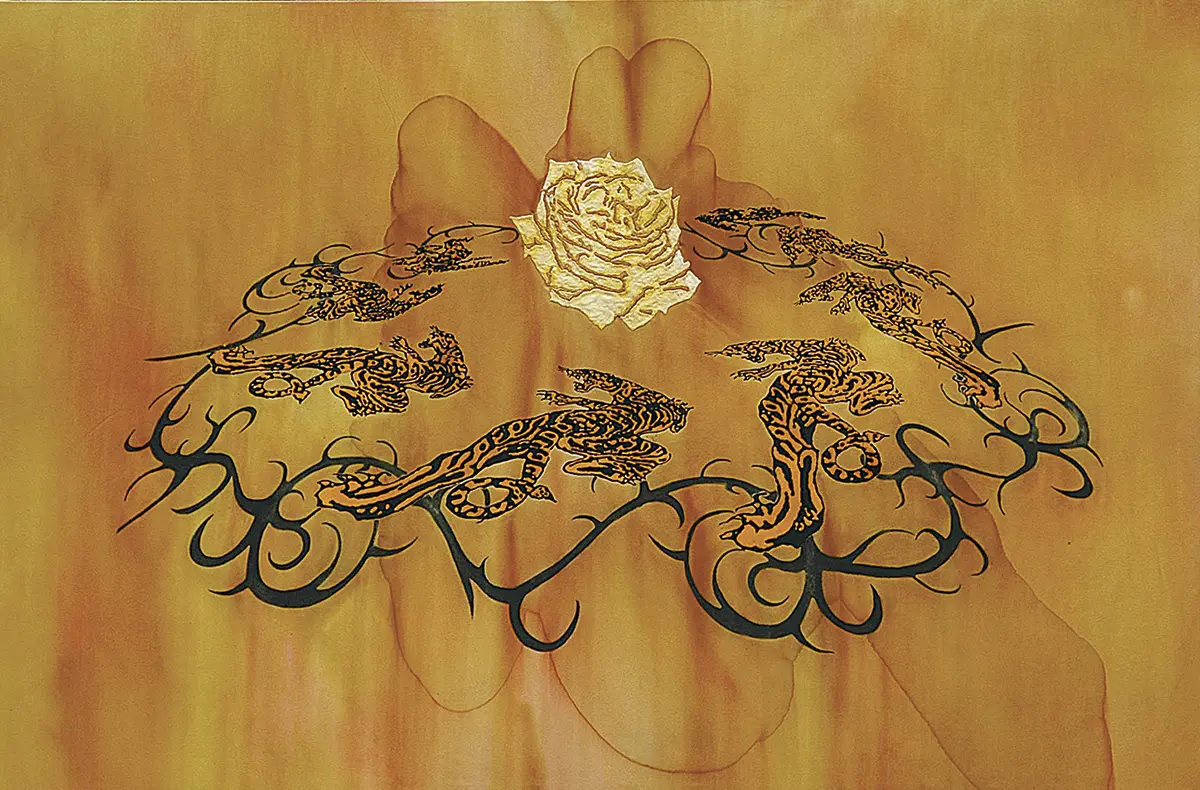
According to the artist, this series incorporating flowers and color reflects his personal renaissance, his total divorce from the early German/Jewish catastrophe series in which he used the color white to counterbalance the psychological effects created by a dark and dramatic theme. Here, Goldfarb’s creative process produced a new “lysergic effect” or altered perceptual experience.1 In this new series, the artist developed a more humanistic approach, one that came from the inside out. The gesture and vital force that was present in his use of color reflected his obsession to explore new ways of interacting physically with the process of creation. The act of creating is his drug, his “lysergic” experience.
Since his first show at Gary Nader in the year 2000, Goldfarb has increasingly added layers to his pictorial language. Drawing with embroidery and charcoal and delicately applying lacquer with a syringe, like a surgeon, he dissects and assembles each piece. Goldfarb seeks a balance between the technical and the thematic as his work shifts in an organic continuum from the baroque to the contemporary. His quasi-religious ritual of art-making is described by the artist in the catalog’s essay: “The work begins as a huge net that is built, and lacquer is applied to this with syringes that give relief to the pictorial mass and makes the image look like a delicate filigree piece; this first step calls for discipline and patience. The injection of lacquer with the help of a syringe is a hard, mechanical process that takes more than two weeks to complete and makes way for rapture, decantation, and the filtering of ideas about this and other work; a pure exercise of reason.” Rather than renouncing his saturated pictorial narrative, Goldfarb is at a point of transition; he seems to be experimenting with the principle “less is more.”
Thematically, Goldfarb continued to engage and confront the viewer with his recurring theme: humanity’s condition and civilization. By appropriating images from Western painting to portray man’s religious, political, and sexual conduct, he provoked the viewer to question, reflect and find meaning in our melancholic existence. For example, in his work titled Chart of Power II, Goldfarb appropriated Matisse’s dancing nymphs to create a fragile enameled trap of androgynous flowerlike insects. With a blue backdrop (the color associated with the heavens), he attempted to lift and divert one from stark reality. Here, the image served as a metaphor for the power structures of the world.
Goldfarb’s interest in architecture reached a high point in A Lysergic Passion at the Opera House I. In this monumental work (370 x 600 cm), Goldfarb once again referred to the Paris Opera with a dramatic composition. The theatre, drawn in white enamel, recreated the glossy effect of the Portuguese tiles found throughout Rio’s buildings. The structure, set against a black backdrop and reflected in a deep indigo pool, drew the viewer in and sedated with its majestic beauty.
Since 2004, the symbols of pop culture have emerged as central players in Goldfarb’s oeuvre. In several works, such as Dancing with Tigers, he repeated the image of a tiger as a virility fetish. The artist took the image from a contemporary tattoo on a masculine body to illustrate Balzac’s story A Passion in the Desert, in which man struggles with his elements to be assertive or submissive. Also prominent in this show was the artist’s interest and effort in applying three-dimensional techniques to liberate the painting from the canvas. By incorporating objects in installations like Silver II and using embroidery as a relief element in his works, Goldfarb challenged the classical concepts of painting.
The twenty-four works in the show were a testament to an artist who is not afraid to experiment with his perceptions and to challenge his artistic language. The complexity of his technique and conceptual approach was a testament to a man who is aware of his history and depicts the human condition. Lysergic Garden was definitely a tour de force in Goldfarb’s career.
NOTE
1. The term “lysergic effect” is derived from one of the main hallucinogenic drugs popularized during the sixties, LSD (lysergic acid diethylamide), which deeply distorts the perception of reality.
MARIANGELA CAPUZZO