
Perhaps one of the richest trajectories in contemporary painting is that followed by Alberto Ibáñez Cerda. A “rich trajectory” in this case speaks of the diversity of expressive means employed by the artist as well as the regular quotations of works by great modern and contemporary artists in the work. Ibáñez Cerda recently presented the exhibition Great Expectations at the Universidad de las Américas, located in the suburbs of historic Puebla, 100 kilometers from Mexico City.
The project developed a critique of painting based on its confrontation with a crisis of representation that, according to many analysts were born from its growing inability to sustain the discourses of contemporary art along with the supposed exhaustion of its formal resources.
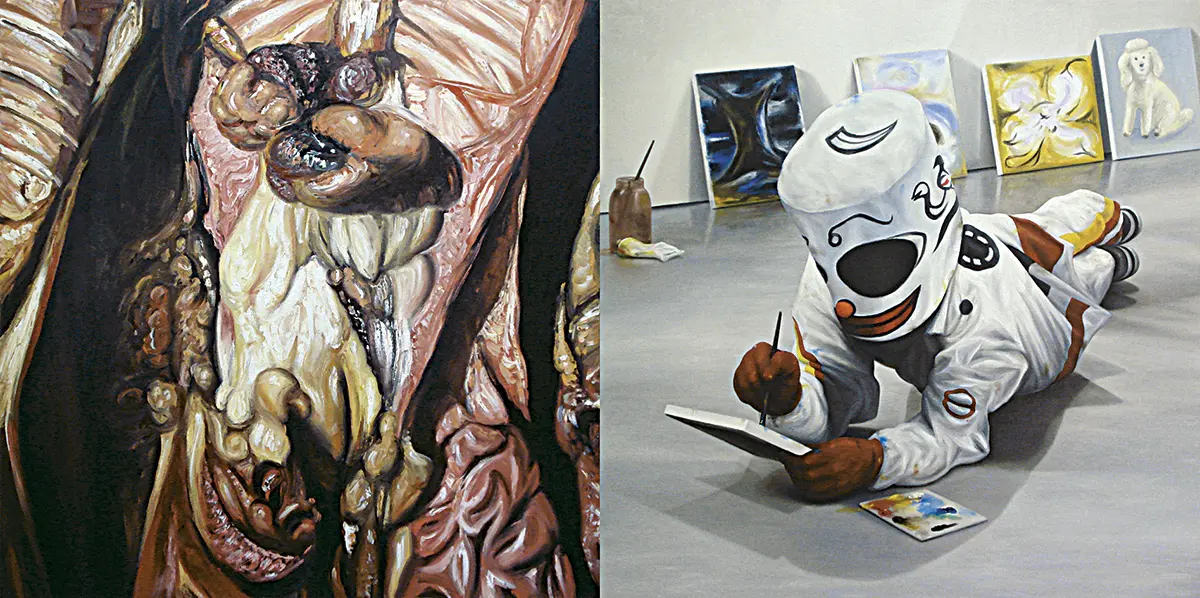
Thus, one finds direct references in Ibáñez Cerda’s work to the everyday aspects of the painting profession and a constant striving for a change in its languages and themes, which leap from one work to the next, always intent on precluding the establishment of a single unifying aesthetic or ideology.
For example, the diptych No Artist was created from a photograph of Wolfgang Kessler, the Canadian painter with whom Ibáñez Cerda shared an artistic residence and who is pictured alongside an entirely abstract painting. In another work, Dear Painter, Paint Me, also a diptych, a man is wearing a self-designed suit (Match Weave) which becomes his work attire. To his left, a young goat lies, sliced open, rendered in the purest, most orthodox representative style.
In both cases, the tension created between one panel and the other not only referred to the interplay of opposites but also strongly petitioned in favor of the thematic and formal inclusion of the wide spectrum of the possibilities of painting. With an extraordinary mastery of the various techniques, Ibáñez Cerda approaches and intently questions these possibilities.
The works Blanco sobre blanco, Violeta, and Great Expectations, from which came the title of the exhibition, gathered the artist’s point of view on painting. They immediately and primarily referred to the painting as paint, even if what one saw were impeccably executed hyperrealist works that represented an accumulation of densely textured paint.
Negro sobre negro was based on a photograph of the artist taken in Istanbul. Here, the viewer encountered a play on Malevich’s work, and in Greenberg’s Bride Striped Bare there were clear references to Richter and Julian Schnabel, who has generated or borrowed images that they modified in their work. In Ibáñez Cerda’s work, painting posed as photography and was covered by painted fake scratches like those of a draftsman’s sketch, revealing perhaps one of the artist’s most powerful quests.
But it was perhaps Funeral that brought this idea to its greatest level of expression. In the words of Ibáñez Cerda: “The idea is that both the televised image and the photographic image attend painting’s funeral.” Accurate or not, it was impossible to ignore the boldness of this statement, inasmuch as it comes from the artist’s position of an unusual virtuosity exercised from the very platform being questioned.
In Ibáñez Cerda’s pictorial work, more than relational methods—which would seem to be present in some cases, by the law of opposites—the goal is to dissent and, based on that position of difference, to seek a way to counteract and change the dominant visual schema. Will this be achieved? This is one of the great expectations.
SANTIAGO ESPINOSA DE LOS MONTEROS